Key takeaways
- Score leads on market data before booking: Rank each lead on demand signals, competitor landscape, and risk profile so the most expensive hours skip founders who are not ready.
- Time saved: Market-data scoring saves agencies 10+ hours/month on dead-end discovery calls.
- ROI: A $59 lead report pays for itself after filtering one bad call.
- Automate it: A white-label version embeds on your site and scores leads automatically.
If you don't pre-qualify startup leads before a discovery call, you burn your most expensive hours on founders who aren't ready. A founder reaches out, the pitch sounds polished, the deck looks professional, and 15 minutes into the 45-minute call you realize the idea has no market, no differentiation, and no research behind it.
This used to be rare. It's not rare anymore.

Will your idea survive the market?
Preuve AI runs 10 agents against live market data and links every claim to a source. Free analysis in 60 seconds.
The AI pitch problem
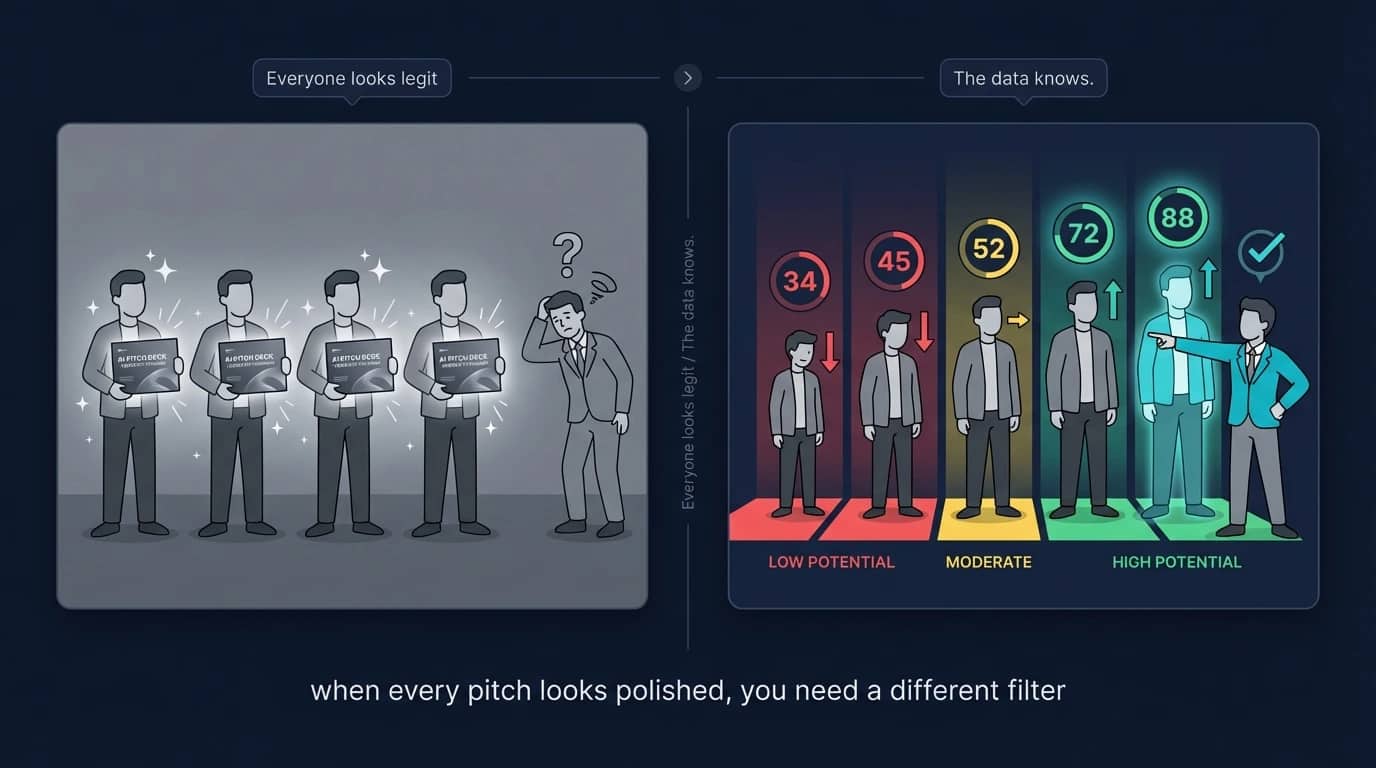
ChatGPT writes the pitch, Canva makes the deck, Midjourney generates the mockups. In 2026, every founder looks legit on paper. The barrier to sounding credible has collapsed.
That's a real problem if your business model depends on discovery calls. When everyone's pitch looks polished, the pitch stops being a filter, and you can't tell who did the homework from who spent 20 minutes with a chatbot.
A note on words: this post is about the sales kind of discovery call, where you qualify a prospect for work you already sell. It is not the customer discovery interview a founder runs to test whether a problem is worth building for.
The result: agencies, dev shops, and venture studios spend 10+ hours per month on calls that should never have been booked.
What do unqualified calls actually cost?
Let's do the math.
A typical agency takes 12-20 discovery calls per month. Of those, 2-3 are qualified. The rest are founders with half-baked ideas who need months of work before they're ready for an agency engagement.
Each call costs 45 minutes of your most expensive people's time. At $150/hour (conservative for a senior strategist or agency principal), that's $112 per call.
12 bad calls x $112 = $1,350/month in wasted time. That's $16,200/year spent listening to founders describe apps that already exist.
And that's just direct cost. The opportunity cost is worse: those 9 hours/month could be strategy work, client delivery, or business development that closes deals.
How do agencies qualify startup leads today?
Most agencies handle this with some version of:
The intake form. "Tell us about your budget, timeline, and idea." The problem is that founders overstate readiness and understate uncertainty. A well-written form response says nothing about whether the idea is viable.
The screening call. A 15-minute pre-call before the real call. Better than nothing, but you're still spending time manually assessing each lead, and you're the one doing the rejecting - which tends to damage the relationship even when done politely.
Gut feel. You read the email, check their LinkedIn, and decide if it "feels" real. That used to work reasonably well. AI-polished pitches have broken it at scale.
None of these methods answer the question that matters: is there a market for what this founder wants to build?
What does good startup lead scoring look like?
The agencies that waste the least time on bad calls share one trait: they score leads on market data rather than self-reported confidence. A startup lead score is a 0-100 viability assessment built on live market signals - demand evidence, competitive landscape, risk factors. It gives you something verifiable to work with instead of a gut read.
Good pre-qualification checks three things before anyone books a meeting:
1. Does the market exist?
Not "is this a big idea?" but "are people searching for this, paying for alternatives, or complaining about the problem in public?" Google Trends data, search volume, community discussions. Verifiable signals.
2. Who's already there?
Founders who can't name a single competitor haven't done the research. But more importantly: competitor analysis reveals whether there's a gap worth filling or whether the market is locked up by well-funded incumbents.
3. What's the risk profile?
Timing risk (too early, too late), differentiation risk (easy to copy), demand risk (no evidence anyone wants this). A score that summarizes these signals tells you more in 60 seconds than a 45-minute call.
Manual research vs. automated market data
You can do this manually. Pull up Google Trends, search Crunchbase for competitors, browse Reddit for demand signals, check Product Hunt for similar launches. A thorough job takes 2-3 hours per lead.
At 15 leads per month, that's 30-45 hours of research. You've traded one problem (wasted calls) for another (wasted research time).
Automated market research compresses that to under 2 minutes per lead. Tools that pull from live data sources scan competitors, demand signals, market sizing, and risk factors in a single pass.
The key word is "live." Any tool that runs the idea through an LLM will hallucinate competitor names, fabricate market sizes, and generate analysis that sounds confident but isn't connected to reality. You need sourced data you can verify.
Skip weeks of manual research
Get complete market research, sourced proof, competitor map, and pricing data for your idea instantly.
How to vet startup ideas before the call: a scoring framework
Here's a framework that works whether you do it manually or use a tool:
| Score range | Action | Why |
|---|---|---|
| 70+ | Take the call | Strong market signals, identifiable competitors, evidence of demand. Your discovery call becomes a strategy session. |
| 50-69 | Conditional | The idea has potential but clear gaps. Send the founder the data and let them address the gaps first. |
| Below 50 | Don't take the call | Low market signals, no differentiation, high risk. The data rejects them, not you. |
That's the shift that matters. Traditional qualification puts the agency in the awkward position of gatekeeper. Data-driven scoring lets the market play that role instead - the founder gets useful feedback either way, and the agency quietly saves 9+ hours a month.
I published data on what these scores look like in practice: according to Preuve AI (formerly Test Your Idea)'s early-2026 analysis of 1,000+ startup ideas, 89% scored below 70. That's the reality of inbound startup leads. Most aren't ready.
Two ways to implement startup lead scoring
Option 1: Build it into your intake process
Add a research step between "founder submits inquiry" and "call gets booked." This can be manual (your team runs the research) or semi-automated (you use a tool and review the output).
Pros: Full control, fits any workflow.
Cons: Still requires your time per lead.
Option 2: White-label it on your website
A white-label startup validation widget sits on your site and runs before the booking page. The founder thinks they're getting a free market analysis (because they are). You get a scored lead with competitor data, market sizing, and risk assessment attached.
The founder sees: "Get a free market analysis for your startup idea."
You see: a dashboard of every lead, sorted by score, with the data you need to decide who's worth a call.
This is the approach I built at Preuve AI. The widget embeds on your site with your branding. Founders enter their idea, get a report in 90 seconds sourced from 60+ live data sources, and you get the score plus the full analysis. I wrote a detailed Preuve AI review covering pricing, pros, and cons.
The dual positioning is what makes it work. Founders don't feel filtered. They feel served. They got a free report with real competitor names, market data, and actionable feedback. If their score is low, the report explains why and suggests pivots. If their score is high, they show up to your call better prepared than 90% of leads.
I tried a lot of market search and validation tools. This is the best in its category.
According to Preuve's 2026 benchmark of 6,000+ analyzed ideas, 82.5% scored below 70. The question is whether you discover that before or during a 45-minute call.
The ROI math for agencies
Here's the simple version.
If you take 15 discovery calls per month and 12 are unqualified:
| Scenario | Monthly cost | Hours wasted |
|---|---|---|
| Without scoring | 12 x $112 = $1,350 | 9 hours |
| With scoring (filters half) | 6 x $112 = $675 | 4.5 hours |
| Savings | $675/month | 4.5 hours |
A $59 lead report pays for itself after filtering one bad call. But honestly, the filtering isn't even the main value.
When you walk into a discovery call with the founder's competitive landscape, market sizing, and risk profile already in front of you, the conversation is different. You're not asking basic orientation questions - you're already discussing strategy. That tends to change close rates.
What this looks like in practice
Before scoring
Founder emails you. The pitch sounds good, so you book a 45-minute call. Fifteen minutes in, you realize there are no competitors because nobody actually wants the product. You politely wrap up. Both sides walk away having wasted an afternoon slot.
After scoring
Founder visits your site. Widget runs a market scan. Score: 34. The report shows minimal demand, no search volume, and three well-funded competitors already in the space. The founder reads it, adjusts their thinking, and either pivots or moves on. You never booked the call - the data handled it.
The good lead path
Another founder hits the widget. Score: 72. Strong demand signals, two competitors with clear weaknesses, growing search trends. You see this in your dashboard and book the call knowing the context already. The conversation runs 25 minutes instead of 45. You close the deal because you walked in understanding their market.
Getting started
If you want to test this approach:
Manual version: Before your next 5 discovery calls, spend 20 minutes on each lead. Check Google Trends for their keywords, search Crunchbase for competitors, browse Reddit for demand signals. Score them 1-10 on market evidence. Track whether the score correlates with call quality.
Automated version: a consultant workspace. $99 once opens yours, first client project included, then $59 a report, or packs of 2 for $89 and 5 for $199. You get a dashboard with scores and full reports. If it saves you one bad call, you'll know whether the approach works for your pipeline.
The tool is just the implementation. The underlying principle is simpler: score leads on market data before you spend 45 minutes on a call. Whether you do that manually, semi-automatically, or with a white-label widget, the math comes out the same.
Every unqualified call you prevent is 45 minutes back in your calendar. At agency rates, that compounds quickly.
Pre-qualify your next client
- ✓White-label widget with your branding
- ✓Viability score from 60+ live data sources
- ✓Sourced competitor data, not ChatGPT guesses
- ✓Agency dashboard with lead scoring and pipeline
$99 once · first client report included
FAQ
What's the best way to vet startup ideas before taking a client call?
Check three things: market demand (are people searching for this or paying for alternatives?), competition (who's already there and are there gaps?), and risk (timing, differentiation, defensibility). You can do this manually with Google Trends, Crunchbase, and Reddit, or use a startup idea scoring tool that pulls from live data sources and gives you a summary score. The score tells you whether the idea warrants a 45-minute conversation.
How is lead scoring different from a standard intake form?
Intake forms capture what the founder says about their idea. Lead scoring captures what the market says about their idea. Founders overstate readiness. Market data doesn't. The combination of both gives you a much clearer picture before you invest time in a call.
Does automated lead scoring replace the discovery call?
No. It replaces the bad discovery calls. The good ones still happen, and they're better because you walk in with data. Think of it as due diligence that runs before the meeting, not instead of it.
What kind of agencies benefit from startup lead scoring?
No-code agencies, MVP dev shops, venture studios, growth agencies, and small accelerators or incubators that screen applicants. Anyone whose pipeline includes founders pitching startup ideas benefits from a way to separate the ones who did the research from the ones who spent 20 minutes with ChatGPT.
Can the scoring widget be white-labeled?
Yes. Preuve AI's agency widget embeds on your site with your logo and branding. The founder sees a free market analysis tool. You see a scored lead in your dashboard. The widget runs in under 2 minutes and pulls from 60+ live sources. A consultant workspace costs $99 once, first client project included, then $59 a report, or packs of 2 for $89 and 5 for $199.
What if the score is wrong and I miss a good lead?
You still see every lead. The score is a signal, not a gate. If a founder scores 45 but their follow-up email shows deep customer research that wouldn't show up in market data, take the call. The score catches the 80% of leads that clearly aren't ready. The edge cases are still your judgment call.
Cite this page
Last updated September 29, 2026
Forat, V. (2026, September 29). How to Pre-Qualify Startup Leads Before a Discovery Call. Preuve AI. https://preuve.ai/blog/pre-qualify-startup-leads-before-discovery-call
Forat, Vincent. “How to Pre-Qualify Startup Leads Before a Discovery Call.” Preuve AI, 29 Sept. 2026, preuve.ai/blog/pre-qualify-startup-leads-before-discovery-call.
Forat, Vincent. “How to Pre-Qualify Startup Leads Before a Discovery Call.” Preuve AI. September 29, 2026. https://preuve.ai/blog/pre-qualify-startup-leads-before-discovery-call.
@misc{forat2026-pre-qualify-startup-leads-before-discovery-call,
  author = {Forat, Vincent},
  title = {{How to Pre-Qualify Startup Leads Before a Discovery Call}},
  howpublished = {Preuve AI},
  year = {2026},
  month = sep,
  url = {https://preuve.ai/blog/pre-qualify-startup-leads-before-discovery-call},
  note = {Last updated September 29, 2026}
}
Vincent
5 years in B2B growth, building Preuve AI in public. 82% of ideas it scores aren't ready, the point is finding out in 10 minutes, not 3 months.
Follow on X →