
Key takeaways
- What it is: Market validation for startups is the process of testing whether real demand exists for a product before building it. A structured framework covers customer definition, market sizing, competitor analysis, demand signals, and willingness-to-pay testing in 2-4 weeks.
- Why it matters: "no market need" is the #1 startup killer according to CB Insights, accounting for 42% of startup failures, ahead of running out of money and team problems.
- The framework: 5 steps, define your buyer, size the market (TAM/SAM/SOM), map competitors, test demand signals, validate willingness to pay.
- The bar: In a 2026 benchmark of 6,000+ anonymized startup ideas, only 17.5% scored 70+ out of 100 on viability. The rest needed more market research before building.
Market validation for startups is what separates founders who build something people pay for from the 42% who fail because nobody wanted what they built. Not because they ran out of money or the team fell apart. They skipped validation. If you're building right now without hard evidence of demand, you're making the same bet.
I built Preuve AI around this exact problem. Across 6,000+ anonymized startup ideas benchmarked on the platform, the average viability score is 56.3 out of 100. Only 17.5% score 70 or above. This guide is the framework I use: five steps, each backed by specific methods and benchmarks that separate real market validation from survey theater.

Will your idea survive the market?
Preuve AI runs 10 agents against live market data and links every claim to a source. Free analysis in 60 seconds.
What Is Market Validation?
Market validation is the process of testing whether real demand exists for a product or service before you build it. Guessing costs you months. Knowing costs you two weeks.
It comes down to three questions:
- Does the problem exist? Are real people experiencing this pain, spending time or money on workarounds, and actively looking for solutions?
- Is the market big enough? Can you build a sustainable business around this, or is it a niche too small to support growth?
- Will people pay for a solution? Interest isn't validation. Someone saying "that sounds useful" isn't the same as someone entering their credit card number.
Market validation isn't a one-time checkbox. Done properly, it takes 2-4 weeks and should happen well before you write a single line of code. If you want a fast starting point, a free validation scan flags your biggest gaps in under 90 seconds.
Get out of the building.
A validated market doesn't guarantee a successful product. But an unvalidated market almost guarantees failure.
How Is Market Validation Different from Product Validation?
Founders often confuse three types of validation. Each answers a different question, and the order matters.
| Type | Core Question | When | Methods |
|---|---|---|---|
| Market validation | Does demand exist? | Before building | Interviews, market sizing, competitor analysis, demand signals |
| Idea validation | Is this worth pursuing? | Before committing | Quick research, viability scoring, sanity checks |
| Product validation | Did we build the right thing? | After prototype | Beta testing, usability tests, conversion metrics |
Idea validation is a quick filter: does this idea make basic sense? I wrote a full walkthrough on validating a business idea before you spend a dollar. Market validation goes deeper. It requires real startup market research about real people in a real market.
Product validation comes after. Once you know the market exists, you test whether your specific solution serves it well.
The mistake: jumping straight to product validation (building a prototype) without confirming the market is there. You end up with a polished solution to a problem nobody has, or a problem that exists in a market too small to sustain a business.
Why Do Most Founders Skip Market Validation?
If market validation is so important, why do most founders skip it? A few reasons keep coming up.
1. Building feels like progress
Writing code, designing screens, choosing a name - these feel productive. Talking to strangers about their problems doesn't have that same momentum. But building without validation isn't progress so much as it is guessing with extra steps and a higher price tag.
2. Confirmation bias
You ask your friends. They say it sounds great. You find one Reddit thread that mentions the problem. You decide that counts as validation. It doesn't - friends lie to be nice, and one thread is an anecdote, not a market.
Rob Fitzpatrick wrote an entire book about this called The Mom Test. The core lesson: people will lie to you about your idea because they like you. Real validation requires talking to strangers and looking for commitment signals, not compliments.
3. Fear of being wrong
Validation can kill your idea, and that feels bad. But spending 6 months building something that fails in week one of launch is considerably worse. Two weeks of validation is probably the cheapest insurance you'll ever find.

How to Validate Market Demand: 5-Step Framework
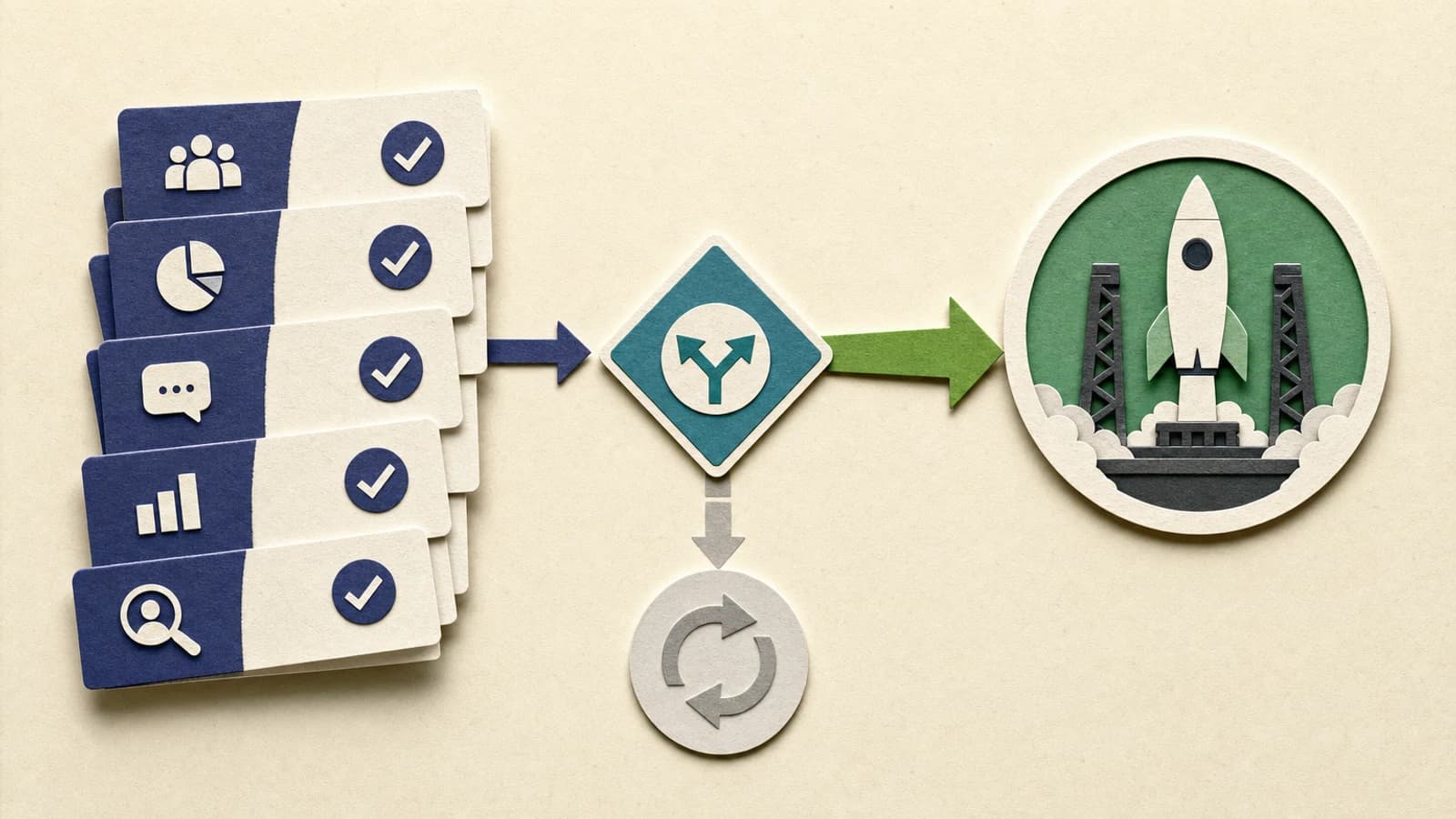
This framework works for SaaS, consumer apps, marketplaces, and service businesses alike. Each step builds on the previous one, so resist the urge to jump ahead.
Step 1: Define your target customer
"Everyone" isn't a target customer. Neither is "small businesses" or "millennials who want to save money." You need a specific person with a specific problem.
A strong customer definition includes:
- Who they are: job title, industry, company size, or demographic
- What problem they have: specific pain, not a vague frustration
- What they do today: current workaround, competitor they use, or manual process
- Where they gather: subreddits, Slack communities, LinkedIn groups, conferences
Example. Bad: "Startup founders who need help with their business." Good: "Solo SaaS founders in the first 6 months who spend 10+ hours researching competitors and market size before building."
How to find them: Search Reddit, Indie Hackers, and niche Slack/Discord communities for people describing the problem you want to solve. Look for posts where someone asks "how do you handle X?" or "is there a tool that does Y?" Those are demand signals.
Run 15-20 customer discovery interviews. Don't pitch your idea. Ask about their current behavior: what they've tried, what they spend time/money on, what frustrates them. Customer discovery is about understanding the problem, not selling the solution. The goal is to confirm the problem exists and matters enough to pay to fix.
Step 2: Size the market (TAM, SAM, SOM)
A real problem in a tiny market equals a lifestyle business at best. You need to know how big the opportunity is.
TAM, SAM, and SOM break this into three layers:
- TAM (Total Addressable Market): the entire market for your category. If you sell project management software, TAM is the global project management software market.
- SAM (Serviceable Addressable Market): the segment you can reach. If you only serve English-speaking startups, SAM is smaller than TAM.
- SOM (Serviceable Obtainable Market): what you can realistically capture in 1-3 years. This is the number that matters for your business plan.
Bottom-up beats top-down. Investors dismiss "the global AI market is $500 billion" because it tells them nothing about your business. Instead: "There are 50,000 SaaS founders who launch each year. 30% seek validation tools. At $59 per report, that is $885,000 in SOM." That is defensible.
Sources for market sizing: Statista, IBISWorld, Grand View Research for industry reports. Crunchbase for competitor funding data. Google Keyword Planner for search volume as a demand proxy.
Step 3: Map competitors and alternatives
"No competition" is a red flag. If nobody is solving this problem, the market is probably too small, or the problem isn't painful enough that people would pay to fix it.
A complete competitor analysis maps three layers:
- Direct competitors: products that solve the same problem for the same audience. Search G2, Capterra, Product Hunt, and "X alternative" queries.
- Indirect competitors: products that solve the problem differently. Spreadsheets are an indirect competitor to almost every SaaS tool.
- DIY workarounds: what people do today without any tool. Manual processes, hiring freelancers, using ChatGPT. This is often your real competition.
For each competitor, note: pricing, customer reviews (read the 1-star and 3-star reviews, those reveal gaps), features they lack, and who they serve. The white space between competitors is where your opportunity lives.
I built Preuve AI specifically because this step takes founders 10+ hours when done manually. The platform automates competitor mapping across 60+ data sources and surfaces the gaps in minutes.
Step 4: Test demand signals
Demand signals are evidence that people actively look for a solution - not theoretically interested in one, but actually searching for it, asking about it, complaining about the lack of it, or already paying someone else for a workaround.
Where to find demand signals:
| Signal Type | Source | What to Look For |
|---|---|---|
| Search demand | Google Trends, Keyword Planner | Monthly search volume for problem-related keywords. Rising trends. |
| Community demand | Reddit, Indie Hackers, Quora | Posts asking for solutions. Upvotes on problem descriptions. Repeat questions. |
| Review gaps | G2, Capterra, TrustRadius | Negative reviews on competitors mentioning missing features or frustrations. |
| Job postings | LinkedIn, Indeed | Companies hiring for the problem you solve. Signals budget allocation. |
| Funding activity | Crunchbase, TechCrunch | Competitors raising money. Investors betting on this problem space. |
Red flags that demand is weak: zero search volume for problem-related keywords. No community discussions. Competitors with no reviews. These mean either the market does not exist yet, or the problem is not painful enough to search for.
A common mistake: looking only at solution-related keywords ("project management tool") instead of problem-related keywords ("how to track team tasks across time zones"). Problem keywords reveal unmet demand. Solution keywords reveal existing supply.

Step 5: Validate willingness to pay
This is where real market validation separates from wishful thinking. Interest costs the person expressing it nothing. Money costs something, which is why it tells you so much more.
Three methods, ranked by strength of signal:
- Pre-sales or deposits (strongest). Create a landing page describing your product and ask for a deposit or pre-order. If strangers give you money before the product exists, you have validated willingness to pay. Buffer, Dropbox, and dozens of successful startups used this approach.
- Smoke test with ads ($50-100). Build a simple landing page on Carrd or Framer. Run $50-100 in Google or Meta ads targeted at your audience. Measure the email signup rate. If 3-5% of visitors sign up, that is a strong signal. Below 1%? The positioning or the market might be off.
- Pricing surveys (weakest but fast). Use the Van Westendorp method: ask potential customers four questions about price (too cheap, acceptable, expensive, too expensive). The overlap zone reveals your pricing sweet spot. Caveat: what people say they would pay and what they actually pay are different numbers.
Two more methods worth knowing. A fake-door test puts up a product page for something that doesn't exist yet and measures how many visitors click "buy" or "sign up." Dropbox collected 70,000+ waitlist signups with an explainer video before writing production code. A concierge MVP delivers your service manually to paying customers, validating demand and your solution in one step. If people pay you to do it by hand, the automation is worth building.
The strongest validation signal is a transaction. Someone paying $1 for your product tells you more than 1,000 people saying "I would use that."
Skip weeks of manual research
Get complete market research, sourced proof, competitor map, and pricing data for your idea instantly.
What Are the Biggest Market Validation Mistakes?
After reviewing anonymized data from 6,000+ startup ideas, these are the validation mistakes that come up over and over.
Mistake 1: Asking friends and family
Your mom thinks your startup idea is brilliant. She also thinks your childhood drawings belong in a museum. Friends and family tell you what you want to hear. Validation requires feedback from people who have no social reason to be nice.
Mistake 2: Confusing opinions with commitment
"I would totally use that" means nothing. "Here is my email, notify me when it launches" means a little more. "Here is $10 for early access" means something real. Each step in that progression - from opinion to action to transaction - carries more signal than the last, and stopping at opinions leaves you with almost nothing to act on.
Mistake 3: Skipping market sizing
A real problem in a tiny market caps your growth before you start. If your total addressable audience is 500 people, and each pays $50/year, that is $25,000 in revenue. Not a business. Calculate your TAM, SAM, and SOM before you commit.
Mistake 4: Ignoring existing alternatives
"Nobody is doing this" usually means you haven't looked hard enough. Spreadsheets, manual processes, and ChatGPT prompts are all competitors in practice. If people solve the problem with a workaround, that's genuinely good news - demand exists - but it also means you need to be meaningfully better than the workaround to earn the switch.
Mistake 5: Validating the solution before the problem
"Will people use my AI-powered task manager?" is the wrong question. The right question: "Do people struggle enough with task management that they are spending money or significant time on a solution right now?" Validate the problem first. Then validate your approach to solving it.
Mistake 6: No go-to-market plan
Anonymized data from 6,000+ startup ideas shows this is the top fixable risk factor, accounting for 25.7% of flagged ideas. Having a validated market means nothing if you can't reach it. How does your first customer find you? If you can't answer that question in one sentence, your market validation is incomplete.
How Long Does Market Validation Take?
A structured market validation sprint takes 2 to 4 weeks:
| Week | Focus | Key Activities |
|---|---|---|
| Week 1 | Customer + Problem | Define target customer. Start 15-20 interviews. Join relevant communities. |
| Week 2 | Market + Competitors | Calculate TAM/SAM/SOM. Map competitors. Analyze review gaps. |
| Week 3 | Demand signals | Search trend analysis. Community demand audit. Build landing page. |
| Week 4 | Willingness to pay | Run smoke test. Measure conversion. Make a go/no-go decision. |
The research phase (weeks 1-2) can be compressed. AI tools can automate competitor analysis, market sizing, and demand signal detection in minutes rather than days. I built Preuve AI to handle exactly this, running 60+ data source checks in parallel and delivering a viability score with sourced evidence.
But customer interviews and smoke tests can't be automated. Talking to real people and testing real conversion rates still takes 1-2 weeks. The research tools save time so you can spend more of it on the steps that require human judgment.
Best Market Research Tools for Startups in 2026
| Category | Tools | Cost |
|---|---|---|
| Customer interviews | Zoom, Calendly, Google Meet | Free |
| Demand signals | Google Trends, AnswerThePublic, Reddit | Free |
| Competitor research | G2, Capterra, Crunchbase, SimilarWeb | Free - $99/mo |
| Market sizing | Statista, IBISWorld, Grand View Research | $39 - $499/mo |
| Landing pages | Carrd, Framer, Typedream | Free - $19/mo |
| Ad testing | Google Ads, Meta Ads | $50 - $100 test budget |
| Automated validation | Preuve AI | Free scan, $59 deep report |
The DIY stack (interviews + Google Trends + G2 research + landing page + $50 in ads) costs under $100 and works. It takes 2-4 weeks.
Automated tools compress the research phase. I compared the best startup validation tools for 2026 in a separate breakdown. Preuve AI runs competitor analysis, demand signal detection, and market sizing in parallel across 60+ sources and delivers a sourced viability report in minutes. The tradeoff: it handles desk research but doesn't replace customer conversations. Use both.
How to Know If Your Market Is Validated
After running through the 5 steps, you need a clear go/no-go decision. Here are the signals that separate a validated market from wishful thinking:
| Signal | Go | No-Go |
|---|---|---|
| Customer interviews | 10+ people describe the same pain unprompted | Scattered problems, no pattern after 15 interviews |
| Market size | SOM supports $1M+ ARR within 3 years | SOM caps at $50K/year |
| Competitors | 3-10 competitors with clear gaps you can fill | Zero competitors (no market) or 50+ (saturated) |
| Demand signals | Rising search trends, active community discussion | Flat/declining trends, no online discussions |
| Willingness to pay | 3-5% email conversion on smoke test, or pre-orders | Below 1% conversion, no one enters payment info |
Mixed signals are normal. Most ideas land somewhere in the "promising but needs work" zone. The right move isn't to abandon the idea - it's to iterate. Narrow the audience, reposition the offer, try a different pricing model. Then test again.
All green? Build. You have more evidence than 90% of founders who launch, and the market is real. The research-level validation is done. What remains is execution.
What Does Market Validation Look Like in Practice?
Here's how this framework looks applied to a real scenario.
The idea: An AI tool that helps freelance copywriters generate first drafts of ad copy.
Step 1 - Target customer: Freelance copywriters on Upwork and Fiverr who handle 10+ client projects per month and spend 2-3 hours per project on first drafts.
Step 2 - Market size: 500,000+ freelance copywriters globally (Upwork data). 20% handle 10+ projects/month. At $19/month, SAM = $22.8M.
Step 3 - Competitors: Jasper, Copy.ai, Writesonic (generalist). No tool targets freelance copywriters specifically. Gap: integrating client brand voice and brief templates.
Step 4 - Demand signals: "AI copywriting tool" gets 12,000 monthly searches (rising). r/freelanceWriters has weekly threads about AI tools. Jasper has 5,000+ G2 reviews (proven demand, room for specialization).
Step 5 - Willingness to pay: Landing page with $19/month offer. 4.2% email signup rate after $80 in Google Ads. 3 pre-orders at the annual price within 48 hours.
Verdict: Go. Clear demand, adequate market size, an identifiable gap in the competitive landscape, and payment signals from strangers. This founder has more evidence backing their idea than most startups that actually raise funding.
FAQ
What is market validation for startups?
Market validation for startups is the process of testing whether real demand exists for a product or service before building it. It involves defining your target customer, sizing the addressable market, analyzing competitors, measuring demand signals from search and community data, and confirming willingness to pay. The goal is to reduce the risk of building something nobody wants.
How is market validation different from product validation?
Market validation answers 'does demand exist?' while product validation answers 'did we build the right solution?' Market validation happens first and focuses on the customer, the problem, and the market size. Product validation comes after you have a prototype and tests whether your specific solution solves the problem well enough for people to use and pay for it.
How long does market validation take?
A structured market validation sprint takes 2 to 4 weeks. Week 1 covers customer definition and interviews. Week 2 focuses on market sizing and competitor analysis. Weeks 3-4 test demand signals and willingness to pay. AI tools like Preuve AI can compress the research phase from days to minutes, but customer interviews and smoke tests still take 1-2 weeks.
What are the most common market validation mistakes?
The top mistakes are: asking friends and family instead of strangers, treating opinions as proof of demand, skipping market sizing, ignoring existing competitors, validating the solution before validating the problem, and confusing interest with willingness to pay. Preuve's 2026 benchmark of 6,000+ anonymized ideas shows that 25.7% of flagged ideas failed because founders had no go-to-market plan.
Can you validate a market without spending money?
Yes. Customer interviews cost nothing. Reddit, Google Trends, and community forums provide free demand signals. Competitor analysis through review sites like G2 and Capterra is free. The only step that benefits from a small budget ($50-100) is smoke testing with ads to measure real conversion rates.
What tools can I use for market validation?
For customer interviews: Zoom and Calendly. For demand signals: Google Trends, Reddit, AnswerThePublic. For competitor analysis: G2, Capterra, Crunchbase, SimilarWeb. For market sizing: Statista, IBISWorld. For smoke tests: Carrd or Framer for landing pages plus Google Ads. For automated validation: Preuve AI scans 60+ live data sources and delivers a viability score with sourced evidence in minutes.
Cite this page
Last updated July 30, 2026
Forat, V. (2026, July 30). Market Validation for Startups: A 5-Step Framework. Preuve AI. https://preuve.ai/blog/market-validation-guide
Forat, Vincent. “Market Validation for Startups: A 5-Step Framework.” Preuve AI, 30 July 2026, preuve.ai/blog/market-validation-guide.
Forat, Vincent. “Market Validation for Startups: A 5-Step Framework.” Preuve AI. July 30, 2026. https://preuve.ai/blog/market-validation-guide.
@misc{forat2026-market-validation-guide,
  author = {Forat, Vincent},
  title = {{Market Validation for Startups: A 5-Step Framework}},
  howpublished = {Preuve AI},
  year = {2026},
  month = jul,
  url = {https://preuve.ai/blog/market-validation-guide},
  note = {Last updated July 30, 2026}
}
Vincent
5 years in B2B growth, building Preuve AI in public. 82% of ideas it scores aren't ready, the point is finding out in 10 minutes, not 3 months.
Follow on X →
Building is expensive. Validation is free.
Run your idea through 10 AI agents before you write a line of code. Every claim source-linked.