TL;DR
Most founders search Google page 1 and conclude "no competitors." That's not research. Search the problem (not your product), check Product Hunt, Crunchbase, Reddit, G2, and YouTube. Find direct, indirect, and adjacent competitors. Organize in a comparison table. Or let Preuve AI (formerly Test Your Idea) do it in 60 seconds.
"We don't really have competitors."
I've heard this from founders who submitted their idea to Preuve's validation scanner. Then the scan came back with 12 competitors they'd never heard of.
Competitive analysis is the process of identifying and evaluating every business that competes for the same customers or solves the same problem as your startup. Every idea has competitors. If nobody is solving the problem, that's not an opportunity. It's a warning sign that the problem might not be worth solving.
Here's how to find them all.
Why Do Most Founders Miss Their Competitors?
The typical founder opens Google, types their idea, scans page 1, and concludes "nothing out there." That is not research. It is a confirmation bias ritual with a search bar.
Competitors don't always look like you. They fall into three categories:
- 1.Direct competitors do the same thing for the same audience. If you're building a project management tool for freelancers, so is someone else.
- 2.Indirect competitors solve the same problem differently. Your freelancer PM tool competes with spreadsheets, Notion templates, and pen-and-paper systems.
- 3.Adjacent competitors serve a different audience with similar tech. An enterprise PM tool could launch a freelancer tier tomorrow.
You need to find all three. Here's where to look.
What Are the Best Free Methods to Find Competitors?
Google (But Do It Right)
Don't search your product name. Search the problem.
If you're building an invoice tool for freelancers, don't search "freelance invoice app." Search what your customer would search:
- •"how to send invoices as a freelancer"
- •"freelance invoice template"
- •"getting paid as a freelancer"
- •"best way to track freelance income"
The results won't just show competitors - they'll show you how your market actually describes the problem. That language is useful for positioning later, often more useful than the competitor list itself.
Also check Google's "People also ask" and "Related searches" sections. They surface competitors you'd never think to look for.
Product Hunt
Go to producthunt.com and search your category. Sort by newest and by most upvoted.
Product Hunt shows you two things Google can't: what has launched recently (timing) and how many people upvoted it (a rough demand signal). Five competitors launching in the last 3 months is a sign the space is heating up, which is information worth having before you start building.
Crunchbase
Search your category on Crunchbase. Filter by funding stage, location, and founding date.
This tells you who has money behind them. A bootstrapped competitor with 2 users is a very different threat than one that just raised $5M - both matter, but they matter in different ways.
Reddit and Hacker News
Search your problem keyword on Reddit (use Google: site:reddit.com [your problem]). Look for threads where people recommend solutions. The tools mentioned in comments are your competitors; the complaints about those tools are your opening.
Do the same on Hacker News - search "Ask HN" and "Show HN" threads in your space. Founders post their launches there, and the comments tend to be the most honest market research you will find anywhere.
G2 and Capterra
If your category exists on G2 or Capterra, you'll find a ranked list of every competitor with real user reviews. Read the 2-star and 3-star reviews. That's where customers describe exactly what's missing. Those gaps are your positioning.
YouTube
Search your problem on YouTube. Videos with 50K+ views on "best [your category] tools" are competitor research someone already compiled for you. Watch the first 3 minutes of each and you will have a list of 8-10 competitors in about 15 minutes.
What Paid Tools Help Find Hidden Competitors?
Exa.ai
Exa is a search engine built for research. It finds companies and products that traditional Google searches miss, especially newer startups that don't rank yet. Good for finding stealth competitors.
SimilarWeb
Once you know your competitors, SimilarWeb shows their traffic, where it comes from, and how big they actually are. A competitor with a pretty website but 200 monthly visitors is different from one with 200K.
App Store and Google Play
If your product has a mobile component, search both app stores. The app store search algorithm surfaces competitors Google doesn't. Read the reviews. Same logic as G2: the complaints are your opportunity.
How Should You Organize Your Competitor Research?
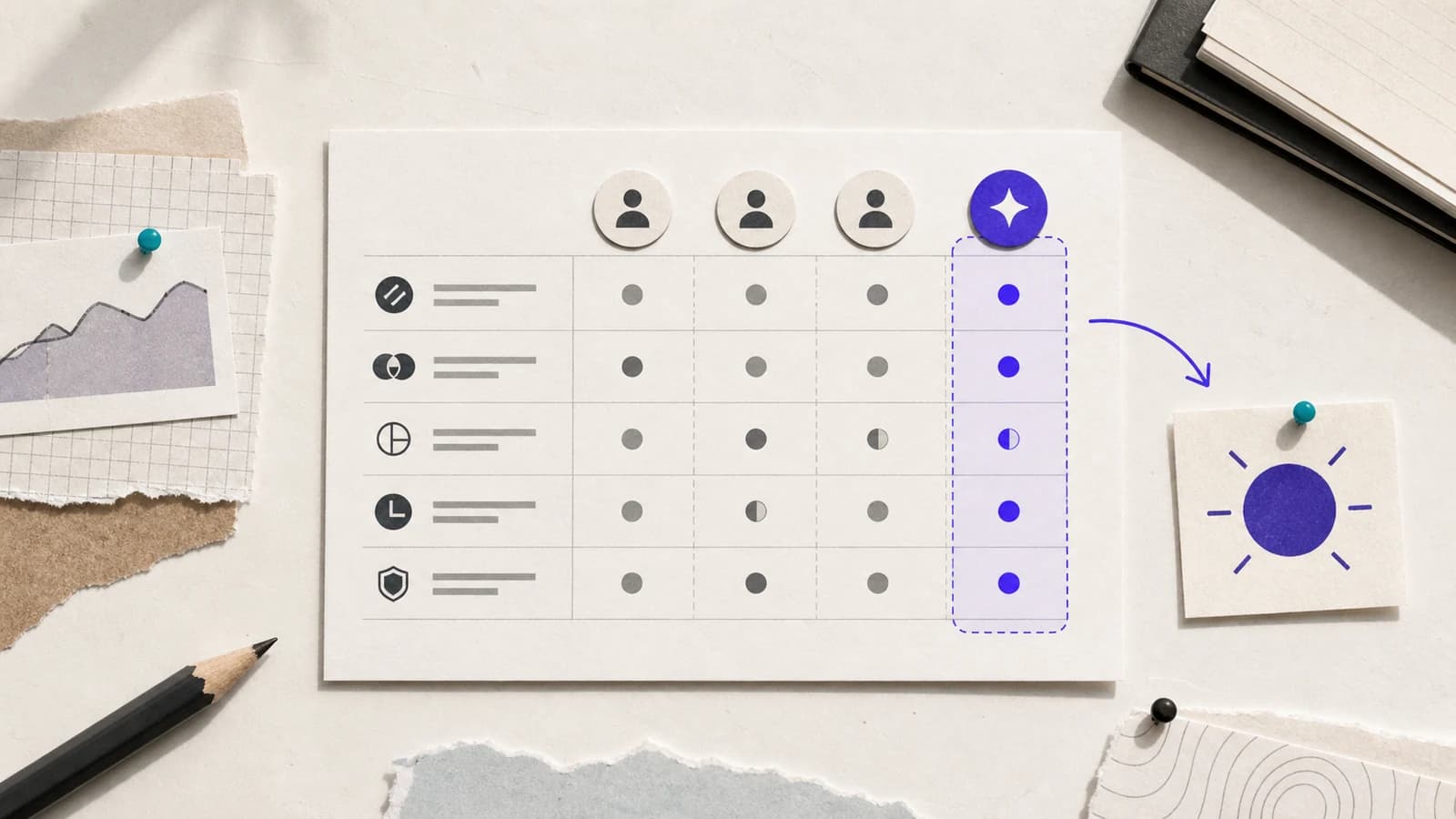
Don't just make a list. Build a comparison table with these columns:
| Column | What to Track |
|---|---|
| Name | Company or product name |
| What they do | One sentence. Forces you to understand their positioning. |
| Pricing | Free, freemium, paid, enterprise. Tells you what the market pays. |
| Funding | Bootstrapped, seed, Series A+. Shows who has resources to compete. |
| Weakness | From reviews, comments, your own testing. This is your opening. |
| Your advantage | What you'd do differently. This becomes your pitch. |
10-15 competitors in this format gives you more clarity than 50 hours of thinking about it.
Which Competitor Data Points Actually Matter?
Early on I tracked a dozen columns per competitor. It produced nothing actionable. Five points survived the cut, because each one changes a real decision.
1. Funding and Stage
Why it matters: A competitor with $50M raised is a different threat than a bootstrapped solo founder. Funded competitors validate the market and also mean you're fighting well-armed opponents.
Where to find it: Crunchbase, PitchBook, company press releases, LinkedIn announcements.
2. Pricing
Why it matters: Pricing reveals positioning. High prices mean enterprise focus, low prices a volume play, a free tier a growth-at-all-costs bet. It shapes your own pricing strategy.
Where to find it: Their pricing page, G2, Capterra, or just sign up for the product.
3. Customer Reviews
Why it matters: Reviews are free customer research. The complaints show gaps you can fill. The praise shows what's table stakes.
Where to find it: G2, Capterra, Product Hunt, App Store, Reddit. Sort by most critical first - the 1-star and 2-star reviews tell you exactly what's broken.
4. Target Customer
Why it matters: You don't have to compete head-to-head. If every competitor targets enterprise, there may be an underserved SMB segment. If everyone is horizontal, go vertical.
Where to find it: Homepage copy, case studies, customer logos, LinkedIn job postings.
5. Key Weakness
Why it matters: This is your angle, your positioning, the reason customers switch. If you can't name a weakness, you don't have a strategy.
Where to find it: Reviews, Reddit threads, churned-customer interviews.
How Do You Turn Competitor Research Into Strategy?
Most founders stop at the table. The doc lives in Notion and never shapes a single decision. Here's what I do with it the same afternoon I finish it, before the energy fades.
Find Your Angle
Look at the weakness column. Which one can you own?
- •All competitors have clunky UX, so you're the "simple" option.
- •All competitors target enterprise, so you're the SMB play.
- •All competitors are horizontal, so you go vertical and niche.
- •All competitors are expensive, so you're the affordable option.
Pick one. The "we are simpler AND cheaper AND more vertical" pitch is what investors mute on Zoom. Own one column from the table and let the rest go.
Set Your Pricing
Competitor pricing is your benchmark. You have three options:
- 1.Price lower: compete on value. Risk: race to the bottom.
- 2.Price similar: compete on features and experience. Risk: you need clear differentiation.
- 3.Price higher: compete on premium positioning. Risk: you need to justify the premium.
Steal Their Customers
The 1-star reviews are a free product roadmap. When I plan a feature, I read every recent low-score review of the closest competitor before I touch a spec. The repeat complaints become the spec. The exact wording often becomes the marketing copy. Tactics that worked for me:
- •SEO for "[competitor] alternative" queries.
- •Comparison landing pages.
- •Replying to complaint tweets with your solution.
- •Building the integration they're missing.
- •Offering migration from the competitor.
Put It on One Pitch Deck Slide
Every pitch deck needs a competitive slide. Here's the format that works:
COMPETITIVE LANDSCAPE

[2x2 matrix or simple table]

         | Feature A    | Feature B
---------+--------------+--------------
Us       | + Best       | + Yes
Comp A   | - No         | ~ Partial
Comp B   | ~ Partial    | + Yes
Comp C   | + Yes        | - No

WHY WE WIN:
"We're the only [solution] built specifically for
[customer] who need [key differentiator]."
One slide. If your advantage needs two slides, the advantage is not real, or you have not finished thinking about it.
What Are the Biggest Competitor Research Mistakes?
- ✗Stopping at page 1. Google shows you the best-marketed competitors, not all of them. The dangerous ones might be on page 3, or not on Google at all.
- ✗Ignoring indirect competitors. "We don't compete with spreadsheets" is what founders say before losing customers to spreadsheets.
- ✗Seeing competitors as threats instead of data. Competitors prove demand exists. They show you what pricing works. They reveal gaps through their bad reviews. A market with zero competitors is scarier than one with 20.
- ✗Doing it once. Competitor research isn't a checkbox. New startups launch every week. Set a monthly reminder to re-scan your space.
A market with zero competitors is scarier than one with 20. Competitors prove demand exists.
"If you can't name at least 3 competitors, you haven't done enough research. And if you think you have no competition, you definitely haven't."
Want This Done in 60 Seconds Instead of 6 Hours?
That's what I built Preuve AI for. Enter your idea, and the scanner pulls competitors from Crunchbase, Product Hunt, G2, Exa, and 15+ other sources automatically - names, pricing, funding, weaknesses, all sourced. See the full idea validation workflow if you want a structured walk-through. See how it performs in my validation tools comparison.
But whether you use a tool or do it manually, the point is the same: know your market before you build for it.
This page helps you find the landscape and decide what matters. Then use the business idea validation guide to test whether buyers care, and the TAM, SAM, SOM guide to see whether the opportunity is large enough.
Frequently Asked Questions
How do I find competitors for my startup?
Search the problem your customers have, not your product name. Use Google, Product Hunt, Crunchbase, Reddit, G2, and YouTube to find direct, indirect, and adjacent competitors. A thorough search typically reveals 10-15 competitors most founders didn't know existed.
What if my startup has no competitors?
Every idea has competitors. If nobody is solving the problem, that's a warning sign. Look broader: indirect competitors like spreadsheets, manual processes, or adjacent tools often serve the same need differently.
What are direct vs indirect competitors?
Direct competitors do the same thing for the same audience. Indirect competitors solve the same problem differently. If you're building a freelance invoice tool, FreshBooks is a direct competitor, while a Google Sheets template is an indirect competitor.
How often should I do competitor research?
Competitor research isn't a one-time checkbox. New startups launch every week. Set a monthly reminder to re-scan your space. Markets shift fast, and the competitor that didn't exist last month might have just raised $5M.
What if my competitors are much bigger than me?
Big competitors are slow. They can't serve niches well, they carry legacy code and enterprise bloat. Find the segment they're ignoring and own it completely. Size is a weakness as often as it is a threat.
Should I mention competitors by name in my pitch?
Yes. Investors know them anyway, and naming competitors shows you've done your homework. Don't trash-talk. State facts: what they do, what they don't, why you're different.
What if a competitor copies my feature?
They will. Features are not moats. Your moat is speed of execution, customer relationships, brand, network effects, or proprietary data. Build something hard to copy, not just a feature.
How do I find competitor revenue?
Most competitors don't publish revenue. Estimate it from employee count (roughly $150-200K revenue per employee for SaaS), funding amounts, or third-party estimates on Growjo, Latka, or SimilarWeb traffic data.
¿Quieres ejecutar este proceso en 60 segundos?
Preuve AI analiza tu idea de startup con datos de mercado reales usando los mismos marcos que usan los inversores.
Analizar mi idea (Gratis)Análisis gratuito. 60 segundos.