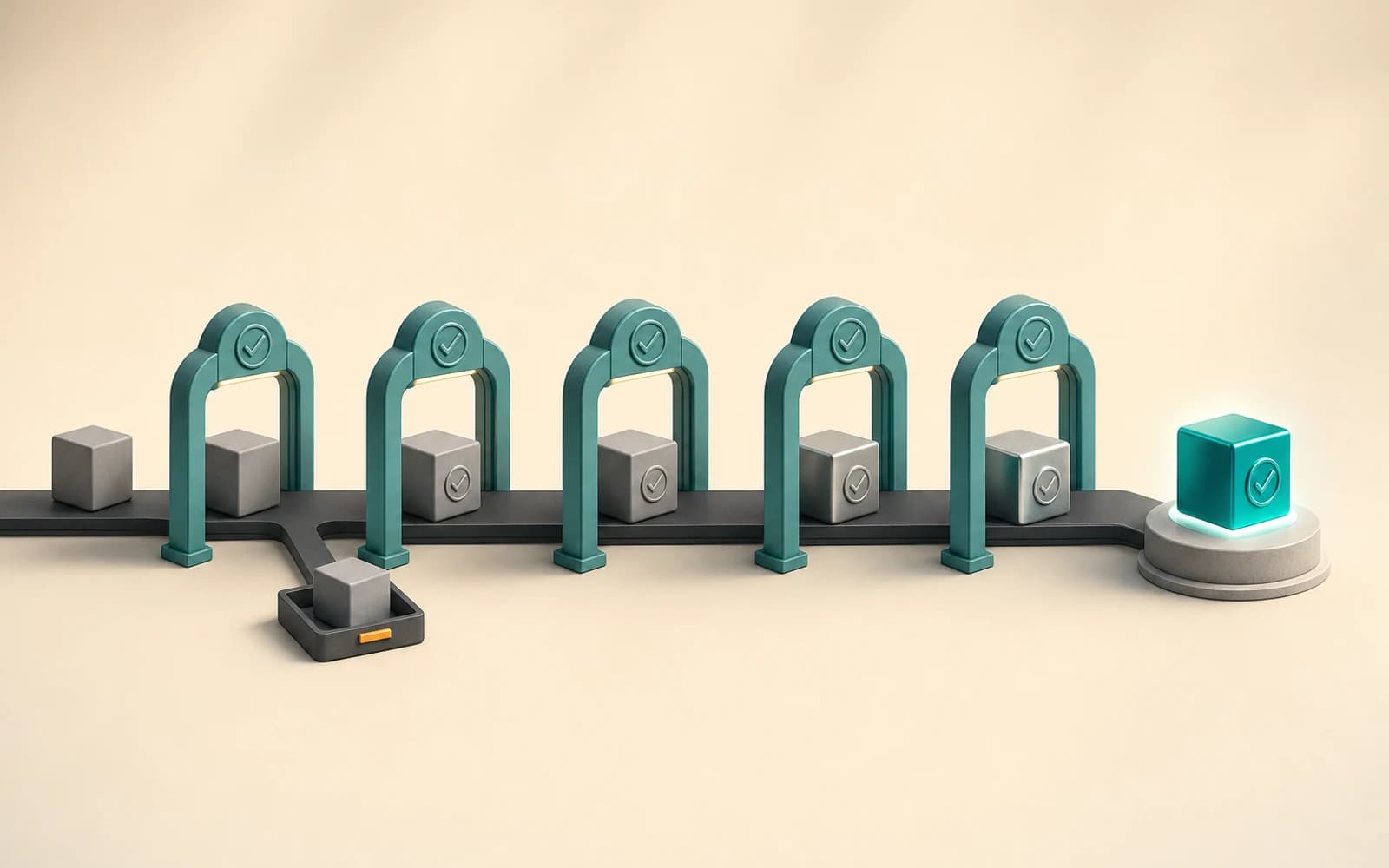
Key takeaways
- No tool replaces the buyer: Sourced research can do the desk work in minutes, but only interviews and a pre-sell show that someone will pay. A deposit, a paid pilot or a signed letter of intent outweighs any report.
- Test for a real market: Research competitors (no competitors = no market), then run a smoke test with a landing page or pre-sell.
- Score, then decide: Rate the idea on 5 criteria and build only if it scores 40+. The whole process takes about 7 days of focused work.
To validate a startup idea before you build, prove three things in order: a specific group of buyers has the problem, they already spend time or money working around it, and some of them will commit by a date you set, with a deposit, a paid pilot or a signed letter of intent. The whole cycle fits in about a week: a day of desk research, then a few days of buyer conversations and a pre-sell. If nobody commits, you have your answer before writing any code.
CB Insights' March 5, 2026 review of 431 VC-backed shutdowns puts poor product-market fit at 43% of failures. Not because of bad code. Not because of funding. They fail because the market never cared enough.
This guide shows you how to pressure-test your startup idea in about a week, using methods that actually work. You do not need a product, and the core path costs little beyond your time: a few small gift cards for interviews, plus ad spend only if you run a smoke test.
Want the data-heavy parts done for you in 60 seconds? Run a free idea validation scan first, then come back here for the customer interview portion no tool can replace.

Will your idea survive the market?
Preuve AI runs 10 agents against live market data and links every claim to a source. Free analysis in 60 seconds.
What "Validation" Actually Means (And What It Doesn't)
Validation isn't asking your friends if your idea sounds cool, and it's not a survey where 73% of respondents say they'd "probably" use your product.
Real validation answers one question: Will strangers pay money for this? Everything else is a proxy for that question, and most proxies are generous liars.
Here's what validation is NOT:
- ✗Your mom saying it's a great idea
- ✗A Reddit post with 50 upvotes
- ✗"I'd definitely use that" from people who won't
- ✗A competitor existing (that proves a market, not your fit in it)
- ✗Your gut feeling after a shower thought
Here's what validation IS:
- ✓Evidence that a specific group of people has a painful problem
- ✓Proof they're actively looking for solutions
- ✓Signs they'll pay real money to solve it
- ✓Data showing you can reach them affordably
The 2026 trap: AI confidence without sources
There's a newer way to fool yourself. You paste your idea into ChatGPT and it hands back a market size, competitor names, and a growth strategy. It sounds authoritative. It is often invented. I wrote a full guide on using ChatGPT for idea validation that covers where it helps and where it lies.
LLMs hallucinate. They fabricate competitor names, make up market sizes with no source, and generate pricing that is completely wrong, and they do it confidently. False data you trust is more dangerous than no data at all.
So I use one rule for any AI-assisted validation: if you can't click through to the source, assume the number is wrong. Use AI for speed, then verify every claim that would change your decision.
The goal isn't to feel confident. It's to find reasons your idea will fail, before you've invested anything.
The 7-Day Validation Plan
You can run a serious validation in about 7 days of focused work. Not 7 days of half-attention between meetings. Blocked calendar, phone off, one idea.
Day 1: Write a falsifiable claim and define the exact buyer. Not "people who need better invoicing." Name the job title, the company size, and the specific pain. Write it as a claim you can prove wrong.
Day 2: Sourced desk research. Competitors, review sites, Reddit threads, keyword demand, Google Trends. Collect 10+ screenshots of real people describing the pain in their own words.
Day 3: Name the top 3 risks. What kills this idea? No demand, too many competitors, unit economics that never work, regulatory walls, or a buyer you cannot reach. Write them down and rank them.
Days 4-5: Buyer interviews and a pre-sell. Run at least 10 conversations with real potential buyers (not friends). Then ask for a commitment you can see by day 7: a deposit, a paid pilot, a signed letter of intent. A longer commitment metric (see below) runs to its own deadline, so if you pick one, decide when that date passes.
Days 6-7: Score and decide. Run the evidence through the validation framework. If the idea survives, build. If not, you saved yourself months.
The research day can shrink to 60 seconds with a sourced tool like Preuve, but the buyer conversations cannot be skipped. Each step is explained below.
Validation Methods Compared
Not every method proves the same thing. This table ranks them by signal strength, weakest to strongest. Cheapest first, but the real signal comes from a buyer doing something irreversible. The time column is time to the first signal: a pre-sell starts inside the 7-day plan, even if the paid pilot it lands runs for weeks.
| Method | Cost | Time to first signal | What It Proves | Signal |
|---|---|---|---|---|
| Desk research | Free | 1 day | Problem exists publicly | Low |
| Customer interviews (10+) | $0-200 | 2-3 days | Pain is real and specific | Medium |
| Fake-door / landing-page smoke test | $50-200 (ads) | 3-5 days | Interest from strangers | Medium |
| Concierge | Your time | Days 4-5 (delivery runs longer) | Willingness to pay for outcome | High |
| Pre-sell / paid pilot | Your time | Days 4-5 (the pilot runs longer) | Buyer pays before product exists | Very high |
| Commitment metric | Free | Your deadline (often 30 days) | Named buyer, named action, named date | Highest |
7 Lenses to Judge an Idea Before You Test It
Before you run any test, run the idea through seven desk-only lenses. Any one of them can kill it, and a kill at this stage costs an afternoon. The same kill eighteen months in costs your savings.
- 1
Market size, honestly. Count the buyers you can actually reach. Multiply by what they already pay for something like this. "We only need 1% of a $50B market" is not a plan.
- 2
Pick your wedge. Not "e-commerce brands" but "Shopify stores doing $1M to $10M that still build post-purchase emails by hand." Look for a trigger event that makes the pain urgent right now.
- 3
Competition is evidence. A crowded market proves the budget exists. An empty one usually means the problem is not painful enough to pay for. Read one-star reviews of the leaders: complaints are a positioning map drawn by the buyers you want.
- 4
Distribution before product. Name where your first 25 customers come from, by room: the trade Slack, the subreddit, the conference. And price and channel have to match: a $9/month product cannot support cold calls.
- 5
Unique insight. Somewhere in a strong idea is a sentence: "Most people think X, but actually Y." When a funded competitor shows up, that insight is usually the only thing they cannot copy by Friday.
- 6
Founder fit. Does the idea's hardest problem match what you are good at? Will you still want this in year three, after the novelty is gone and a competitor just raised a round?
- 7
Write your kill criteria now. Pre-committed, dated, specific: "Fewer than 4 of 10 interviews name the pain unprompted" or "No channel reaches the wedge below a third of first-year price." Kill criteria written today are cheap. Written after six months of building, they bend to protect the sunk cost.
Step 1: Define the Problem, Not the Solution
Most founders start with a solution: "I want to build an app that does X." That's the wrong frame. Start with the problem.
The Problem Statement Formula:
[Specific group of people] struggles with [specific problem] because [root cause]. This costs them [time/money/pain].
✗ Weak
"People need better invoicing software."
Vague. No specific buyer, no measurable cost - nothing you can test.
✓ Strong
"Freelance consultants lose $2,000-5,000/year in unbilled hours because they forget to invoice for ad-hoc calls. Manual tracking takes 3+ hours/week."
Names the buyer, the cost, and the trigger - every piece is testable.
The second version tells you who to talk to (freelance consultants), what pain to probe (unbilled hours, manual tracking), and what success looks like ($2,000+ saved, 3 hours/week recovered).
If you can't write a specific problem statement, you don't have an idea yet. You have a vibe.
→ Action Step
Write your problem statement in under 50 words. If you use the word "people" without a modifier, start over.
Step 2: Find Proof the Problem Exists (Without Talking to Anyone Yet)
Before you schedule a single customer interview, do your homework. The internet is full of people complaining about their problems for free.
This is still the basic logic of customer development: use public market signals first, then use interviews to test whether the pain is real enough to buy against.
Where to Look:
Search for your problem keywords in relevant subreddits. Look for rant posts ("I'm so frustrated with..."), advice requests ("How do you handle..."), and tool recommendations ("What do you use for...").
G2 and Capterra Reviews
Find competitors (even tangential ones) and read 1-3 star reviews. These are gold. Users tell you exactly what's broken about existing solutions.
Google Trends
Is search interest for your problem growing, flat, or dying? A flat line isn't death, but a downward slope is a red flag.
Google Ads Keyword Planner
Keyword Planner gives you keyword ideas, monthly search estimates, and cost ranges. In 2026, it is still one of the fastest ways to see whether commercial demand exists beyond your own network.
Quora and Stack Exchange
For B2B or technical products, these platforms surface real questions from real users. Sort by recent to see if the problem is still active.
Twitter/X Search
Search for "[problem] is broken" or "[solution category] sucks." Unfiltered complaints from real users.
What You're Looking For:
- •Volume: Are lots of people talking about this, or just 3?
- •Intensity: Are they mildly annoyed or genuinely frustrated?
- •Recency: Is this an active problem or a 2019 thread?
- •Spend signals: Are they asking for paid solutions or expecting free?
Red Flags:
- ⚠You can't find anyone complaining about this problem
- ⚠All discussion is 2+ years old
- ⚠People discuss it but seem fine with existing solutions
- ⚠The only complaints are about price (means the market is commoditized)
→ Action Step
Spend 60 minutes searching. Screenshot 10+ examples of real people describing your problem in their own words. If you can't find 10, your problem might not be painful enough.
Short on time? Preuve AI (formerly Test Your Idea) scans Reddit, Indie Hackers, Product Hunt and more, across 60+ live data sources.

Step 3: Map the Competitive Landscape (Properly)
"I don't have competitors" is about the most dangerous thing you can say at this stage. You always have competitors. They might be direct (same solution, same audience), indirect (different solution, same problem), or status quo (spreadsheets, manual processes, doing nothing).
Most founders find 2-3 competitors and stop. The real number is usually 10-20+.
How to Find Competitors You're Missing:
- 1Google the problem, not the solution. Search "how to [solve problem]" not "[your product category] software."
- 2Check Product Hunt and G2 categories. Browse adjacent categories, not just the obvious one.
- 3Search Crunchbase and PitchBook for funded companies in your space. If there are 5+ companies with $10M+ raised, you're entering a dogfight.
- 4Ask in communities. Post "What do you use for [problem]?" in relevant Slack groups, Discord servers, or subreddits.
- 5Look at job postings. Companies hiring for roles related to your problem are building internal solutions, which makes them potential customers or competitors worth watching.
What to Document:
For each competitor, note: pricing model and price points, primary audience, key features, weaknesses (from reviews), and funding/traction if available.
The Real Question:
After mapping competitors, ask yourself: Why would someone choose me over the established player?
✓ Valid answers
- "I'm 10x cheaper for the same outcome"
- "I serve a niche they ignore"
- "I solve it in a fundamentally different way"
- "Their product is from 2015 and feels like it"
✗ Invalid answers
- "My UI will be better" (everyone says this)
- "I'll have more features" (feature wars are unwinnable)
- "I'm more passionate" (irrelevant to customers)
→ Action step
Create a spreadsheet with 10+ competitors. If you can't find 10, you're not looking hard enough, or the market doesn't exist.

Skip weeks of manual research
Get complete market research, sourced proof, competitor map, and pricing data for your idea instantly.
Step 4: Talk to Real Humans (The Right Way)
Online research tells you the problem exists. Customer conversations tell you if your solution fits.
Who to Talk To:
Not your friends. Not your network. Not people who will be "nice." You need strangers who match your target profile and have no reason to protect your feelings.
Where to find them: Reddit/Discord DMs, LinkedIn cold outreach, Twitter engagement, local meetups and Slack communities, Upwork/Fiverr (pay for 30-minute calls if needed).
How Many Conversations?
10
Minimum
20-30
Ideal
7-8
Pattern kicks in
What to Ask:
Don't pitch your idea. You're here to learn, not sell. Use the Mom Test framework (from Rob Fitzpatrick's book):
1. Ask about their life, not your idea.
"Walk me through the last time you dealt with [problem]. What did you try? What happened?"
2. Ask about specifics, not hypotheticals.
Bad: "Would you use an app that does X?"
Good: "Last month, how did you handle X? What did that cost you?"
3. Ask about money and time.
"How much time do you spend on this per week? Have you paid for solutions before? What would you pay to make this disappear?"
4. Shut up and listen.
Take notes verbatim. Follow-up with "Tell me more about that." Resist the urge to explain your solution.
Warning Signs vs. Green Lights:
⚠ Warning signs
- They say "that's interesting" but can't describe their pain
- They've never tried to solve this problem
- They've tried free solutions and are satisfied
- They can't articulate what they'd pay
- You have to explain why they should care
✓ Green lights
- They get visibly frustrated describing the problem
- They've tried multiple solutions and hate all of them
- They quote specific time/money costs unprompted
- They ask when your product launches
- They offer to pay for early access
→ Action step
Book 10 conversations this week. Use Calendly. Offer a $20 Amazon gift card if needed. No excuses.
The Commitment Metric: A Sharper Smoke Test Than a Waitlist
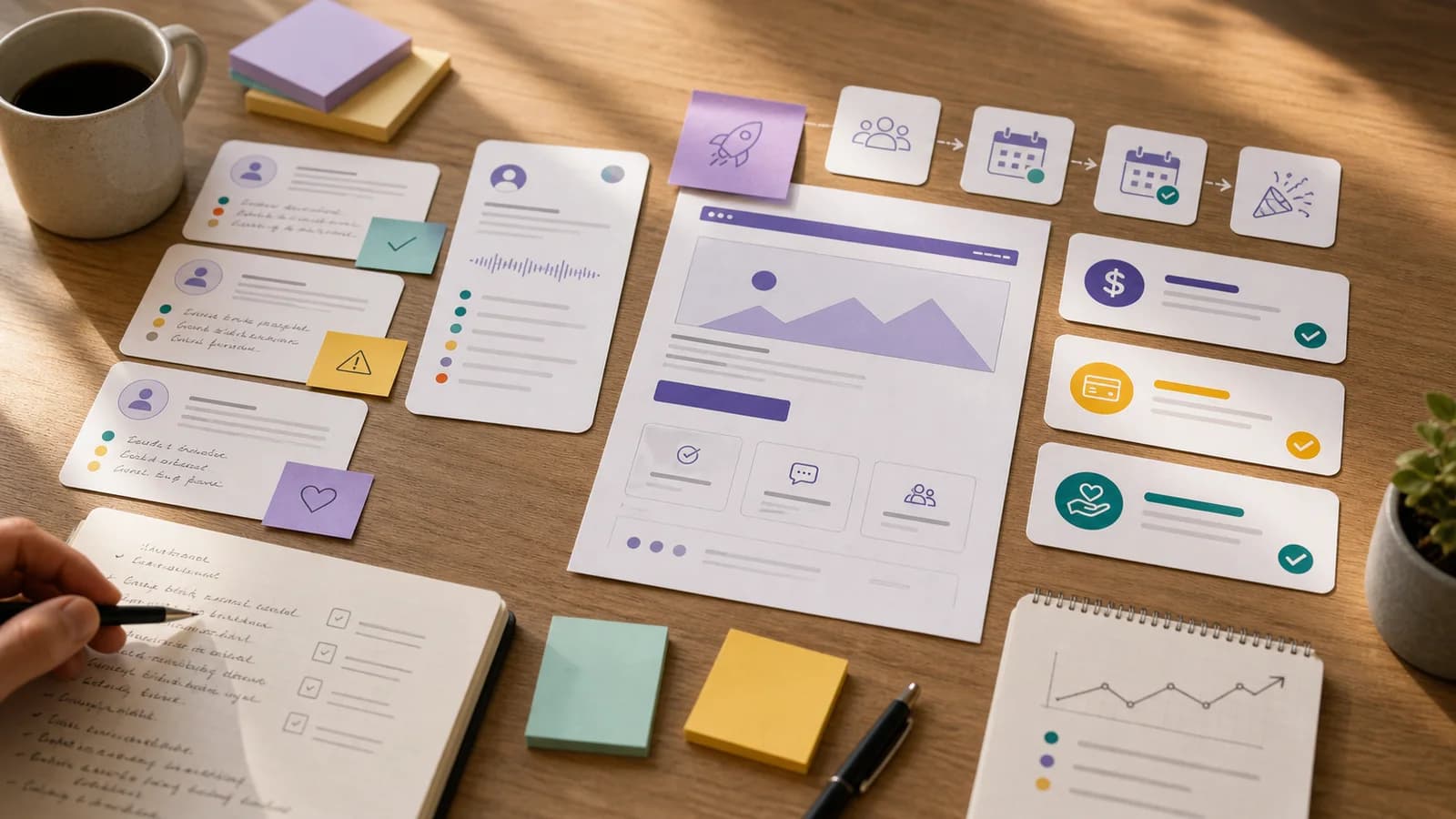
Customer conversations tell you the pain is real. But "that sounds great" is not a buying signal. Before I greenlight a build I want one harder signal: a named person doing a named thing by a named date.
Brian Shin (founder of Once, a disposable camera app) calls this the commitment metric. In May 2026 he walked through the framework on Starter Story after growing Once from zero to $20K MRR in 83 days without writing a line of code first.
We made sure that people committed to this product before writing a single line of code.
Two halves, both required:
- 1.Your commitment. A finite date and a finite count. "Inside 30 days I need 10 buyers doing X, or I kill this idea." No drift, no extensions.
- 2.Their commitment. An irreversible action, not an opinion. For Once, it was an event host actually using the product at a real event. For a B2B product, that might be a signed LOI, a paid pilot, or a scheduled implementation call with the buyer's team on the invite. The word that matters is action.
The math from Brian's run: 250 cold messages, 15 replies, 12 events booked inside one month. That ratio is the validation, not the eventual $20K MRR. The MRR was a consequence of hitting the commitment metric.
Why this beats a waitlist
Waitlists and email signups are cheap things to give away. A commitment metric forces the buyer to do something they would only do if the pain is real, which means the signal density per data point is much higher. In practice that lets me kill or pivot earlier, before any build cost has piled up.
One caveat I keep running into: the commitment metric only works on ideas that already pass the desk-research step (Steps 1-3 above). If the market doesn't exist, you can run a perfect commitment sprint and still book zero meetings. Run the desk research first, then spend the sprint on the ideas that survive.
→ Action Step
Write your commitment metric as one sentence with a count, a buyer action, and a deadline. Example: "10 founders book a 30-minute discovery call by June 30." If you can't pin down both the count and the date, the idea isn't defined enough yet.
Step 5: Stress-Test with Frameworks VCs Actually Use
Gut feelings are unreliable here. Before you go further, run your idea through the same filters investors use when they see hundreds of pitches a year.
Framework 1: TAM/SAM/SOM (Market Sizing)
- •TAM (Total Addressable Market): Everyone who could theoretically buy this
- •SAM (Serviceable Addressable Market): The segment you can actually reach
- •SOM (Serviceable Obtainable Market): What you can realistically capture in 2-3 years
A $100B TAM means nothing if your SAM is $5M. Be honest about who you can actually reach.
Red flag: Your SOM is under $1M. That's a lifestyle business at best.
Framework 2: Unit Economics
Before you build, estimate your Customer Acquisition Cost (CAC), Lifetime Value (LTV), and LTV:CAC Ratio (should be at least 3:1).
If paid ads cost $50/click in your space and your product is $10/month, the math doesn't work.
Framework 3: Porter's Five Forces (Defensibility)
- →Threat of new entrants: How easy is it to copy you?
- →Bargaining power of suppliers: Are you dependent on one API/platform?
- →Bargaining power of buyers: Can customers easily switch?
- →Threat of substitutes: What else solves this problem?
- →Industry rivalry: How bloody is the competition?
If you score poorly on 3+ forces, you're building a business that's easy to kill.
Framework 4: The Timing Question
Why now? What changed that makes this the right moment?
Valid answers: new technology enables something previously impossible, regulatory change created demand, behavioral shift (remote work, AI adoption), or incumbent is dying/distracted.
"I just thought of it" isn't a timing thesis.
→ Action Step
Score your idea on each framework. Be brutal. If you wouldn't invest in this company, why would you spend 2 years of your life on it?
How to Pre-Sell Before You Build
The commitment metric needs a buyer action, and a pre-sell is the cleanest one. "That sounds cool" is worthless. "Here's my card" is validation.
You don't need a product to pre-sell. You need an offer. Three formats that work:
- •Paid pilot. "I'll do this manually for your first 3 clients for $X." Validates demand and teaches you the workflow before you automate it.
- •Concierge version. "I'll deliver the result by hand this week for $X." Higher touch, but proves willingness to pay.
- •Paid audit. "I'll analyze your [situation] and send a report with recommendations for $X." Works especially well for B2B, where agencies and consultants already understand paying for expertise.
Set the target before you start: "If 2 of 10 conversations convert to a paid pilot, I build. If 0 do, I kill it." The price doesn't have to be your final price. It just has to be non-zero. Free pilots validate nothing - people say yes to free forever.
What Our 2026 Benchmark of 6,000+ Analyses Shows
I built Preuve to automate the desk-research step of this process. I published the anonymized results from 6,000+ completed analyses in a benchmark study (third edition, data through July 30, 2026). A few numbers that matter for anyone validating an idea right now:
| Signal | Number | Source |
|---|---|---|
| Model verdicts: go / caution / no-go | 17.5% / 76.0% / 6.4% | Preuve benchmarks, July 2026 |
| Median assessment score | 54 / 100 | Same study |
| #1 primary risk label (of 4,995 labeled analyses) | Early-stage risk (36.9%) | Same study |
| #2 primary risk label (same subset) | Go-to-market (25.7%) | Same study |
| Selected rescan comparison (734 re-scored iterations, not causal) | +8.9 pts avg, 75.2% went up | Same study |
These are model verdicts, not startup outcomes. There is no follow-up study tracking which ideas succeeded. The scores describe how the model read the evidence at the time of each scan. The rescan row is a selected, uncontrolled comparison. Changed inputs, tier or model-version differences and repeat chains can all move a score, so it does not show that rescanning causes the gain. Early-stage risk, the label for a concept too loosely specified to assess, is the most frequent primary risk label among the 4,995 analyses that carry one, at 36.9%. Go-to-market is second at 25.7% of that subset. The labels do not establish why ideas score low or fail. The practical read is narrower: write the Step 1 problem statement tightly enough that nobody could call it vague.
When to Stop, Pivot, or Keep Going
Evidence almost always comes back mixed. Mixed results are exactly what your kill criteria were built for. Read them as written. If a threshold failed, the idea is dead in its current form.
A cheap enforcement trick: give the criteria a witness. Send them to a cofounder or a trusted friend the day you write them, and commit to reporting the result. Renegotiating with yourself is easy. Explaining to someone else why "fewer than 4 of 10" quietly became "3 counts if they were enthusiastic" is much harder.
The three-move pivot menu
Most validations end with strong evidence on several lenses and a hard fail on one. That fail tells you which move to consider.
- 1.Same problem, new buyer. The pain was real but the buyer had no budget. Who else has this exact pain and already pays for software?
- 2.Same buyer, new problem. The buyer was reachable and engaged, but your problem ranked fourth on their list. You now know these people better than any outsider. What ranked first?
- 3.Same product, new channel. Demand held, the product held, and the channel math failed. Check whether a partner, a marketplace, or an embed changes the arithmetic.
One rule: a pivot inherits the evidence, never the verdict. The new version is a new idea. Run it through the lenses again, write fresh kill criteria, and give it its own deadline. Three pivots in three months means the criteria were never real.
What "validated enough" looks like at pre-seed
- ✓Buyers describe the pain unprompted, in their own words.
- ✓Money moved: a payment, a prepayment, or a deposit. A signed letter of intent is a commitment, not money.
- ✓You can name the channel and the first 25 buyers.
- ✓The napkin math works without a miracle.
Certainty arrives years later, priced accordingly. If you wait for it, the answer will come from watching someone else build the company. Past this bar, more validation has negative returns. Interviews start repeating themselves. Competitors ship. The market data you collected in spring goes stale by fall.
The Validation Verdict: Go or No-Go?
After completing these five steps, you'll have a specific problem statement, evidence the problem exists, a map of 10+ competitors, 10+ customer conversations with real insights, and framework scores showing market viability.
Now make the call:
✓ GO Signals
- Problem is urgent and frequent
- Customers actively spending on solutions
- You have a defensible angle
- Unit economics pencil out
- Clear "why now" thesis
✗ NO-GO Signals
- Can't find evidence of problem online
- Competitors solved it well enough
- Customers won't pay (or pay enough)
- Market too small or shrinking
- No clear differentiation
A "no-go" isn't failure. You just saved yourself months of building something nobody wants, which is genuinely useful information.
Score Your Idea: The 5-Question Scorecard
If you want a number instead of a gut call, score each of the five questions below from 1 to 10 and add them up.
| Question | Your Score |
|---|---|
| Problem is real and painful | /10 |
| Competition validates the market (not saturated) | /10 |
| You can reach customers | /10 |
| Unit economics work | /10 |
| You have an edge | /10 |
40+
Strong idea. Start validating deeper.
25-39
Potential, but something is weak. Fix that thing.
Under 25
Move on. Find a better idea.
Red Flags a Good Score Can Still Hide
Even when the scorecard looks healthy, these phrases should trigger alarm bells:
"Everyone needs this"
No they don't. When everyone is your customer, no one is. "Busy professionals" is meaningless. "Solo accountants with 10-50 clients" is a market you can actually reach.
"No one is doing this"
Someone is, either directly or with spreadsheets and duct tape. If you truly cannot find alternatives, the market probably doesn't exist, or you stopped looking too early.
"I just need to build it and they'll come"
They won't. Distribution is harder than building. If you can't explain exactly how 100 customers find you in the first 6 months, the idea isn't ready.
"It's like Uber for X"
Uber worked because of specific conditions: smartphone adoption, GPS, payment rails, and regulatory arbitrage. "Uber for X" is usually code for "I haven't thought through the economics."
What Comes Next
Validation doesn't end here. It continues as you build.
But if you've done the work above, you're no longer guessing. You have data and conviction backed by evidence, which puts you ahead of most founders who skip straight to building.
Using AI tools like Cursor, Replit, or Claude to build? I wrote a guide on validation for vibecoders - a faster 30-minute process designed for the AI coding era.
Tempted to write the business plan next? Read why I tell founders to wait on the startup business plan until validation is done.
The founders who end up in the product-market-fit bucket of CB Insights' March 5, 2026 shutdown review usually skipped steps like these. They trusted their gut. They built first and asked questions later.
Before you move into build mode, tighten the rest of the business case with competitor research and market size math. I also wrote a market validation guide if you want the research step expanded, and a separate walkthrough for validating a product idea when you are past the concept stage. Those steps usually expose whether the startup idea is merely interesting or actually investable. If you lean on AI to speed this up, the one question that matters is whether the model is doing AI business context validation against live sources or just generating plausible text.
Don't be them.
FAQ
How do you validate a startup idea without building anything?
Start with a precise problem statement, look for proof the pain exists online, interview at least 10 target customers, map the current alternatives, and run a smoke test or pre-sell before you write code.
Can you validate a startup idea without an MVP?
Yes, and in most cases you should. Customer interviews, competitor research, a landing page, a concierge test, or a paid pilot reveal more about real demand than a rushed MVP with no distribution behind it.
How long does it take to validate a startup idea?
About 7 days of focused work: one day to define a falsifiable claim and the exact buyer, one day of sourced market research, one day to name the top risks, two days of buyer interviews and a pre-sell, then a go or no-go decision. The research day can shrink to 60 seconds with a sourced tool, but buyer conversations cannot be skipped.
Can you validate a startup idea with AI?
Partly. AI speeds up market research, but most tools hallucinate competitor names, market sizes, and pricing, and state them confidently. The rule: if you cannot click through to the source, assume the number is wrong. Use AI for speed, then verify every claim that would change your decision.
What is the biggest mistake founders make when validating ideas?
Confirmation bias. Founders search for evidence that supports the idea and stop the moment they find it. Real validation means actively hunting for reasons not to build, talking to buyers instead of friends, and treating money, not compliments, as the signal.
How many customer interviews do I need to validate an idea?
At least 10 conversations with real potential buyers, not friends or existing users. Patterns start emerging around conversation 6 or 7. The goal is not to pitch but to collect the exact language buyers use for their pain, their workarounds, and what they already pay.
What counts as a real validation signal for a startup idea?
Behavior beats compliments. Strong signals include repeated pain in customer calls, a buyer asking for access, a pilot request, a pre-payment, or qualified signups from the exact audience you want.
What is the commitment metric in startup validation?
The commitment metric is a pre-build test: pick a buyer action that signals real intent (a hosted event, a deposit paid, a pilot call scheduled), then commit to a target count and a deadline. Brian Shin used it to grow Once to $20K MRR in 83 days without writing a line of code first. It beats a waitlist because the buyer takes an irreversible action inside a finite window.
What makes a startup idea good?
A good startup idea solves a painful problem for a specific group of people who will pay to fix it, sits in a market you can actually reach, has economics that work without miracles, and gives you some edge (expertise, distribution, or timing). It does not have to be original or clever - most good ideas are better versions of things that already exist.
How many competitors is too many?
No competitors is usually a bad sign - it often means the market does not exist. 5-15 competitors with clear weaknesses is the sweet spot: the market is validated and there is room to differentiate. 50+ direct competitors with no clear gaps is a red flag unless you have a very sharp angle.
Is my startup idea too simple?
Probably not. Simple is good. The best products solve one problem extremely well. If an idea feels too simple, that is usually a feature, not a bug. Complexity often means you have not yet figured out what actually matters to the customer.
Cite this page
Last updated September 23, 2026
Forat, V. (2026, September 23). How to Validate a Startup Idea Without Building Anything. Preuve AI. https://preuve.ai/blog/how-to-validate-startup-idea
Forat, Vincent. “How to Validate a Startup Idea Without Building Anything.” Preuve AI, 23 Sept. 2026, preuve.ai/blog/how-to-validate-startup-idea.
Forat, Vincent. “How to Validate a Startup Idea Without Building Anything.” Preuve AI. September 23, 2026. https://preuve.ai/blog/how-to-validate-startup-idea.
@misc{forat2026-how-to-validate-startup-idea,
  author = {Forat, Vincent},
  title = {{How to Validate a Startup Idea Without Building Anything}},
  howpublished = {Preuve AI},
  year = {2026},
  month = sep,
  url = {https://preuve.ai/blog/how-to-validate-startup-idea},
  note = {Last updated September 23, 2026}
}
Vincent
5 years in B2B growth, building Preuve AI in public. 82% of ideas it scores aren't ready, the point is finding out in 10 minutes, not 3 months.
Follow on X →