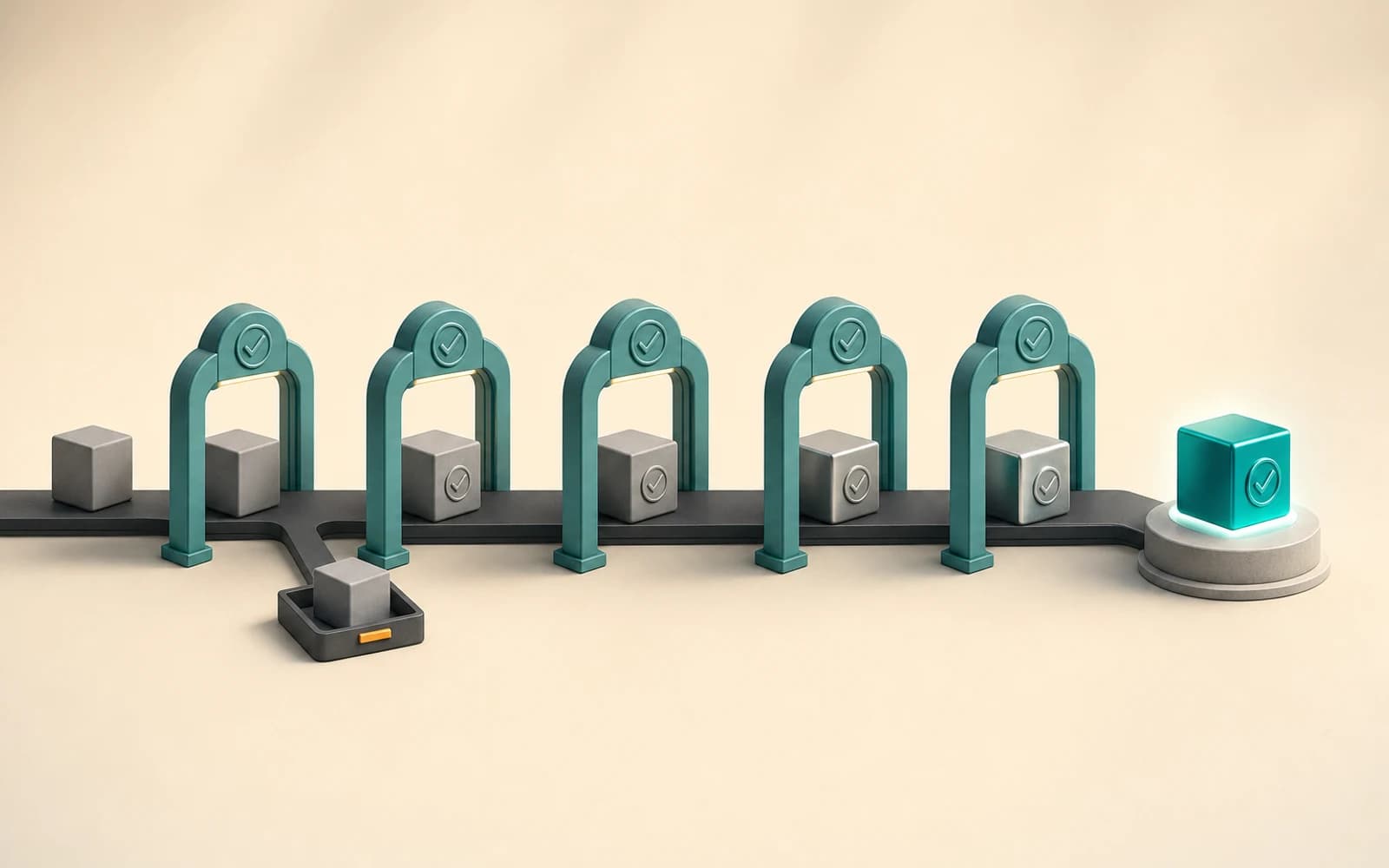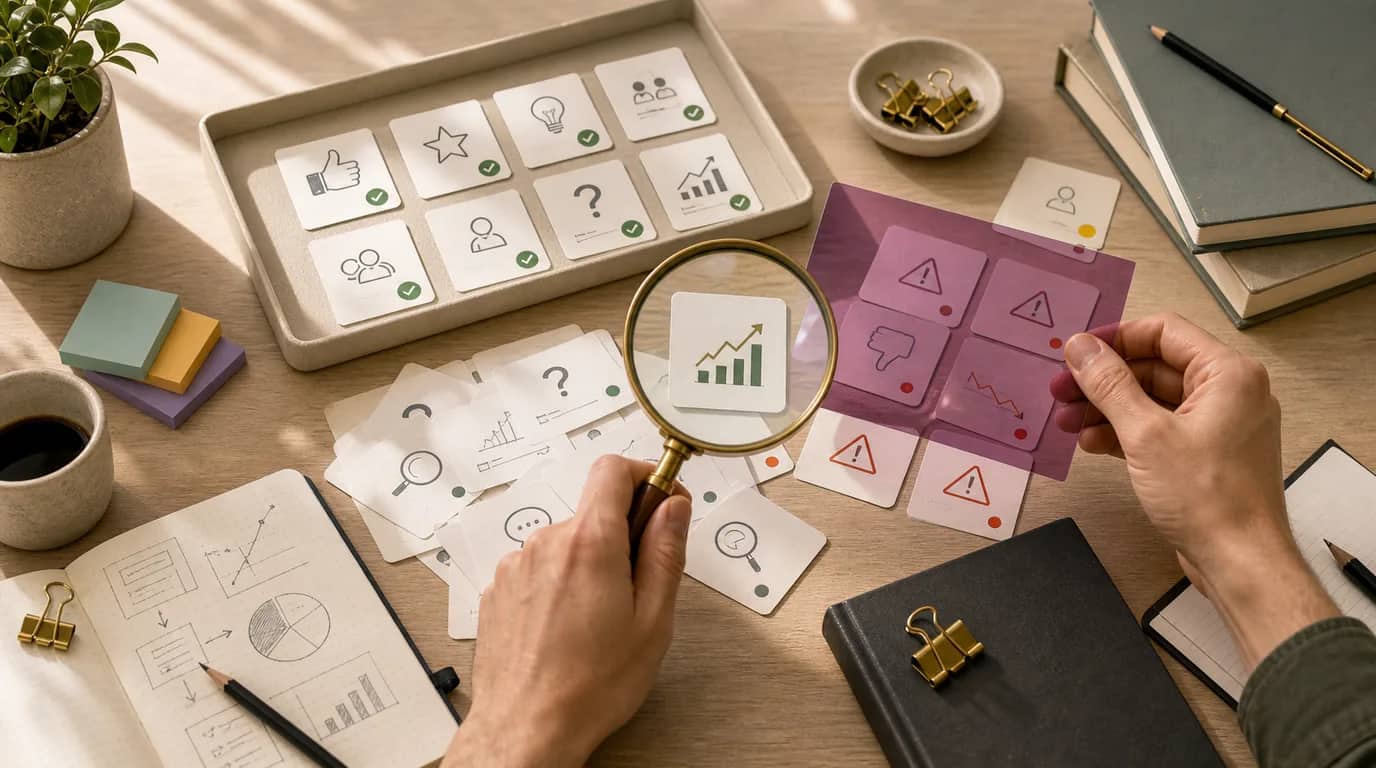
Key takeaways
- Confirmation bias is the #1 enemy of honest startup validation: A 2026 benchmark of 6,000+ analyzed ideas shows self-validated founders overestimate market readiness by 2-3x.
- How it shows up: Founders cherry-pick positive signals, read politeness as demand, and ignore competitor traction.
- The cost: Across 6,000+ ideas, self-validated founders overestimate market readiness by 2-3x.
- The fix: Seek disconfirming evidence first, use data sources that cannot be polite, and let automated tools score the idea without emotional attachment.
Confirmation bias in startup validation is the reason a founder can spend four months on research, feel certain, and still shut down with zero paying customers. A founder I'll call Marco talked to 30 people, read every Reddit thread about his market, found three Google Trends charts trending up, and built a landing page that got 200 signups. His data wasn't bad. His brain was.
The 30 people were friends who didn't want to hurt his feelings. The Reddit threads came from a niche community that didn't represent actual buyers. The Google Trends spike was a related keyword, not the one that mattered. Marco didn't fail at research. He failed at objectivity, and I've seen this pattern hundreds of times across the 7,000+ startup ideas Preuve AI has scored.
Will your idea survive the market?
Preuve AI runs 10 agents against live market data and links every claim to a source. Free analysis in 60 seconds.
What Is Confirmation Bias in Startup Validation?
Confirmation bias is the tendency to search for, interpret, and recall information in a way that confirms your pre-existing beliefs - while giving disproportionately less attention to information that contradicts them.
In startup validation, this means you start with a belief ("my idea is good") and then unconsciously filter every piece of evidence to support it. Positive signals get amplified, negative signals get explained away, and ambiguous signals get quietly rounded up to positive.
The dangerous part: you don't know you're doing it. Confirmation bias operates below conscious awareness. You feel rigorous, you feel like you're following the data, but you are running a rigged experiment where the conclusion was written before the research started.
This is different from lying. Founders who fall into this trap aren't dishonest - they're human. The same cognitive machinery that helps us make fast decisions in daily life becomes a liability when we need to evaluate our own ideas without flinching.
5 Ways Founders Trick Themselves During Validation
I've analyzed the validation approaches of hundreds of founders through Preuve AI. These are the five confirmation bias traps I see over and over.
1. Asking Friends and Family (Politeness Bias)
"I asked 20 people and they all said they'd use it."
Were those 20 people your friends? Your parents? Your co-workers who sit three feet away from you? Then you didn't validate anything. You measured how polite your social circle is.
People who care about you will not tell you your idea is bad. They'll say "that sounds cool" or "yeah, I could see people using that." These responses feel like validation. They're not. They're social lubrication.
The test: would any of those 20 people pay you $50 right now for early access? If you haven't asked that question, you haven't validated demand. You've validated friendships.
2. Only Reading Positive Reddit Comments (Selective Attention)
You search Reddit for your market. You find a thread where someone says "I wish this existed." You screenshot it. You save it. You reference it in your pitch deck.
But did you read the 15 replies saying "I tried this and nobody wanted it"? Did you notice the thread was from 2023 and the market has shifted? Did you check whether the person who posted it ever actually paid for a solution?
Selective attention makes you a highlight reel editor. You clip the best moments and discard everything else. One enthusiastic comment in a sea of indifference becomes "the market is asking for this."
3. Ignoring Competitor Traction ("They're Doing It Wrong")
This is the most sophisticated form of founder self-deception. You find a direct competitor with 10,000 users and, instead of treating that as evidence the market already has a solution, you convince yourself they're "doing it wrong" and you'll just do it better.
Sometimes that's actually true. Most of the time it's confirmation bias wearing a strategy hat. The competitor's existence proves demand, but it also proves the market is already served. Those 10,000 users have chosen something, and switching costs are real.
I wrote a full competitor analysis guide that covers how to evaluate competitors without the "they're doing it wrong" bias. The short version: if a competitor has traction, respect the traction first, then identify the gap.
4. Interpreting "That's Interesting" as "I'd Pay for It"
Interest and willingness to pay are entirely different things. I find quantum computing interesting. I will not buy a quantum computing SaaS product. The gap between "that's cool" and "here's my credit card" is enormous.
Founders running customer discovery interviews fall into this trap constantly. They pitch their idea, the listener leans forward and asks questions, seems genuinely engaged. The founder walks away thinking "they loved it." Engagement is not commitment. Curiosity is nowhere near demand.
The measure of a good validation is not how many people said yes. It's how hard you tried to make them say no - and they still said yes.
5. Google Trends Tunnel Vision (Searching Until You Find a Spike)
Google Trends is a powerful tool. It's also a confirmation bias amplifier. Here's why: you can adjust the time range, the geography, and the comparison terms until you find a chart that looks promising.
Your keyword is flat worldwide? Try "United States only." Still flat? Try the last 90 days. Still flat? Try a related keyword that's trending but isn't your actual market. Keep adjusting until the chart goes up and to the right - then stop there and call it research.
That is data mining in the worst sense. You are not discovering a trend; you are manufacturing one. The worst part is that you will genuinely believe the chart you landed on is "the right way to look at it."
The Research: How Bad Is Confirmation Bias?
This isn't speculation. Confirmation bias is one of the most studied phenomena in cognitive psychology.
Raymond Nickerson's 1998 review in the Review of General Psychology called confirmation bias "perhaps the best known and most widely accepted notion of inferential error to come out of the literature on human reasoning." He documented how it affects everything from medical diagnosis to criminal investigation to scientific research.
Daniel Kahneman's work on dual-process theory explains the mechanism. Your fast, intuitive System 1 forms a belief. Then your slow, analytical System 2 - rather than testing that belief - goes to work defending it. You think you are reasoning when you are actually rationalizing.
In a startup context, the stakes make this worse. You have quit your job, told your friends, spent months building. The psychological cost of discovering the idea is flawed is so high that your brain actively works to prevent that discovery.
Preuve's 2026 benchmark of 6,000+ analyzed ideas shows that founders who self-validate before using the tool overestimate their market readiness score by 2-3x compared to the data-driven score generated from 60+ independent sources.
That 2-3x gap isn't random noise. It's confirmation bias in startup validation measured at scale. Founders consistently rate their market opportunity higher, their competitive position stronger, and their target audience larger than the data supports. I published the broader data breakdown in the early-2026 study of 1,000+ startup ideas scanned through the platform.
Skip weeks of manual research
Get complete market research, sourced proof, competitor map, and pricing data for your idea instantly.
How to Remove Bias From Your Startup Validation
You cannot eliminate confirmation bias - it is hardwired into how we think. But you can build a validation process that accounts for it rather than pretending you are immune. Here is what I actually use.
Seek Disconfirming Evidence First
Before you look for reasons your idea will work, spend equal time looking for reasons it will fail. This is called falsification - the cornerstone of the scientific method.
Write down three specific conditions that would prove your idea is not viable. Then go look for evidence of those conditions. If you can't find it, your idea survives that test. If you can find it, you've saved yourself months of wasted effort.
- ✓"If the total addressable market is under $100M, this won't support a VC-scale business"
- ✓"If three funded competitors already exist with strong retention, switching costs make this unviable"
- ✓"If search volume for this problem has declined 30%+ in two years, timing is wrong"
Use Data Sources That Cannot Be Polite
People lie to you, but not maliciously - they are being kind. Data has no feelings and does not care about your dreams. That is exactly what you need when you are trying to find out whether an idea is real.
Focus your validation on sources that give you raw, unfiltered signals:
- ✓Search volume data - how many people actively search for this problem?
- ✓Competitor revenue and growth - are existing solutions making money?
- ✓Patent filings and funding rounds - where is smart money flowing?
- ✓Community sentiment at scale - not one Reddit comment, but thousands of discussions analyzed together
I wrote a detailed guide on how to validate with real sources that covers each data type and where to find it.
Have Someone Else Review Your Findings
Find someone with zero emotional attachment to your idea. Not a friend. Not a co-founder candidate. Ideally, someone who doesn't even know you well. Give them your validation data and ask: "Based on this evidence alone, would you invest $50,000 in this idea?"
Their answer matters less than their reasoning. If they poke holes you hadn't considered, that's confirmation bias revealed. If they ask questions you avoided, that's selective attention exposed.
Use Automated Tools That Don't Care About Your Feelings
This is why I built Preuve AI. An algorithm has no ego. It has no sunk cost fallacy. It doesn't know you've been working on this idea for six months. It pulls data from 60+ sources and scores your idea the same way whether you're a first-time founder or a serial entrepreneur.
I'm not saying tools replace human judgment. I'm saying they remove the single biggest source of error in human judgment: the emotional relationship between a founder and their idea. If you want to understand the full validation process, I wrote a step-by-step validation guide that walks through it.
How I Built Preuve AI to Fight Confirmation Bias
When I started building Preuve AI, I had one design principle: the tool should be impossible to manipulate into telling you what you want to hear.
I made that choice because I had fallen into every trap on this list myself. I had validated my own previous ideas by asking friends, cherry-picking data, and ignoring competitors. I knew firsthand how seductive confirmation bias is. I needed something that would be brutally honest with me - and with every founder who used it.
Here's how the design fights bias:
- ✓60+ independent data sources. No single source can dominate. Market data, search trends, competitor intelligence, patent filings, community signals, and financial indicators all contribute to the score. You can't cherry-pick when the algorithm is pulling from everywhere.
- ✓Objective scoring with no founder input bias. The scoring model doesn't ask "how confident are you?" or "how big do you think the market is?" It measures. It counts. It calculates. Your optimism doesn't enter the equation.
- ✓Competitor analysis that respects traction. The tool doesn't dismiss competitors. It measures their traffic, funding, tech stack, and market position. If a competitor is strong, the report says so. I designed it to be the honest friend you need but rarely have.
- ✓Red flags surfaced, not hidden. If the data says your market is shrinking, the report highlights it. If your differentiator isn't unique, you'll see that. Preuve is French for "proof" - and proof goes both ways.
The result: founders who run their idea through Preuve AI get a score that reflects reality - not their hopes. Some ideas score high. Many score medium. Some score low. And that's the point. If you want to know whether your idea is a winner, you need a process that can also tell you it's not.
What Does Confirmation Bias Cost Founders?
Confirmation bias doesn't cost you a few hours of research. It costs you months or years of building the wrong thing, depletes your savings, and burns the runway you could have spent on an idea that actually had legs.
The average founder who shuts down a startup has spent 18 months and tens of thousands of dollars before admitting failure. A significant portion of those failures trace back to flawed validation - not flawed execution. They built the right product for the wrong market, or the wrong product for a market that didn't exist at the scale they imagined.
Honest validation hurts in the short term. It forces you to confront uncomfortable data and might kill an idea you have been living with for months. But it does this in days rather than months, which frees you to pursue the idea that actually has traction behind it.
The first principle is that you must not fool yourself - and you are the easiest person to fool.
If your idea survives unbiased validation, you can build with conviction. If it doesn't, you've received the most valuable gift in entrepreneurship: the truth, delivered early enough to act on it. I covered what to do in that scenario in my guide on handling a low validation score.
FAQ
What is confirmation bias in startup validation?
Confirmation bias in startup validation is the psychological tendency for founders to seek, interpret, and remember information that confirms their belief that their startup idea is viable - while unconsciously ignoring or dismissing evidence that contradicts it.
How common is confirmation bias among startup founders?
Extremely common. Research by Nickerson (1998) found confirmation bias to be one of the most pervasive cognitive biases in human reasoning. Preuve's 2026 benchmark of 6,000+ analyzed ideas shows founders who self-validate overestimate market readiness by 2-3x compared to data-driven validation.
Can you eliminate confirmation bias completely?
No. Confirmation bias is hardwired into human cognition. But you can reduce its impact by using disconfirming evidence strategies, relying on data sources that cannot be polite (market data, search trends, competitor revenue), having third parties review your findings, and using automated validation tools.
What are the best ways to validate a startup idea without bias?
Start by actively seeking evidence your idea will fail. Use quantitative data sources like search volume, competitor financials, and market sizing. Have someone with no emotional attachment review your research. Use automated tools that pull from multiple independent sources and score objectively.
How does Preuve AI help reduce confirmation bias in validation?
Preuve AI pulls data from 60+ independent sources including market databases, patent filings, search trends, competitor financials, and community signals. It scores your idea against objective criteria without knowing or caring about your emotional attachment. The algorithm treats every idea the same way.

Vincent
5 years in B2B growth, building Preuve AI in public. 82% of ideas it scores aren't ready, the point is finding out in 10 minutes, not 3 months.
Follow on X →
Building is expensive. Validation is free.
Run your idea through 10 AI agents before you write a line of code. Every claim source-linked.