Key takeaways
- Say who pays, what it costs and how it is delivered. Ideas under 400 characters left the scan to assume 2.7 details on average, against 1.35 past 1,000 characters. Inputs rated thin got a NO-GO 25% of the time, rich ones 6%.
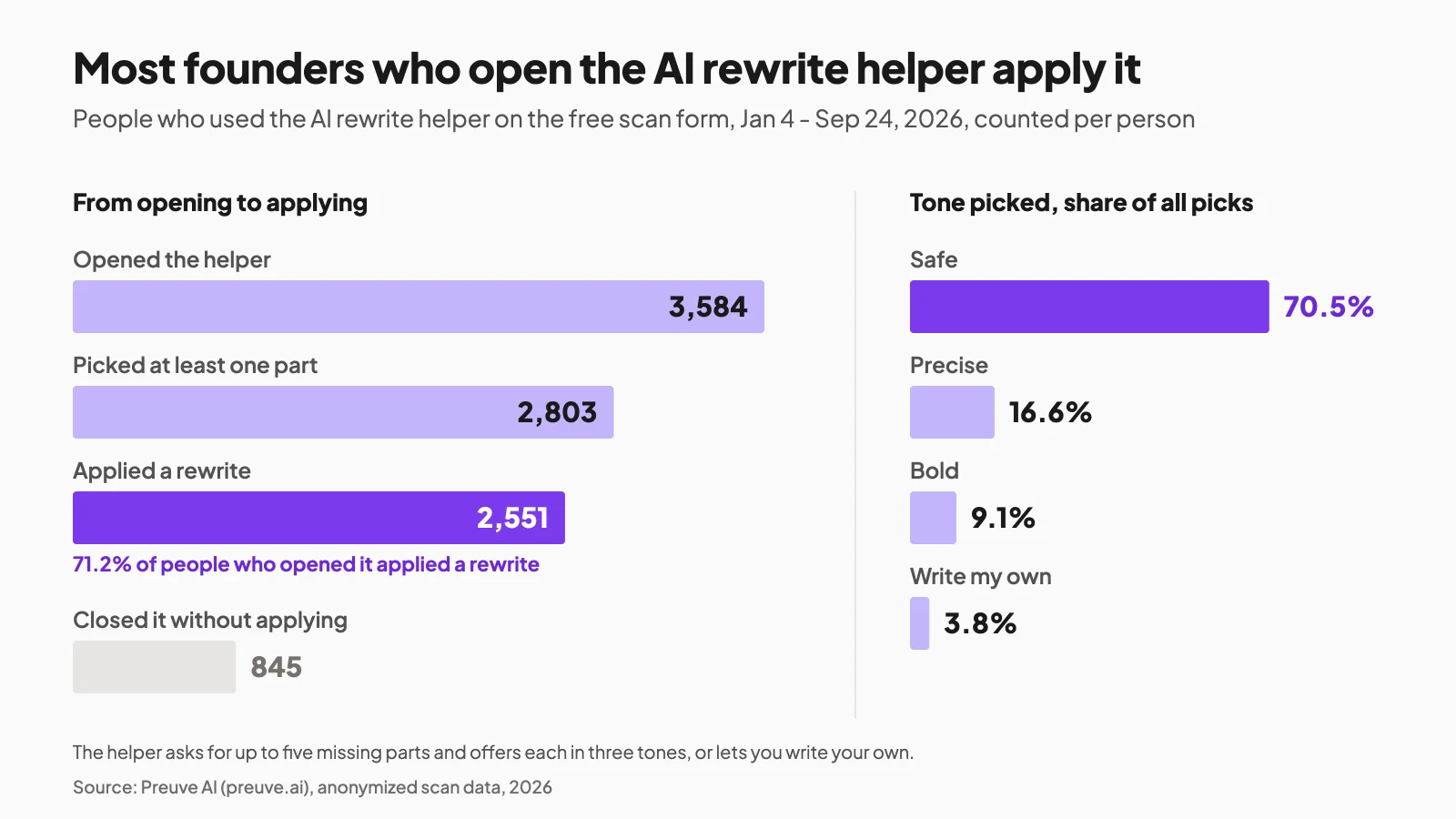
- One-liners get the most NO-GOs. Under the current rules, 31% of ideas under 150 characters got one, against 6% at 1,000 to 2,499. Before the rule change the gap pointed the same way, 12% against 6%.
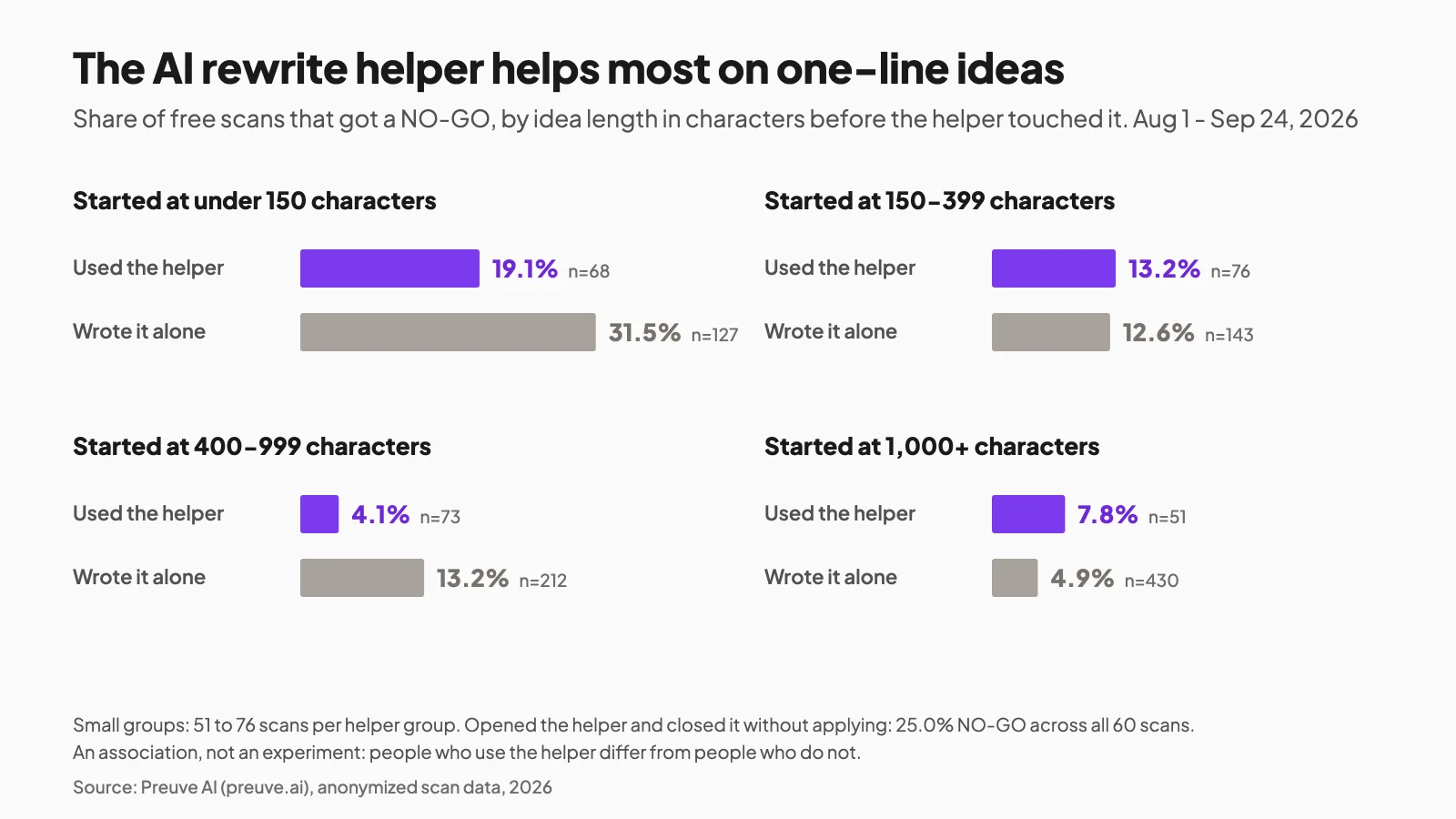
- One-liners written with the AI rewrite helper got fewer NO-GOs. Started under 150 characters, 19% got a NO-GO with the helper and 31.5% without. At the same final length, helper-written ideas scored a little lower.
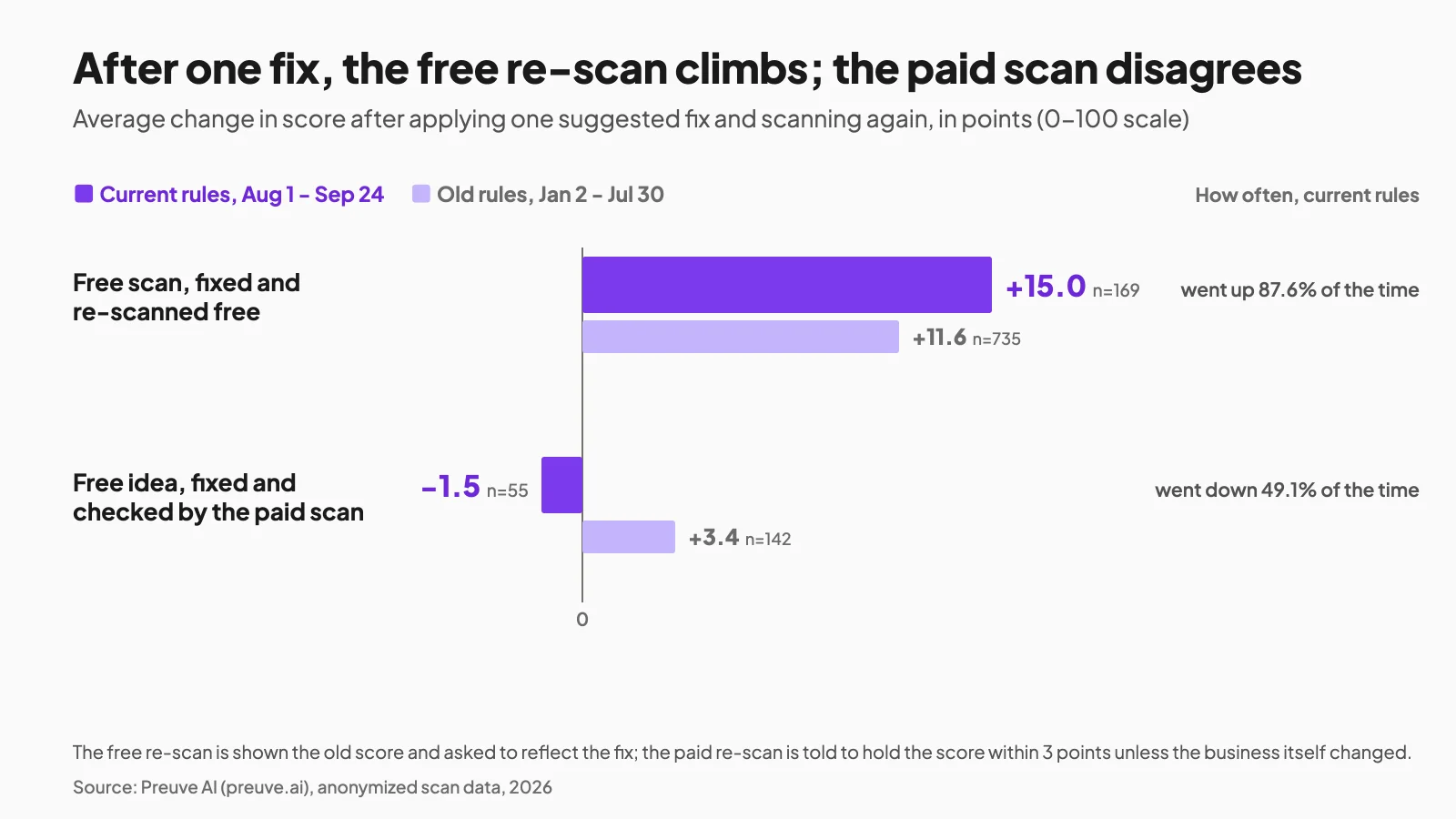
- A free re-scan gained 15 points on average. Improved free ideas later checked by the paid deep scan lost 1.5 points on average and went down 49% of the time. Part of the free gain is how the question is asked.
One free scan in ten describes the startup idea in under 150 characters, about half a tweet. Under the scoring rules in place since August 1, 2026, those one-liners got a NO-GO verdict 31% of the time. Ideas of 1,000 to 2,499 characters got one 6% of the time.
So I pulled the numbers on how you describe your startup idea. Of the 8,000+ ideas scanned on Preuve so far, 6,379 were free first tries that passed cleaning, from 5,118 accounts between January and September 2026. I also dug into what people did with the AI rewrite helper and the fix-and-re-scan button. Short version: detail wins, but only your own. AI helps most on a one-liner. It cannot write what only you know.
| Signal | Number | Source |
|---|---|---|
| Median idea length | 826 characters (10.7% under 150) | 6,379 free scans, Jan 2 to Sep 24, 2026 |
| NO-GO rate by idea length: under 150 / 150-399 / 400-999 / 1,000-2,499 / 2,500+ characters | 31% / 13% / 15.5% / 6% / 5% | 1,230 free scans, current rules (Aug 1 to Sep 24) |
| Assumptions the scan made, under 400 vs 1,000+ characters | 2.7 vs 1.35 per scan | 1,043 free scans since Aug 10 |
| AI rewrite helper: opened, applied | 3,584 people, 2,551 applied (71%) | Product analytics, Jan 4 to Sep 24 |
| NO-GO, one-liners with vs without the helper | 19% vs 31.5% | Free scans since Aug 1 started under 150 characters |
| Average score change after one fix: free re-scan vs paid check | +15 vs -1.5 points | Re-scans since Aug 1 (169 and 55) |
Short startup idea descriptions get a NO-GO far more often
Under the current rules (August 1 to September 24, 2026, 1,230 free scans), ideas under 150 characters got a NO-GO 31% of the time, against 6% at 1,000 to 2,499 characters and 5% past 2,500. Before the rules changed (January 2 to July 30, 5,149 scans) the direction was the same, only flatter: 12% for one-liners, 6% for long ideas.
The free scan ends on one of three verdicts: GO, CAUTION or NO-GO. Under the current rules a NO-GO means a score of 34 or below out of 100, and a GO means 75 or above. Of those 1,230 scans, 86.5% landed in CAUTION and 1.3% got a GO. A GO stays rare. The length effect lives in the NO-GO pile.
The scan has no length penalty. When the price, the buyer, the delivery or the way it makes money is missing, the scan says in the report what it had to assume. Ideas under 400 characters needed 2.7 assumptions on average, ideas over 1,000 needed 1.35.
Same pattern when the scan rates how complete the input is. Thin inputs got a NO-GO 25% of the time, rich ones 6%. The verdict can only score what it is told.
That does not make the one-sentence pitch wrong. A one-liner is written for a listener who can ask a follow-up question. A description you want judged, by a reader who cannot ask or by an AI scan, has to carry the buyer, the price and the delivery on its own, and one line rarely does.
How founders use the AI rewrite helper
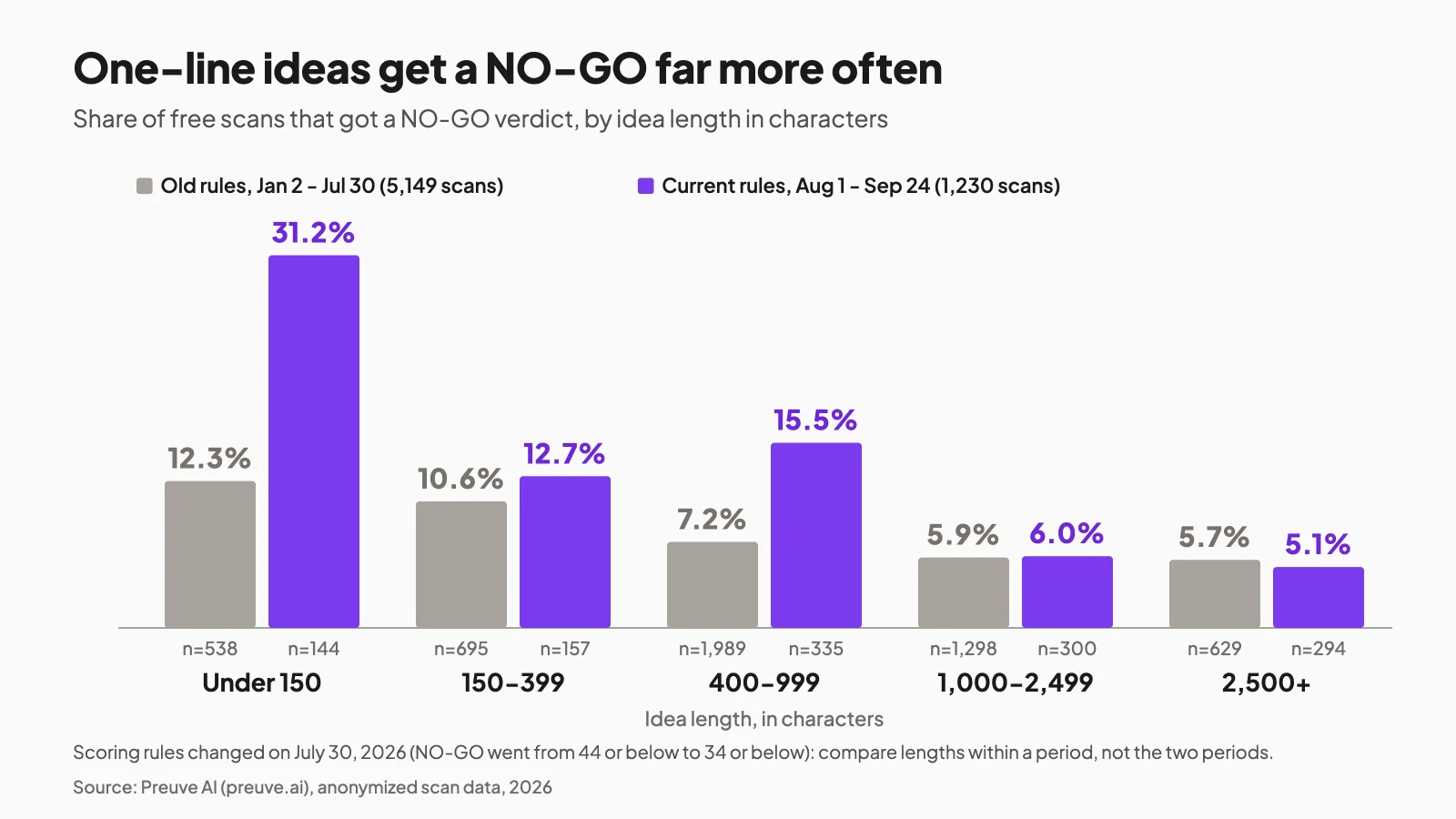
The free scan form has a helper that asks for up to five missing parts: who it is for, the problem, the solution, what makes it different, and how it makes money. For each part it offers three rewrites (safe, precise, bold), or you can write your own.
3,584 people opened it and 2,551 applied a rewrite, 71% of them. 69% of the closes came on the first step.
People open it on short ideas, a median of 260 characters, and almost only on free scans: since August 1, 268 free scans followed an applied rewrite, and almost no paid ones.
The safe tone won 70.5% of the picks. Precise got 17%, bold 9%, and 4% of picks were people writing their own.
Half of all applies took all five parts, and 62% used the AI wording word for word, while the other 38% changed at least one part before applying it.
Does an AI rewrite change the verdict?
An AI rewrite went with fewer NO-GO verdicts on one-line startup ideas, and made no clear difference once an idea ran longer. I grouped Preuve's free scans since August 1, 2026 by how long the idea was before the helper touched it, then compared people who applied a rewrite with people who wrote it alone.
Ideas that started under 150 characters got a NO-GO 19% of the time with the helper, against 31.5% for founders who wrote that length alone in this comparison. The helper turns a one-liner into about 750 characters.
Past that, it is mixed and the groups get small. At 150 to 399 characters it was 13% either way. At 400 to 999 it was 4% with the helper and 13% without, but only 73 helper scans sit in that group, and at 1,000 characters and up the helper group did slightly worse, 8% against 5%.
Compare ideas by their final length instead and the helper loses its edge. Finished between 400 and 999 characters, helper-written ideas got a NO-GO 18% of the time and founder-written ones 13%. The people who opened the helper and closed it without applying anything did worst of all, 25% NO-GO across 60 scans.
The helper fills blanks with text that sounds right. It cannot add the facts only you have, like who your buyer is, what you will charge, or the access you have that nobody else does. The groups are small, though, and people who use the helper differ from people who skip it, so this is an association, not an experiment.
What happens when you fix the idea after the verdict?
After one suggested fix, Preuve's free re-scan went up nearly nine times in ten. The paid deep scan often disagreed. After a report you can apply a suggested fix, the "Improve This Idea" button, and re-scan. About 15% of free reports and 20% of paid reports get one. 94% stop there.
Under the current rules (since August 1, 2026), a free re-scan gained 15 points on average and went up 88% of the time. NO-GO verdicts fell from 13% to under 1%.
Then I looked at the free ideas that were improved and later checked by the paid deep scan. The average change was -1.5 points, and the score went down 49% of the time.
Both re-scans are shown the old score. The free one is told to reflect the fix if the weakness it named got fixed, while the paid one is told to hold the score within 3 points unless the business itself changed. So part of the free gain is how I ask the question.
Low scores also have the most room to move. Across all free re-scans, ideas starting under 45 gained 24 points and ideas starting at 65 or above gained 1.5.
Among fixes tried at least 50 times, the ones that moved the free score most, all time, were zooming in on one use case (+15.6 points across 59 re-scans), a smaller niche (+12.3 across 293, the most used) and a narrow wedge (+12.1 across 271). That is score movement, not proof the business got better.
How should you describe your startup idea?
Describe a startup idea with seven facts, not one line: who pays, the painful problem, the price, how it is delivered, how you reach the first 10 customers, what people use today, and the one thing you know that others do not. The buyer, the price and the delivery are what the scan has to guess when you leave them out, and the last one is what only you can add.
Who pays. A specific person with a specific job, not "small businesses".
The painful problem. Say it the way that person would complain about it.
The price. A number and how often it is charged. "Affordable" is not a price.
How it is delivered. An app, a done-for-you service, a physical product, a marketplace.
How you reach the first 10 customers. Name the place they already gather. "Marketing" is not a place.
What exists already. What those people use today, even if it is a spreadsheet or a phone call.
The one thing you know that others do not. The access, the pattern you saw in your own work, the customer who already asked you for it. This is the part no rewrite helper can write.
Open the helper to see which blanks you left. Then throw away its safe wording and put your own facts in their place. When you are ready, run a free scan on your idea and read the list of what it had to assume. That list is your to-do. What the free check covers is on the idea validation page.
How this study was done
- Idea length and verdicts: anonymized data from 6,379 free scans by 5,118 accounts, January 2 to September 24, 2026, out of the 8,000+ ideas scanned on Preuve so far (the rest are paid scans, re-scans and the exclusions below). First submissions only, at most the first 10 scans per account; agency scans, scans sent from other apps, entries the scan could not score as an idea and accounts with more than 20 scans were left out.
- The AI rewrite helper: product analytics from January 4 to September 24, 2026, counted per person, with test traffic removed.
- Helper versus no helper: 1,240 free scans since August 1 that could be linked to whether the same person used the helper just before scanning.
- Fixes after the verdict: 1,220 re-scans from January 5 to September 24, 2026, agency and other-app scans left out.
Nobody read any idea. A script counted characters, verdicts, scores and which buttons were used, and no idea text left the database. Every figure here covers at least 50 scans or people. The scoring rules changed on July 30, 2026 (GO moved from 70+ to 75+, NO-GO from 44 or below to 34 or below), so every figure that depends on the verdict bands is split by period, with July 31 left out. The fix-by-fix and starting-score figures, marked "all time", cover every re-scan.
These are model verdicts, not startup outcomes. Associations, not experiments: nobody was assigned to a group, and nobody followed up on what happened to their businesses. How the scan itself works is in how Preuve AI validates startup ideas, and the wider score picture from the July edition is in my startup validation benchmarks.
Suggested citation: Forat, V. (2026). How to Describe Your Startup Idea: What 6,379 Scans Say. Preuve AI. https://preuve.ai/blog/how-to-describe-your-startup-idea
FAQ
How long should a startup idea description be?
Long enough to name the buyer, the price and how it is delivered. On the Preuve AI free scan, under the scoring rules in place since August 1, 2026, ideas under 150 characters got a NO-GO 31% of the time, against 13% at 150 to 399 characters, 15.5% at 400 to 999, 6% at 1,000 to 2,499 and 5% past 2,500. There is no length penalty: short descriptions leave out details the scan then has to assume, and it states each assumption in the report.
Does AI help write a startup idea description?
It helps most on a one-liner. Use it to find the blanks, not to fill them. For ideas that started under 150 characters, scans made with the AI rewrite helper got a NO-GO 19% of the time, against 31.5% for founders who wrote alone. But 62% of applied rewrites kept the AI wording word for word, and at the same final length helper-written ideas scored a little below founder-written ones. Replace the suggested wording with your own facts.
What should I include when I describe my startup idea?
Seven things: who pays, the painful problem, the price, how it is delivered, how you will reach the first 10 customers, what people use today, and the one thing you know that others do not. The buyer, the price and the delivery are among the details the scan has to assume when they are missing.
Does fixing my idea after the verdict raise the score?
On the free scan, yes: under the rules in place since August 1, 2026, a re-scan after one suggested fix gained 15 points on average and went up 88% of the time. When improved free ideas were later checked by the paid deep scan, the average change was -1.5 points. The free re-scan is told to reflect a fix that addresses the weakness; the paid one is told to hold the score within 3 points unless the business itself changed.
Did anyone at Preuve read the ideas in this study?
No. A script counted characters, verdicts, scores and which buttons were used, and no idea text left the database. No idea, person, company or country is named or described.

Vincent
5 years in B2B growth, building Preuve AI in public. 82% of ideas it scores aren't ready, the point is finding out in 10 minutes, not 3 months.
Follow on X →
Building is expensive. Validation is free.
Run your idea through 10 AI agents before you write a line of code. Every claim source-linked.