Key takeaways
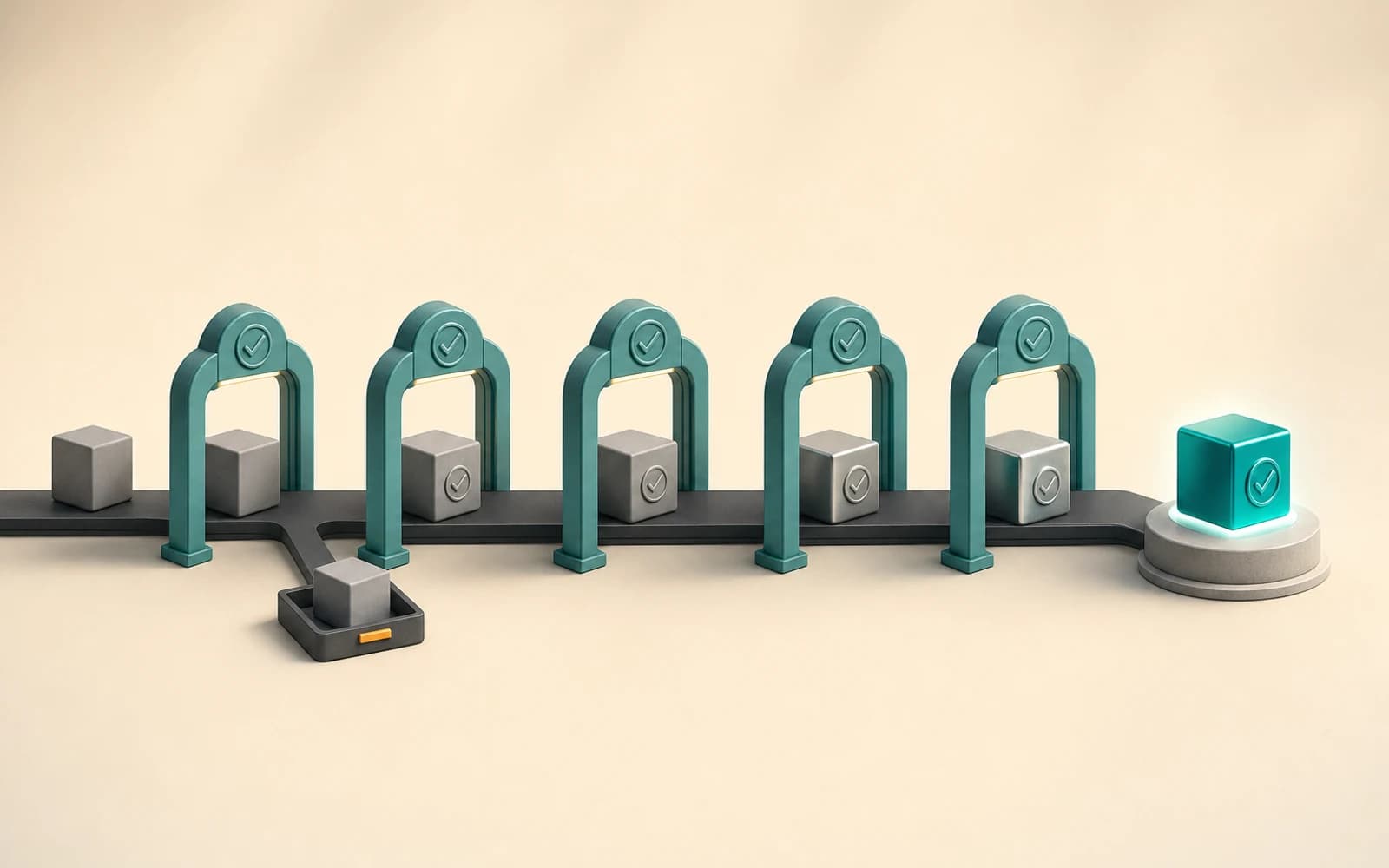
- Three ordered rungs replace an MVP: Desk evidence, conversation evidence, and commitment evidence answer the demand question in order, and the first one to fail ends the climb.
- Each rung has a blind spot the next rung covers: Desk data confirms the category but not the angle, conversations reveal pain but not switching behavior, and commitments prove intent but not retention.
- Stopping at desk evidence is the most common premature-validation mistake: Search volume and competitor presence confirm the category exists, not that a specific product will sell in it.
- No rung tests execution, retention, or unit economics: The ladder answers whether anyone wants the thing, never whether a given build of it works.
In CB Insights' 2014 post-mortem of 110 failed startups, 42% cited no market need, a figure their later research has since reframed. You can answer "does anyone need this?" before writing a line of code, in a few weeks instead of a few months.
The evidence ladder I use to validate an idea without building an MVP has three rungs, cheapest first, and each one carries a blind spot that test will never cover. If rung one kills the idea, you have lost an afternoon, not a quarter.

Will your idea survive the market?
Preuve AI runs 10 agents against live market data and links every claim to a source. Free analysis in 60 seconds.
Can you validate a startup idea without building an MVP?
Yes. Public data, five conversations with strangers, and one commitment test answer the demand question for a fraction of what an MVP costs. The catch is the order: each rung is more expensive than the last, and any rung can kill the idea before you reach the next one.
For the broader validation playbook, I wrote a complete guide to validating a startup idea. I also published specific pass/fail thresholds per test, with a cost and a time budget for each. Go there for what each test costs. This post covers the dimension neither of them does: the blind spot each rung can never cover, and which rung covers it.
How do you test an idea before building it?
Three rungs, cheapest first. Stop climbing the moment the evidence says no.
| Rung | What it proves | Pass bar | Blind spot |
|---|---|---|---|
| Desk evidence | The category exists and someone pays | Paid competitors exist AND the problem appears unprompted in 2+ independent channels | Whether your angle wins customers from the incumbent |
| Conversation evidence | Real buyers feel the pain and spend on workarounds | More than half of interviewees describe current spending on the problem without being prompted | Whether they will actually switch from what they use today |
| Commitment evidence | A cold stranger will put money behind the idea | At least 1 cold stranger deposits money, signs an LOI, or schedules a paid pilot | Whether the product retains users or unit economics work |
Read the last column first. Every rung is blind to something, and the rung above it is what covers that gap. That is the whole argument for climbing in order rather than picking the test that sounds most convincing.
Rung one: desk evidence
Start here, always. Search Google Trends or a keyword tool for the problem your idea solves. Read Reddit and Hacker News, plus whatever niche forum your target buyers hang out in, for strangers describing that problem unprompted. Check G2 or Capterra for existing competitors and read their negative reviews.
Pass bar: you can name at least one company charging real money for a related solution, and the problem appears in at least two independent channels where you did not plant it.
A sourced desk scan compresses this rung. I built Preuve AI to pull from 60+ live data sources in 60 seconds, covering search demand, competitors, and pricing in one pass.
Rung two: conversation evidence
Line up five problem interviews with strangers in the target segment. The question set matters more than the number of calls. I covered 15 questions and how to run a 20-minute session in my customer discovery interview guide.
Pass bar: more than half of interviewees describe what they currently spend on the problem, whether that is money, dedicated employee time, or manual workarounds, without you asking "would you pay for this?"
Rung three: commitment evidence
The test is a fake door, a pre-order page, or a letter of intent. I covered how to run a fake door and where it goes wrong in my fake door test guide.
Pass bar: at least one cold stranger takes an irreversible action. That means depositing money, signing an LOI, or scheduling a paid pilot. An email signup does not count.
For B2B, the letter of intent is often the right instrument. Approach a qualified buyer and describe the problem and the proposed fix. Ask them to sign a non-binding letter saying they would purchase if the product existed. One signed LOI from a decision-maker tells you more than a spreadsheet full of email addresses.


Skip weeks of manual research
Get complete market research, sourced proof, competitor map, and pricing data for your idea instantly.
What each rung cannot tell you
Every pre-build validation test has a specific question it cannot answer, no matter how well you run it. Desk research misses positioning fit, conversations miss switching behavior, and commitment tests miss retention. I have never seen another validation guide cover this in useful detail. I keep meeting founders who "passed" every test on the checklist and still launched into silence.
Ten paid competitors on your desk scan prove the category is real. They tell you nothing about whether your specific angle resonates with anyone who already pays an incumbent. Switching costs are invisible in public data, and switching costs are what kill a differentiated product in a crowded market.
Conversations close part of that gap, but they open a new one. Rob Fitzpatrick calls it the say-do gap in The Mom Test. An interviewee who says "I would pay $50 a month" has spent nothing but words, and words do not predict a wallet. The question of whether people will actually switch stays open after every interview.
Then commitment evidence. A pre-order proves a stranger will hand you money once. But it says nothing about retention or unit economics. Will they come back next month? Will the margins survive at scale? Only a shipped product answers those, and that is where the ladder stops.
The blind spots stack on purpose: desk data's gap becomes the question conversations answer, and conversations' gap becomes the question commitments answer. Retention is what is left over, and only a shipped product can settle it.

How do you validate an idea without code?
A startup idea can be validated without writing any code by using three types of evidence: public data from search tools and review sites, problem interviews over phone or video, and commitment tests run through a landing page builder or contract template.
"Without code" does not mean without testing. It means testing harder with cheaper instruments. Buffer's Joel Gascoigne validated the original Buffer concept in 2010 by putting up a pricing page before the product existed and watching who clicked through. A fake door with a real price on it.
If you want to start on rung one now, I built Preuve AI to scan 60+ live data sources in 60 seconds. The free Reality Check covers the desk-evidence rung in a fraction of the time it takes to do manually. It will not tell you whether people will switch or pay, only whether the category exists. Rungs two and three still have to happen.
FAQ
What can pre-build validation never tell you?
Three things, no matter how many rungs you climb: whether users come back, whether the unit economics work, and whether your team can actually execute the build. Every pre-build test measures wanting, not keeping. That is the honest ceiling of validating without building, and it is the reason a passing ladder is permission to start, not proof you will succeed.
Why does the order of the rungs matter?
Because each rung is blind to something the next one sees, and running them out of order means paying for an expensive test to learn something a free one would have told you. Desk evidence confirms the category but not your angle. Conversations surface real pain but not switching behaviour. Commitment tests prove someone will pay once. Climb in order and a dead idea costs you an afternoon instead of a quarter.
Is desk research enough to validate a startup idea?
Rarely. Desk research confirms whether the category exists and someone already pays to solve the problem, but it cannot reveal whether a specific product angle resonates, whether buyers will switch from incumbents, or whether pricing is right. Desk evidence is a filter that kills bad ideas early, not a complete validation on its own.
What is the difference between validating an idea and building an MVP?
Validation asks whether anyone needs the product badly enough to pay. An MVP asks whether a specific implementation of the product works. Both test a demand hypothesis, but validation skips the engineering entirely. The trade-off is that validation cannot test execution quality, user retention, or unit economics.
Cite this page
Last updated August 19, 2026
Forat, V. (2026, August 19). How to Validate an Idea Without Building an MVP. Preuve AI. https://preuve.ai/blog/validate-idea-without-building-mvp
Forat, Vincent. “How to Validate an Idea Without Building an MVP.” Preuve AI, 19 Aug. 2026, preuve.ai/blog/validate-idea-without-building-mvp.
Forat, Vincent. “How to Validate an Idea Without Building an MVP.” Preuve AI. August 19, 2026. https://preuve.ai/blog/validate-idea-without-building-mvp.
@misc{forat2026-validate-idea-without-building-mvp,
  author = {Forat, Vincent},
  title = {{How to Validate an Idea Without Building an MVP}},
  howpublished = {Preuve AI},
  year = {2026},
  month = aug,
  url = {https://preuve.ai/blog/validate-idea-without-building-mvp},
  note = {Last updated August 19, 2026}
}
Vincent
5 years in B2B growth, building Preuve AI in public. 82% of ideas it scores aren't ready, the point is finding out in 10 minutes, not 3 months.
Follow on X →
Building is expensive. Validation is free.
Run your idea through 10 AI agents before you write a line of code. Every claim source-linked.