
Key takeaways
- Almost nobody independent has reviewed it: Four written reviews exist anywhere, one of the six ratings on TheresAnAIForThat was posted by the founder himself, and most of what you find on Google is affiliate content. You are buying largely on the vendor's word.
- A problem database is not validation: BigIdeasDB surfaces complaints worth investigating. Knowing that users complain about email sync does not tell you whether your specific fix is worth building.
- The product is real and the pricing is honest: You can rent it at $49/month or buy it outright at $29, $199 or $349, sold as "Pay once, own forever. No hidden fees." Almost every rival is subscription-only, so having a lifetime option at all is a real advantage.
- It is a snapshot, not a live feed: The lifetime tiers hand you the complaints as they were mined; continuous updates sit on the $49/month plan. If you need a check on one specific idea rather than a broad browse, neither shape fits.
BigIdeasDB at a glance
BigIdeasDB sells access to a database of pre-mined user complaints, scored by AI, either monthly or as a one-time lifetime buy. I ran the free scan myself. The product is real. What to know first: almost no independent evidence about it exists.
- Founder
- Om Patel
- Company
- Pavado Technologies Inc.
- Location
- Ontario, Canada
- Selling since
- 2025
- Pricing
- $49/mo, or $29 / $199 / $349 lifetime
- Billing model
- Subscription or lifetime, your pick
- Trustpilot
- 3.2/5 (1 review)
- Independent reviews
- Almost none, anywhere
- Best fit
- Browsing pre-mined problems, once
- Skip if
- You need live data or validation
Bottom line: a real product, and one of the few here you can buy outright instead of renting, sitting on an evidence base almost nobody outside the company has ever tested.
Reviewed July 28, 2026 by Vincent, founder of Preuve AI.
I expected to write a harsher review than this one. The product held up; the evidence around it did not, because almost nothing is written about BigIdeasDB by anyone who is not paid to write it.
Disclosure: I built Preuve AI, which sits downstream of tools like BigIdeasDB, so I have bias. I have also cited their data in eight previous Preuve posts. It was useful to me, which is why I wanted to know what independent checking sits behind it.
How I checked, in one paragraph.
Read on July 28, 2026 unless dated otherwise, and re-checked on September 15, 2026. On October 26, 2026 BigIdeasDB's own prices had moved: Lite lifetime from $99 to $29, monthly Pro from $45 to $49. The BigIdeasDB prices below are the October ones. I ran the free scan and read the pricing page myself, then checked Trustpilot, Hacker News, Indie Hackers, the directory listings and six of the products named on their testimonial wall. I did not buy a paid tier, so everything behind the paywall is out of scope here.

Will your idea survive the market?
Preuve AI runs 10 agents against live market data and links every claim to a source. Free analysis in 60 seconds.
What is BigIdeasDB, and what does it show you?
BigIdeasDB scrapes user complaints from review platforms and app stores, then indexes them as searchable pain-point cards with severity ratings, frequency counts, and AI-written build verdicts. The tiers name G2, Upwork, Capterra, the App Store and Google Play as the sources feeding the database, plus revenue feeds like Stripe Index, a funded-companies database and a sell-side database at the top tier.
You buy access once and browse. There is no ongoing scan and no alerting. It is a snapshot of other people's complaints, indexed and scored. (It is often typed bigideadb, without the second s, which is how a lot of people search for it.)
The free path in is a scan you can run before paying, and it is a good demo. Mine came back in roughly ten seconds with a result screen announcing 180 validated problems and an opportunity score of 93 out of 100, over a counter reading "1M+ Data points scanned." Then a paywall. Ten seconds to a specific, non-generic-looking number is a better first impression than most tools in this category manage.
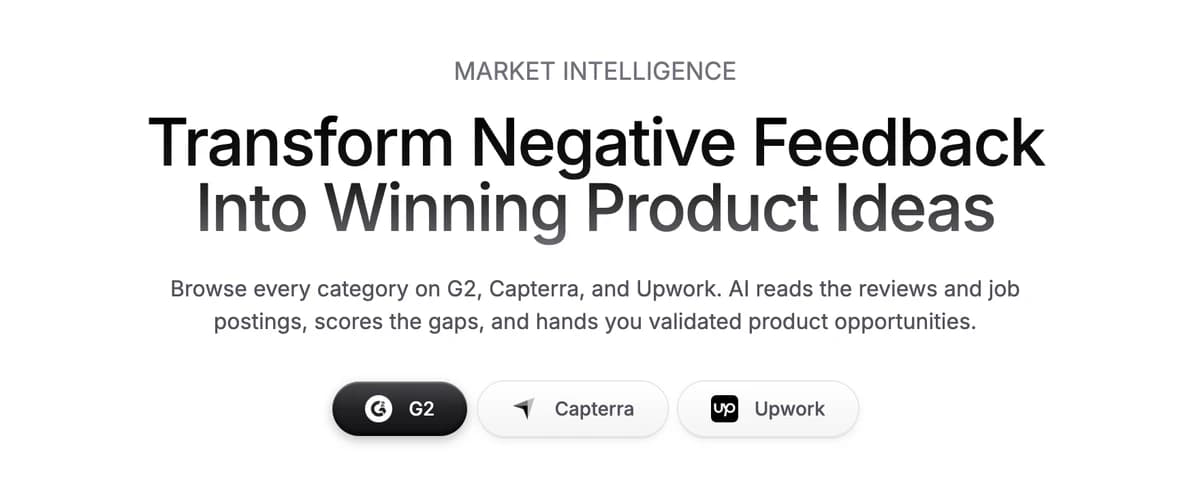
One inconsistency on that same screen, stated as the small thing it is: the result panel credits "29 Live data sources", while the marketing elsewhere on the site describes 10 sources. Both numbers are theirs, on the same visit, and they do not match. I have no way to tell which one counts the thing you are buying.
The product is run by Om Patel, a solo operator reported as 15 years old in a July 2025 We Are Founders profile, through Pavado Technologies Inc., a Canadian company that also operates Clairop and Linkeddit. I checked that company page directly. It is real, it lists the portfolio, and it publishes a working contact address.
What BigIdeasDB gets right
Everyone in this category rents you a login. BigIdeasDB will too, at $49 a month, but it is one of the very few that also lets you just buy the thing. Flip the pricing toggle from Monthly to Lifetime and the rental disappears. That is the most interesting thing about it, and it is worth doing the arithmetic out loud.
One year of access, same job, five price tags
- BigIdeasDB Lite, lifetime: $29, paid once, never again
- BigIdeasDB Pro, monthly: $49/mo = $588 a year
- Exploding Topics: $39/mo = $468 a year
- IdeaBrowser: $499 a year
- Buzzabout.ai: $50/mo = $600 a year
- SparkToro: $50/mo = $600 a year
Every line but the first is a rental: stop paying and the tool disappears. Their own monthly plan is the second most expensive option on this list. The $29 lifetime tier costs less than one month of it, and then never charges again. BigIdeasDB prices read October 26, 2026, the others July 28, 2026.
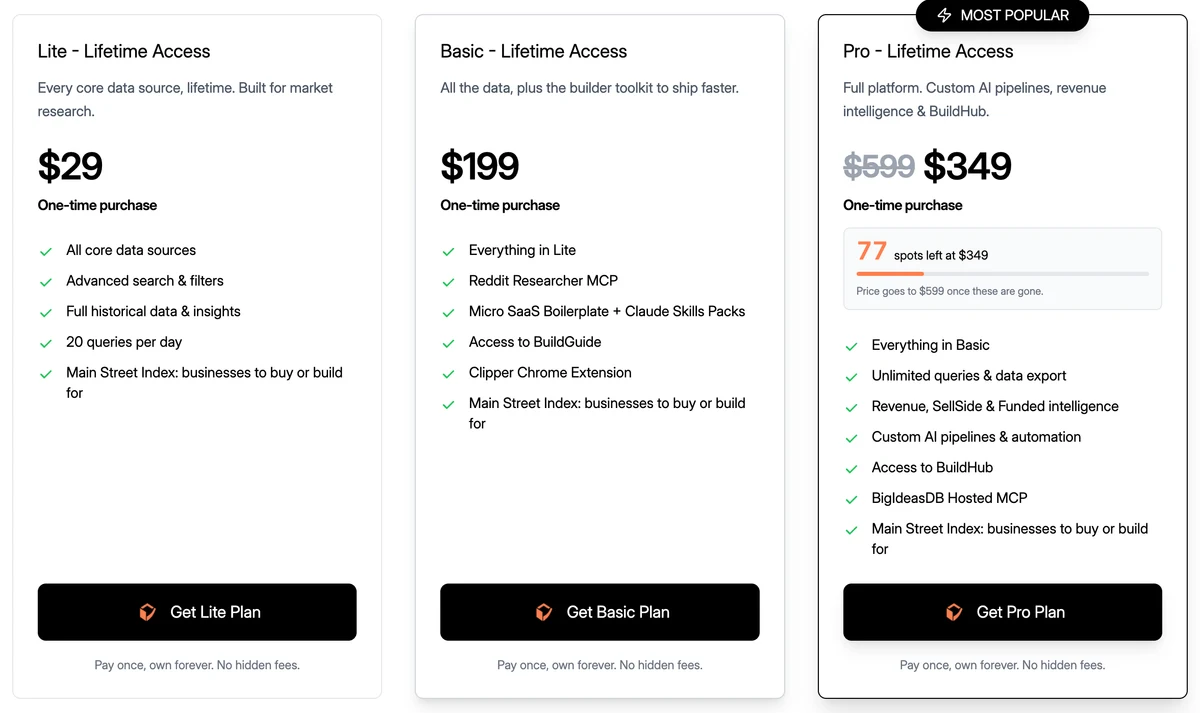
The full ladder, read live on October 26, 2026. Free gets you 16 tools and calculators, but not the database. Monthly Pro is $49, anchored against a struck-through $65, and it is the only tier promising continuous updates. Lifetime runs Lite at $29, down from $99 when I first read it in July, Basic at $199 and Pro at $349 against a struck-through $599 for a limited batch of spots, each carrying the same line: "Pay once, own forever. No hidden fees." In July a promo was running, code SHIPIT20 for 20% off Pro.
And the tiers are specific rather than hand-wavy, which is rarer than it should be at this price point. On lifetime, Lite and Basic cap you at 20 queries a day and Pro is unlimited. Basic adds the Reddit Researcher MCP, a micro-SaaS boilerplate, the Claude Skills packs and a Chrome clipper. Pro layers on the hosted MCP server, Revenue Intelligence, the sell-side and funded databases, and the Stripe Index. You can read the whole table before you pay.
Four other things hold up under pressure.
The MCP integrations are ahead of the category. A Reddit Researcher MCP and a hosted MCP server mean the data goes into your own agent workflow instead of being copy-pasted out of a web app. Almost nobody else here has shipped that.
The data is structured, not vibes. Every pain point arrives with a source platform, a frequency count and a severity score. Compare that to a tool like IdeasAI, which invents its ideas wholesale with no complaint data underneath. The free scan gets you to that structure in about ten seconds. Whatever else is true, this thing is built on top of something real.
Nobody says they paid and got nothing. Hacker News, Indie Hackers, Trustpilot, SourceForge, YouTube, every directory that lists it: not one non-delivery claim, not one scam allegation. The company behind it is real and registered, which I checked myself. The criticism that does exist is about differentiation and about paywalling scraped content, not about trust, and I am not going to blur those two.
One piece of the social proof is genuinely falsifiable. Instead of quote cards, part of the homepage shows unedited Stripe dashboards from founders, including Glossa.live at $19,036.65 net volume, up 88.23%. A raw dashboard is much harder to fake than a testimonial, and publishing one invites anyone to go check.
The testimonial wall itself is a more mixed result. None of the cards links out, so I picked six of the products named there and hunted each one down by hand. Score: two clean, three fuzzy, one I could not confirm. Falcon and JobsAICopilot check out fully, live sites and founder names corroborated independently. Cliqora and Finwise are real and live but positioned differently from what their card says. PitchWise is the clearest mismatch: the product tied to the named person is a deck-tracking and data-room tool, not the deck generator described. Andiamo, no verdict. Not one parked domain, not one invented company, which puts this wall far above the affiliate-video tier. It is also not six for six.
The real blind spot: almost nobody has reviewed this
This is the finding that matters most for a buyer, and it took the longest to establish. The entire independent written record on BigIdeasDB is four reviews. Here is the whole footprint, read July 28, 2026.
- Trustpilot: 3.2/5, one review, 1 star
- TheresAnAIForThat: 4.0/5, six ratings, three with text, one of those posted by the founder
- SourceForge: one review, 1 star, same complaint as the Trustpilot one
- GeniusFirms: 3.5 from 21 reviews, text locked behind a login
- SaaSHub, Toolify, Futurepedia: listed, zero reviews each
- Product Hunt: no launch. Reddit: no thread
That last one stings given the pitch. A tool built substantially on mined Reddit complaints has never, as far as I can find, been discussed in a Reddit thread of its own.
The two positive reviews are both worth reading. A 5-star from June 2026 says the funded and sell-side datasets are where it "really clicked." A 4-star from May 2026 likes it as a starting point but finds the "validation side feels a bit surface level." That is roughly where I landed too. The third rating with text, dated July 14, 2025, is a 5-star posted by Om Patel, the founder: "@BigIdeasDB helps people get...bigger, winning ideas." His name and verified badge are on the card, so nothing is hidden, but it is still one of the six ratings making that 4.0 average.
Before anyone over-reads the Trustpilot score: the platform weights new profiles toward the mean, which is why one 1-star review shows as 3.2 rather than 1.0. BigIdeasDB is not gaming that. Here is the review and the company's reply, both unedited.
I cancelled my subscription when I signed up for the free trial and they blacklisted my email and cancelled my access. Awful behaviour, I've never seen this before. My recommendation is don't use this. Petty owner.
We have never provided a free trial on our product. You have never used our product. Our lawyers will be in contact thanks.
I am not adjudicating that. I have no way to know what happened between those two parties, and one review is thin evidence in either direction. The SourceForge review describes the same sequence, so it may well be the same person writing twice.
What fills the gap instead is affiliate content. Two YouTube "reviews" run word-for-word identical scripts and carry the same tracked link, bigideasdb.com/?via=olayinka, with 23 and 34 views. MakerStack scored it 7.1/10 in June 2026 and is the most even-handed write-up out there, but MakerStack's own homepage sells this exact service: "Get Your Review · $49." The We Are Founders piece reads as a genuine interview with real quotes and a named byline, but the same site sells paid tool placements. All checked July 28, 2026.
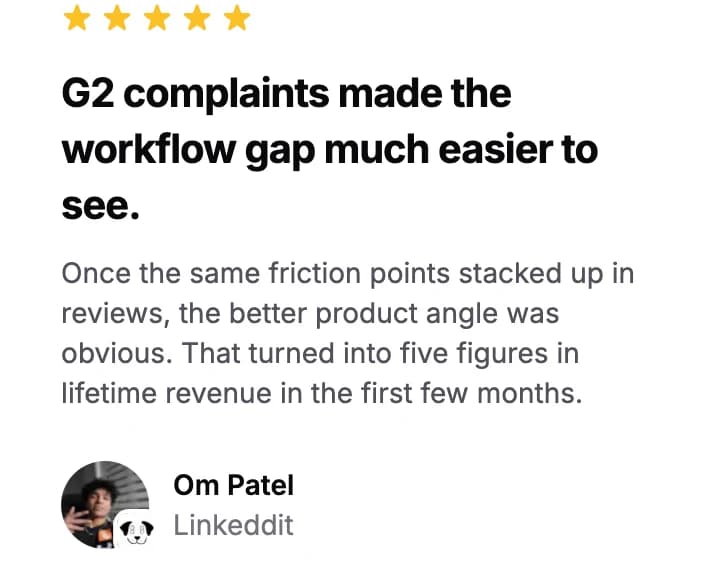
One last fact: a five-star card on the testimonial wall is the founder reviewing his own product, signed "Om Patel, Linkeddit" after his other company, with no mention of either link.
Do the revenue figures add up?
The founder publishes his own numbers, which is more than most operators in this category bother to do. Two of those public records cover the same month and do not show the same figure. Both pages are his, and I read both on July 28, 2026. The first is a post on his X account, dated December 31, 2025, quoted here in full:
I made $8,681 in December 2025 as a 16 y/o
BigIdeasDB — $7,021
Linkeddit — $1,269
Twitter — $391
highest revenue month ever.
2026 is going to be better.
The second is his public founder page on TrustMRR. TrustMRR is a revenue tracker that founders connect to their Stripe account so the numbers are pulled rather than typed. With the range selector on "Last 12 month," covering August 2025 through July 2026, the page showed $1,025 for December 2025 and a headline total of $8,165 for the whole twelve-month window. Both records are founder-level totals across his products, which is what makes them readable against each other: same operator, same month, $8,681 on one page and $1,025 on the other.
The caveat is a real one, not a formality. TrustMRR only reflects the accounts a founder chooses to connect to it. Revenue taken through a different Stripe account, through another processor entirely, or through a channel that was never wired up would not appear on that page. That could explain part of the gap, and it could explain all of it. I cannot see which accounts are connected, and I am not going to guess at it.

Skip weeks of manual research
Get complete market research, sourced proof, competitor map, and pricing data for your idea instantly.
How does BigIdeasDB compare to alternatives?
The closest direct alternative is PainMap, at $29 to $49 per month, which mines live data instead of serving a static snapshot. Past that the category spreads out fast, from pre-mined databases like IdeaBrowser through live mining at Buzzabout.ai, trend detection at Exploding Topics, keyword alerting at Syften, and audience research at SparkToro. Prices run from free to $2,999 per year. I keep a running comparison of startup validation tools if you want the wider list. All figures below were verified live on July 28, 2026 (BigIdeasDB re-read October 26, 2026), except IdeaBrowser and PainMap, whose pricing pages did not load for me; those two are triangulated from secondary sources.
| Tool | Price | Data source | Best for |
|---|---|---|---|
| BigIdeasDB | $49/mo, or $29 to $349 lifetime | Scraped review and app-store complaints | One-time browse of pre-mined complaints |
| IdeaBrowser | $499 / $1,499 / $2,999 per year | Curated + research agent | Ongoing curation at a premium price |
| Exploding Topics | $39 / $99 / $249 per month | Trend detection | Spotting rising demand early |
| SparkToro | Free / $50 / $150 / $300 per month | Audience research | Finding where an audience already gathers |
| Buzzabout.ai | $50 / $150 / $350 per month | Social listening | Live conversation, not pre-mined data |
| Syften | $29.95 / $49.95 / $119.95 per month | Keyword monitoring | Real-time mention alerts |
| PainMap | $29 to $49 per month or credits | Live mining | The closest direct competitor |
| IdeasAI | Free | 100% Grok-generated | Contrast: no real data at all |
| GummySearch | Unavailable | Reddit, shut down November 30, 2025 | A cautionary data point about Reddit-research tools |
Read that price column vertically and BigIdeasDB's case makes itself. PainMap positions directly against it and publishes its own comparison page, pitching live data against a static database. That is a real trade-off, and which side you want depends on whether you are researching once or continuously. GummySearch, which mined Reddit, shut down on November 30, 2025. Worth remembering when a tool's entire dataset lives on someone else's platform, whichever side of the trade-off you land on.
Who BigIdeasDB is for, and who it is not for
Buy it if you want a browsable snapshot of pre-mined complaints, you prefer one payment to a subscription you will forget to cancel, and $29 is money you can spend on research without needing it back. Take the monthly plan instead only if the continuous updates are the point, and diary the cancellation. Take the demo call first if you are unsure, since it is the closest look at the real data before you pay. If you work with agents, the MCP integrations on the Basic and Pro tiers are the part most likely to earn the price on their own.
Skip it if you need live or repeatable data, if you want alerting rather than browsing, or if you already have a specific idea and want to know whether that one is worth building. The last case is the most common one, and it is a different job entirely.
A database like this sits at the discovery layer. It answers "what problems exist," which is a real question, and BigIdeasDB answers it competently. It is just not the question that decides anything. Knowing that 21 of 28 email clients have sync complaints does not tell you whether your fix is worth building, size a market, or map who is already there.
Preuve AI is what I built for that next step. It scans TAM, competitors and demand signals across 60+ live data sources, with a free scan that returns in under a minute and a $59 Founder tier for the full report. The honest sequence is to pull a raw pain point from a database like BigIdeasDB, then run it through Preuve before you write a line of code. Different jobs, in order. For the longer version of how I think about it, I wrote a guide to validating a startup idea that predates this review.
My verdict: is BigIdeasDB worth it?
3.8 out of 5. This looks like a good product. I ran the free scan and read every page they publish, but I did not pay, so I am rating what a buyer can verify before handing over $29, not the paid database itself. What holds it just short of a 4 is not the software, it is how little there is around it for a buyer to check it against.
The credit first, because it is the larger half. The free scan is fast and specific. The tier comparison tells you what you get before you pay rather than after. The MCP integrations are ahead of most of the category. The data comes back structured, with a source platform and a severity score attached, not as AI-written suggestions dressed up as research. And the pricing is the most straightforwardly honest thing about the whole product: one payment, no renewal, no hidden fees, at a floor that costs less than one month of most competitors. Plenty of tools in this space charge $49 a month forever for less. If you buy the $29 tier and use it, you are unlikely to feel cheated.
The reason it stops short of 4 is that you are buying almost entirely on the vendor's own word. Four independent written reviews exist anywhere: two critical ones describing the same complaint, and two positive ones on a single directory. What ranks when you search the product's name is affiliate content wearing a reviewer's face. The testimonial wall cannot be clicked through to check anything, one of the five-star cards on it is signed by the founder under his other product with no mention of the link, and a sixth of that directory's rating count is a five-star the founder posted himself. And the December 2025 revenue figure posted on X is not the figure his own connected TrustMRR page shows for that month, a gap that an unconnected payment account could partly explain and that neither page resolves. None of that makes the product worse than it is. It means an ordinary buyer has no outside evidence to weigh, and at a $29 lifetime entry point that is a real, if survivable, thing to accept going in.
If BigIdeasDB's independent review count grows, or if anything above is wrong or has changed, email me at reviews@preuve.ai and I will re-check and update this post. That offer is open to the company as much as to anyone else.
Sources
Sources reviewed for this analysis: bigideasdb.com free scan, pricing page, tier comparison and testimonial wall, browsed directly on July 28, 2026; Trustpilot profile (1 review, 3.2/5, read July 28, 2026); TheresAnAIForThat profile (4.0/5, 6 ratings, read July 28, 2026); SourceForge listing (1/5 review, read July 28, 2026); SaaSHub, Toolify, Futurepedia, GeniusFirms and Uneed listings (read July 28, 2026); Product Hunt, Capterra and AlternativeTo searches (no listing found, July 28, 2026); Hacker News posts via HN Algolia API (7 posts, read July 28, 2026); Indie Hackers post by Om Patel (July 2025); trustmrr.com/founder/om_patel5 public founder page, headline total and monthly hover values on the "Last 12 month" range (read July 28, 2026); x.com/om_patel5, including the December 31, 2025 revenue post quoted in full (read July 28, 2026); YouTube search for "bigideasdb" (two affiliate-template videos identified, read July 28, 2026); MakerStack review (7.1/10, June 2026); We Are Founders profile (July 2025); pavado.ca company page (read July 28, 2026); direct checks of six products named on the BigIdeasDB testimonial wall (falconresearch.xyz, jobsaicopilot.com, cliqora.com, pitchwise.se, tryfinwise.com, andiamotrips.com, all read July 28, 2026); competitor pricing pages for Exploding Topics, SparkToro, Buzzabout.ai, Syften, IdeasAI, and GummySearch (all read live July 28, 2026), with IdeaBrowser and PainMap pricing triangulated from secondary sources after their pricing pages failed to load. Every claim above is linked to its primary source.
FAQ
What is BigIdeasDB?
BigIdeasDB is a searchable database of user complaints scraped from review platforms and app stores, including G2, Capterra, Upwork, the App Store and Google Play. An AI scores each gap and writes a build verdict. It is operated by Pavado Technologies Inc. in Ontario, Canada, and has been selling since 2025.
How much does BigIdeasDB cost?
Three ways to pay, read live on October 26, 2026. Free gets you 16 tools and calculators but not the database. Pro is $49 per month, anchored against a struck-through $65. Under the Lifetime toggle, three one-time tiers: Lite at $29 (down from $99 in July), Basic at $199, Pro at $349 against a struck-through $599, each carrying the line "Pay once, own forever. No hidden fees."
Is BigIdeasDB legit?
Yes, on the evidence I could gather. It is a real product from a registered company, Pavado Technologies Inc. in Ontario, Canada. The free scan works, the tier comparison is specific, and no scam or non-delivery allegation appears anywhere in public reviews as of July 2026. The caveat is that almost no independent review of it exists, so there is very little outside evidence to check the product against.
Is BigIdeasDB worth it?
At $29 lifetime, it is a reasonable price for a browsable snapshot of pre-mined complaints, and one payment beats their own $49 per month if you only need the data once. It is not worth it if you need live data, ongoing alerts, or a way to check one specific idea rather than browse other people's.
Does BigIdeasDB have a free trial?
There is a free scan that returns a problem count and an opportunity score in about ten seconds before hitting a paywall, plus a permanent Free tier giving you 16 tools and calculators, though not the database itself. On Indie Hackers the founder wrote: "I unfortunately had to remove the free trial because of the amount of people abusing it." You can also book a demo call before buying.
What do BigIdeasDB reviews say?
There is barely a corpus to read. Trustpilot shows 3.2/5 from a single 1-star review, TheresAnAIForThat shows 4.0/5 from six ratings, one of which is a 5-star rating posted by the founder himself in July 2025, and SourceForge carries one 1-star review describing the same complaint as the Trustpilot one. SaaSHub, Toolify and Futurepedia each list the product with zero user reviews. All read July 28, 2026.
What are the best BigIdeasDB alternatives?
PainMap ($29 to $49 per month) is the closest direct competitor, mining live data instead of serving a static database. Exploding Topics ($39 to $249 per month) does trend detection, SparkToro (free to $300 per month) does audience research, and Buzzabout.ai ($50 to $350 per month) covers social listening. All prices read July 28, 2026.
Cite this page
Last updated October 26, 2026
Forat, V. (2026, October 26). BigIdeasDB Review (2026): What $29 Buys You. Preuve AI. https://preuve.ai/blog/bigideasdb-review
Forat, Vincent. “BigIdeasDB Review (2026): What $29 Buys You.” Preuve AI, 26 Oct. 2026, preuve.ai/blog/bigideasdb-review.
Forat, Vincent. “BigIdeasDB Review (2026): What $29 Buys You.” Preuve AI. October 26, 2026. https://preuve.ai/blog/bigideasdb-review.
@misc{forat2026-bigideasdb-review,
  author = {Forat, Vincent},
  title = {{BigIdeasDB Review (2026): What \$29 Buys You}},
  howpublished = {Preuve AI},
  year = {2026},
  month = oct,
  url = {https://preuve.ai/blog/bigideasdb-review},
  note = {Last updated October 26, 2026}
}
Vincent
5 years in B2B growth, building Preuve AI in public. 82% of ideas it scores aren't ready, the point is finding out in 10 minutes, not 3 months.
Follow on X →
Building is expensive. Validation is free.
Run your idea through 10 AI agents before you write a line of code. Every claim source-linked.