Key takeaways
- Validated means every claim maps to evidence: A named source, a date, a sample size or method, and a falsifiable version the investor can check independently.
- The centerpiece artifact is a validation evidence table: One row per material claim, with columns for claim, evidence type, source + date, how the investor checks it, and what would disprove it.
- Negative findings strengthen a raise: A risk you found and addressed is more credible than a deck with zero red flags, which investors read as incomplete research.
- Deck versus data room: The deck carries 3-5 headline claims with inline citations. The evidence table, raw data, and interview transcripts live in the data room where diligence happens.
Most pre-seed decks I read say "we have validated demand" somewhere on slide 3 or 4. The phrase carries zero information, so it gets skimmed past. If you want to show investors your idea is validated, show what "validated" means on paper: every claim with a source, a date, and a sample size, or the investor does the math themselves and you lose control of the narrative.
This post is about one artifact: a validation evidence table you build before the meeting and hand over during diligence. I already covered whether you are ready to raise, and I wrote a separate guide on structuring the deck itself. What follows is the evidence standard underneath both: what a validated claim looks like line by line, how to source and date it, and what to do when one of your findings is negative.

Will your idea survive the market?
Preuve AI runs 10 agents against live market data and links every claim to a source. Free analysis in 60 seconds.
What counts as proof that an idea is validated?
Startup validation evidence is documentation that maps every material claim in a pitch to a verifiable data point with a named source, a collection date, and a defined failure threshold. "Strong demand" is not evidence. Neither is "huge market" or "growing interest." Those are adjectives, and an investor who has heard every variation this week cannot distinguish yours from the last founder's.
Each piece of evidence needs four properties. First, a named source, not "industry reports" but "IBISWorld HVAC Services report, June 2026." Second, a date. My own rule is that I discount anything older than 12 months and treat anything past 24 months as background, not evidence. Third, a sample or method: 15 buyer interviews, 2,400 survey responses, a Google Keyword Planner export. And finally a falsifiable version of the claim, a sentence stating what result would disprove it if the evidence came back differently.
A Wefunder analysis (March 2026) breaks investor evaluation into a stronger/weaker evidence grid. Paid pilots, customer retention, and repeat usage rank as strong. Waitlists, press coverage, and vague letters of intent rank as weak. The dividing line is always the same: can the investor verify the claim without asking you a follow-up question?
I use a simple test on my own copy. Take any sentence from the deck or memo and try to append a parenthetical with a source name and a date. If you cannot, the claim is an opinion you believe, fine for your own conviction, but not for someone writing a check.
The validation evidence table
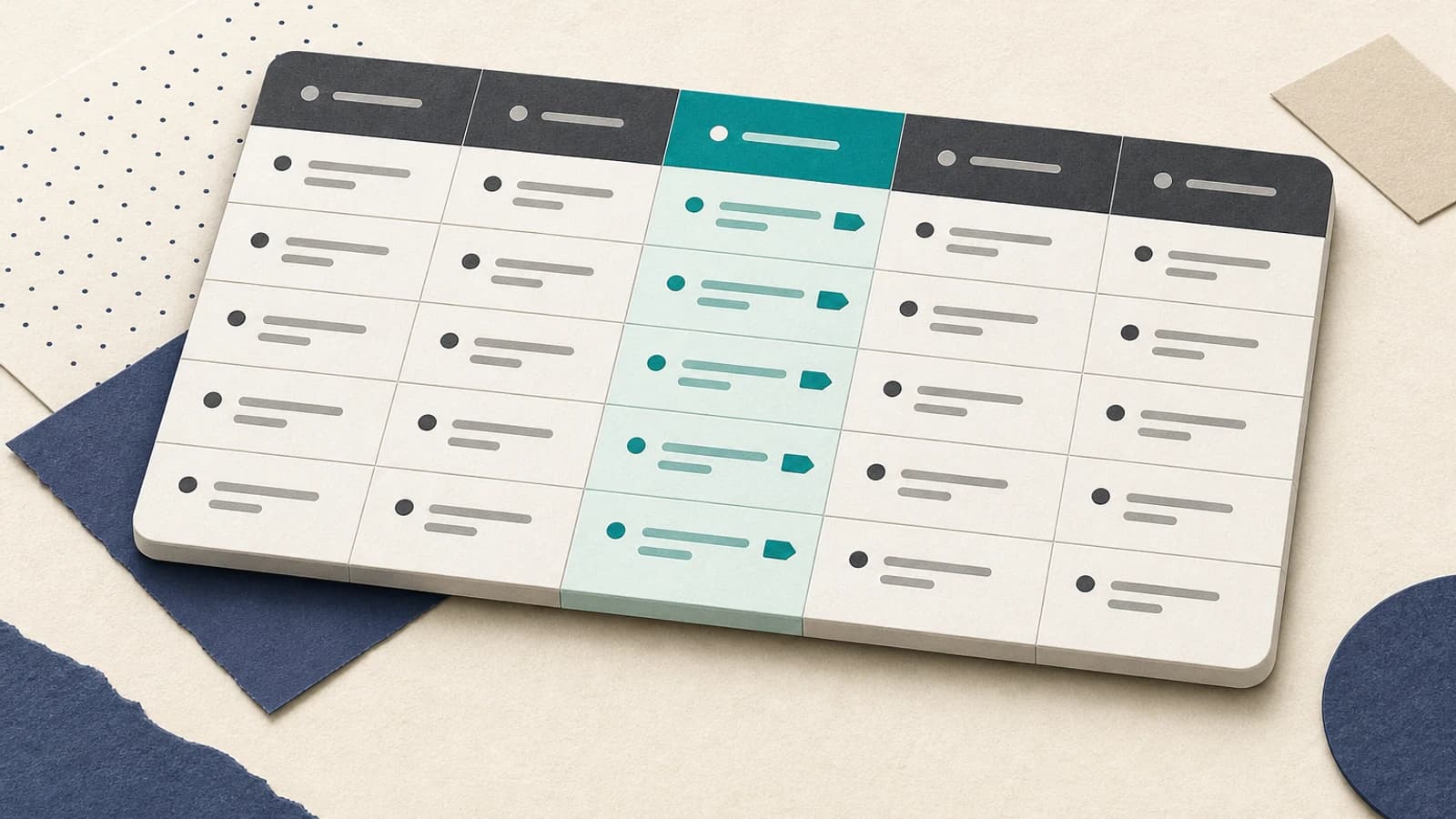
This table is the deliverable you build before the pitch and link from the data room after it. One row per material claim, five columns, and every row must be complete before the claim earns a spot in your deck. A row with blanks means the claim either needs more research or should not be in the pitch at all.
| Claim | Evidence type | Source + date | How investor checks it | What would disprove it |
|---|---|---|---|---|
| 12 of 15 pilot companies converted to paid at $800/mo | Revenue / pilot data | Stripe dashboard export, Q2 2026 | Ask for the Stripe export or reference call with 2 pilots | Conversion rate below 50% or average contract value below $500/mo |
| US HVAC services market is $35B | Market sizing (top-down sanity check) | IBISWorld HVAC report, June 2026 | Google the IBISWorld report number | TAM below $5B or declining more than 5% YoY |
| SAM is $2.1B (mid-size commercial HVAC in 12 metro areas) | Market sizing (bottom-up) | Census Bureau County Business Patterns + company pricing, July 2026 | Recalculate from Census data and compare | Fewer than 8,000 firms in the segment or price assumption off by 2x |
| 15 of 20 interviewees named scheduling as their #1 pain | Customer discovery | Founder interviews, May-June 2026, notes in data room | Read 3-4 interview transcripts, call one reference | Fewer than 10 of 20 naming the same pain, or pain ranked below billing/dispatch |
| No direct competitor offers AI-based dispatch for mid-size commercial | Competitive map | G2 + Capterra search, Crunchbase, July 2026 | Search G2 "HVAC dispatch software," check Crunchbase | A funded competitor with more than $2M raised targeting the same segment |
| 420 waitlist signups with 38% from organic search | Demand signal | Landing page analytics (Plausible), Jan-July 2026 | Ask for analytics screenshot or live dashboard access | Fewer than 200 signups or more than 80% from paid ads (not organic intent) |
The rule for every row in the table: if the investor cannot verify the claim without asking you a follow-up question, the claim is not ready for the deck. That rule applies to market sizing, customer interviews, traction metrics, and competitive analysis equally.
Nobody writes the fifth column, which is exactly why it carries the most weight. When you state what would disprove a claim, the investor reads it as evidence that you thought hard enough to know the failure condition. That signal matters more than the claim itself: it says you will not burn their capital ignoring data that contradicts your thesis.
I wrote a full post on how to validate with sourced data that covers the sourcing discipline behind each row. The table above is the investor-facing format of that same discipline.
How do you show validation in a pitch deck?
An investor spends an average of 3 minutes 44 seconds on a seed deck and 4 minutes 10 seconds on a pre-seed deck, according to DocSend data compiled by HummingDeck (February-March 2026). You do not have time to walk through a full evidence table slide by slide. The deck is not the evidence. The deck is the argument that makes the investor want to see the evidence. How to run the underlying research is its own job, and I covered that in the pitch deck guide.
The table maps to the deck one row at a time:
Problem slide.
One claim from your customer-discovery row. "15 of 20 HVAC operators named scheduling as their #1 pain (founder interviews, May-June 2026)." The parenthetical is the citation. It takes six words and changes the slide from an assertion to a fact.
Market slide.
Your bottom-up SAM row, with the source visible on the slide. "$2.1B SAM (Census Bureau County Business Patterns + company pricing, July 2026)." I covered why bottom-up always beats top-down in the pitch deck guide.
Traction / validation slide.
Your strongest demand-signal row. "12 of 15 pilots converted to paid at $800/mo (Stripe, Q2 2026)." If you do not have revenue, the strongest signal you do have: waitlist with source breakdown, LOIs with contract value, or pre-sales count.
Competition slide.
Your competition row. Named alternatives, not a 2x2 matrix where you are magically in the top-right corner. Source: "G2 + Crunchbase, July 2026."
Each slide carries exactly one claim from the evidence table, with the source inline. The full table, the raw data, and the interview transcripts live in the data room where the investor goes after the meeting, not in the deck itself.


Skip weeks of manual research
Get complete market research, sourced proof, competitor map, and pricing data for your idea instantly.
What do investors check first in due diligence?
A Harvard Business School survey of 885 institutional VCs (cited by SeedForge, May 2026) found the founding team was cited as an important factor by 95% of firms, business model by 74%, and market by 68%. But the team signal is tested live in conversation, not in documents. The claims investors actually verify in your data room, before the second meeting, are the ones on paper: market, traction, and the competitive picture.
Investors run three checks against every claim in your evidence table: source verification, recency, and falsifiability. A claim that fails any one of these gets mentally tagged as "needs follow-up," which slows the process and taxes conviction.
Source verification. Can they find the report, dataset, or person you cited? "Industry reports" fails. "IBISWorld HVAC Services #23822, June 2026" passes. If an investor Googles your source and gets nothing, every other claim in the deck is now suspect.
Recency. Is the data from the last 6-12 months? Market conditions in 2026 look nothing like 2023. A Wefunder data room guide (December 2025) flags stale financials as one of the most common friction points. The same applies to market data.
Falsifiability. Did you state what would disprove the claim? A founder who writes "conversion below 50% would invalidate this signal" is telling the investor they stress-tested their own thesis. An AngelHub due diligence checklist (February 2026) lists customer validation as a standalone item, with the strongest form being "actual revenue" and the weakest being "customer interviews expressing interest." The gap between those two is the falsifiability gap.
Every follow-up question you force the investor to ask is friction you could have prevented by filling in the source column before the meeting.
How do you present negative findings without killing your raise?
This is the section none of the pitch-deck guides write, and it is the one that matters most to investors who have seen a hundred decks with zero red flags.
When a deck lands in my inbox and every single finding is positive, my read is that the founder stopped looking after the first green signal. Investors reach the same conclusion. A SeedForge analysis (May 2026) makes the same point from the investor side. Its pre-pitch checklist asks whether you have an honest model with defensible assumptions, and whether you have stress-tested the failure cases out loud. Both questions assume you went looking for weaknesses and found some. Neither one asks you to hide them.
I use the same format for every negative finding in my own evidence tables:
The negative-finding format
- What you tested. "We ran 20 cold outreach emails to property managers in Q1 2026."
- What the result was. "Response rate was 4%, below the 8-10% we needed for the channel to work at our target CAC."
- What you changed or why the risk is bounded. "We pivoted to referral partnerships with HVAC distributors, which produced 3 warm intros per week at zero CAC."
That three-line structure does a lot of work. The investor sees that you test assumptions instead of confirming them, and that you can kill a channel when the numbers say to, which is a founder-judgment signal most decks never demonstrate. The replacement evidence keeps the thesis intact, so the negative finding closes a door without opening a hole.
In your evidence table, negative findings get their own rows. The "claim" column becomes: "Cold outbound to property managers is not a viable primary channel." The "evidence type" column is the test result. The "what would disprove it" column flips: "Response rate above 8% with a different subject line or list would reopen the channel." That row is not a weakness. It is proof of operational rigor.
What goes in the deck versus what stays in the data room?
Founders overload decks with evidence because they worry the investor will never open the data room. In practice, a well-sourced claim in the deck is exactly what pulls an investor into the data room to verify it. A 30-row table crammed onto one slide has the opposite effect: they skim it, process none of it, and move on.
The split is simple:
| Lives in the deck | Lives in the data room |
|---|---|
| 3-5 headline claims, one per relevant slide | Full validation evidence table (8-12 rows) |
| Inline citation per claim (source name + date) | Source documents, reports, datasets |
| One customer quote on the problem slide | Full interview transcripts or notes |
| Headline traction metric | Stripe export, analytics dashboard screenshots |
| Named competitors with positioning gap | Competitor funding, pricing, G2 reviews, feature matrix |
| Bottom-up SAM with source | Full TAM/SAM/SOM calculation with Census data and assumptions |
A Wefunder data room guide walks through what belongs in one. My own rule is narrower: a data room does not create trust, it makes trust cheap to verify. The deck builds interest, and then the data room closes the deal by letting the investor confirm that every claim is real and the sourcing holds.
If you are pre-revenue, most of your evidence table will be market research, customer interviews, and demand signals. That is fine, because at pre-seed the grade is not ARR but whether you did the research at all and can point to where every number came from. A sourced validation report fills those rows for you. I built Preuve to cover the market sizing, competitor mapping, and demand-signal rows with every number linked to its source. I made the pipeline scan 60+ live data sources because the alternative is 20-35 hours of manual research before you can fill those rows, and most founders skip the research entirely and show up with unsourced claims.
How to build the table from what you already have
You probably have more evidence than you think. The problem is usually not missing data. It is data that sits in scattered places without the structure that makes it usable in a pitch.
List every claim in your current deck or memo. Open the deck. Highlight every sentence that asserts something an investor could question. "Large and growing market" is a claim. "We solve scheduling" is not, it is a description.
For each claim, fill in the source and date columns. If you cannot name the source, the claim is unsupported. Either find the source, run the research, or cut the claim. An unsourced claim in a pitch is worse than no claim because it signals you did not do the work.
Write the falsifiable version. For each claim, finish the sentence: "This claim would be wrong if ___." That sentence forces you to think about the failure mode, which is the exercise investors do mentally anyway. You might as well do it first and have the answer ready.
Add the "how investor checks it" column. This is the verifiability test. If the answer is "trust me," the claim needs a better source. If the answer is "Google the report number" or "call one of three reference customers," the claim passes.
Aim for 8-12 finished rows. A row only counts when all five columns are filled, so a table of twenty half-filled rows is weaker than one with eight complete ones. Which topics deserve a row is a readiness question I handle in the pre-seed checklist linked above. If you find gaps, a free validation scan can generate the market sizing, competitor mapping, and demand-signal rows with sourced data in under 60 seconds. For founders who want the complete investor deliverable, the $499 Investor Package is the one place you can hire me directly: you opt in, and I build your pitch deck and investment memo from your own report, founder-built and reviewed, with every claim sourced and dated. Every other tier stays 100% AI. No human reads your idea to score it.
FAQ
What does "validated" mean to a pre-seed investor?
Validated means every material claim in your pitch, problem severity, market size, demand signal, competitive gap, maps to a specific piece of evidence with a named source, a date, and a method or sample size. Investors do not accept adjectives like "strong demand" or "huge market" without a citation they can verify independently.
How many pieces of validation evidence do I need before pitching?
Count finished rows, not topics covered. A row is done when all five columns are filled: the claim, the evidence type, the source with its collection date, how an investor checks it without asking you, and what result would disprove it. Eight to twelve complete rows typically carries a pre-seed pitch, and a table of twenty half-filled rows is weaker than one with eight finished ones, because every incomplete row is a follow-up question you handed the investor. Which topics those rows should cover is a separate readiness question.
Should I include negative findings in my validation evidence?
Yes. A risk you discovered and addressed is stronger evidence than a deck with no red flags. Investors read a zero-risk pitch as incomplete research, not as a sign of a perfect idea. Present each negative finding as: we tested X, the result was Y, and here is what we changed or why the risk is bounded.
What is the difference between the deck and the data room for validation?
The deck carries 3-5 headline validation claims with inline citations, one per slide or as a traction slide summary. The data room holds the full evidence table, raw interview notes, survey data, source documents, and anything the investor needs to verify a claim independently. Think of the deck as the argument and the data room as the footnotes.
How do investors verify the validation claims in my pitch?
Investors run three checks: source verification (can they find the report, dataset, or person you cited?), recency (is the data from the last 6-12 months?), and falsifiability (did you state what would disprove the claim, and is that test reasonable?). Claims that fail any of these three checks get discounted or flagged for follow-up.

Vincent
5 years in B2B growth, building Preuve AI in public. 82% of ideas it scores aren't ready, the point is finding out in 10 minutes, not 3 months.
Follow on X →
Building is expensive. Validation is free.
Run your idea through 10 AI agents before you write a line of code. Every claim source-linked.