Key takeaways
- Best free tools, 2026: ValidatorAI (free quick scores), Rapidly (lean canvas), Preuve AI (sourced report), IdeaProof (40 credits, one scored validation), MiskMap (60-second verdict), Trend Seeker (Reddit demand), and IdeaValidator (PRD generation).
- Free-tier depth varies wildly. ValidatorAI cites no sources. Before you trust a free score, click one of its claims and see if it opens a page you can read.
- Most free tools are a single LLM call. Without retrieval grounding they hallucinate factual claims; only tools with live data pipelines cut that risk.
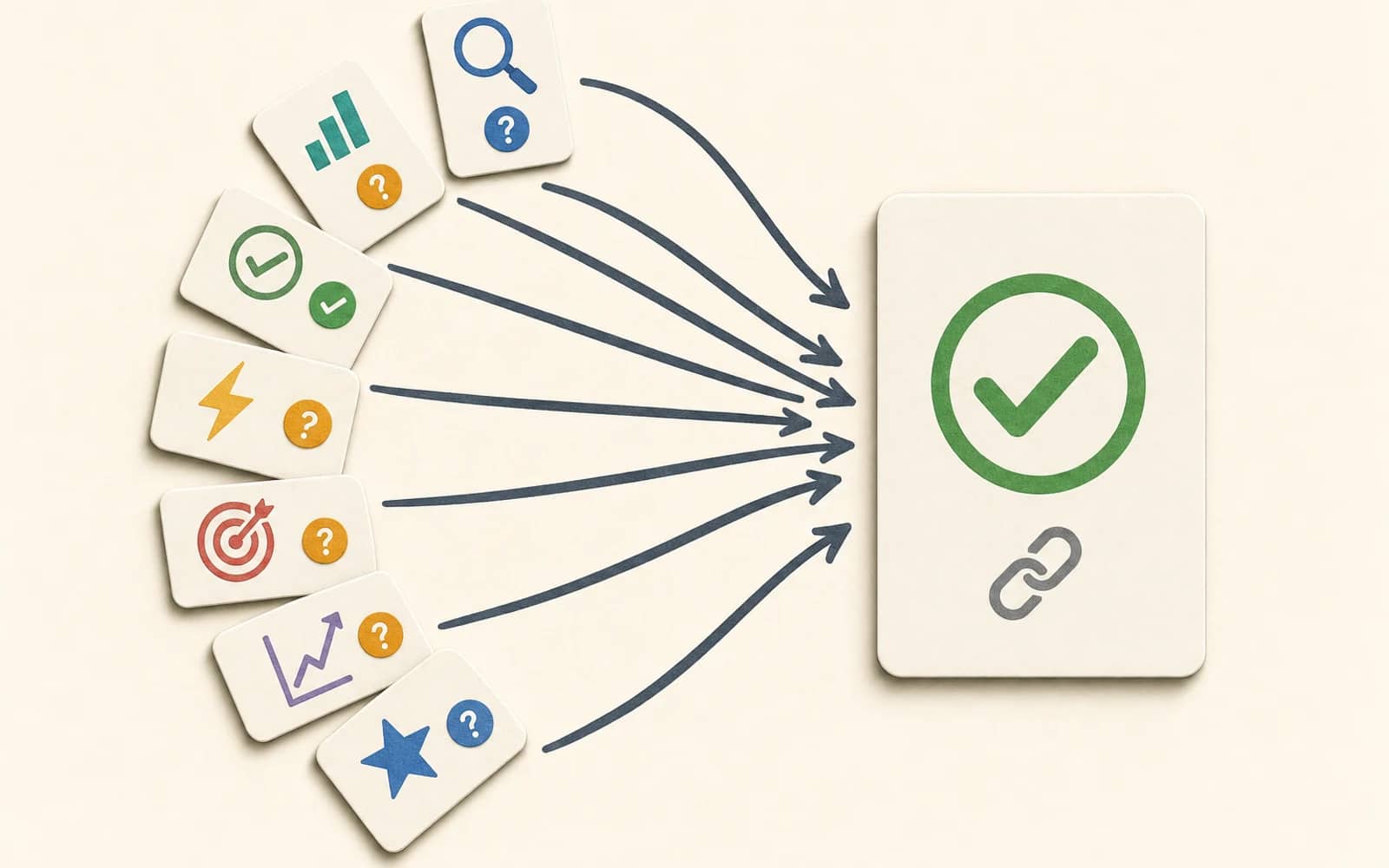
- The smart play is stacking. Gut-check on ValidatorAI, demand signals on Trend Seeker, sourced report on Preuve AI. Total cost: $0.
I tested every free idea validation tool I could find. Most do the same thing: wrap a single GPT call in a nice UI and hand you a score. Some do more. A few do something useful for $0. I built an idea validation tool myself, so I read these outputs the way a builder does.
Here is what you actually get when you click "validate free" on each tool. Not what the landing page promises. What the output looks like when you read it.

Will your idea survive the market?
Preuve AI runs 10 agents against live market data and links every claim to a source. Free analysis in 60 seconds.
What are the best free tools to validate a startup idea?
I tested seven tools by running the same idea through each one: "an AI-powered meal planning app for people with food allergies." Here is what each free tier returned.
| Tool | Free tier | Output quality | Sources cited? | Signup required? |
|---|---|---|---|---|
| ValidatorAI | Free | Score + short prose critique | No | Yes (Google sign-in) |
| Rapidly | Unlimited, no signup | Lean canvas + hypotheses + experiment | No | No |
| Preuve AI | 2 free scans | Viability score + market overview + competitors + blockers | Yes, every claim | Yes |
| IdeaProof | 40 credits (1 validation) | Score + GO/NO-GO signal | No | Yes |
| MiskMap | Unlimited, no signup | Viability score + BUILD/PIVOT verdict | No | No |
| Trend Seeker | Free basic | Demand score matched against 50K+ Reddit posts | Yes (Reddit posts) | No |
| IdeaValidator | 50 credits/month | Score + 4 dimensions + PRD generation | No | Yes |
I wrote a full breakdown of paid options in my best startup validation tools comparison. This post focuses on what $0 gets you.
Can AI really validate a business idea for free?
Yes and no. AI tools can surface useful signals: competitor names, rough market sizing, demand indicators from search and social data. For $0 that is real value. Three years ago you would have paid a consultant $5,000 for a worse version of what these tools output in 60 seconds.
The catch is evidence quality. Most free validators run your idea through a single LLM call. The model generates plausible-sounding analysis from its training data, not from live research. A 2024 Stanford HAI study found that general-purpose LLMs hallucinate factual claims at non-trivial rates without retrieval grounding. That means the competitor your free tool named might not exist, the market size it cited might be invented, and the "growing demand" it flagged might be flat.
I built Preuve AI to fix this problem. Every claim in the report links to the source it came from, so you can click through and verify it yourself. Not because I think AI validation is fake, but because I think unverifiable AI validation is dangerous when you are about to spend six months of your life building something.
What do you actually get on the free tier of each tool?
This is the section no other comparison post writes, because it requires running each tool and reading the actual output. Here is what I found.

1. ValidatorAI - free with a Google sign-in, no sources
ValidatorAI is one of the best-known free validators, and it claims 300K+ founders. The free output is a score (0-100), a short prose critique, and some suggested next steps. It costs nothing, but scoring now needs a Google sign-in and a bot check. It also offers 21 single-shot tools, from a market size estimator to a pivot assistant.
Where it falls short: the output cites zero sources. When I ran my test idea, it named three competitors. One did not exist. The market sizing felt plausible but I could not verify it. ValidatorAI is good for a 30-second gut check. It is not good for a build decision.
2. Rapidly - free lean canvas, experiment-first
Rapidly takes a different approach. Instead of scoring your idea, it generates a lean canvas, testable hypotheses, and a first experiment you can run. The methodology is pretotyping, created by Alberto Savoia at Google. No signup, completely free, 6,000+ ideas validated on the platform.
Where it falls short: no viability score, no competitor analysis, no market sizing. Rapidly answers "what should I test first?" not "is this worth building?" If you already know you want to run experiments, it is excellent. If you want a verdict, look elsewhere.
3. Preuve AI - free sourced viability report
I built Preuve AI so I will be direct about what the free tier does and does not include. The free scan runs 10 AI agents across 60+ live data sources and returns a viability score, market overview, competitor previews with real names and pricing, and a list of blockers. Every claim links to the source.
Where it falls short: the free tier is a filter, not the full picture. The 19-section deep analysis, pivot directions, and bank-ready plan PDF are behind the $59 Founder Report. The free scan tells you whether your idea has obvious blockers. It does not tell you how to fix them.
4. IdeaProof - 40 free credits, broad but unverified
IdeaProof gives new users 40 free credits with no credit card required. Each validation costs 40 credits, so that is one full run. Its pricing page lists that run as a score and a GO/NO-GO signal, and puts TAM/SAM/SOM and competitors in the Market Analysis step at 50 credits. They claim 89% prediction accuracy, 10,000+ founders, and 27,000+ validated ideas, and they support 18+ languages.
Where it falls short: the "89% accuracy" claim is self-reported. I could not find independent verification. The report carries a few inline citations, but the market sizing and competitor data arrive unlinked. Paid credit packs are one-time, not a subscription, and start at €19.99 for 150 credits.
5. MiskMap - instant BUILD/PIVOT verdict
MiskMap is the fastest free option. No signup, no credit card, viability score in 60 seconds. The output includes a score (0-100), competitor breakdown, revenue projections, risk assessment, and a clear BUILD/PIVOT/DON'T BUILD recommendation. They claim 1,000+ founders have used it.
Where it falls short: no cited sources for any of the analysis. The "revenue projections" are AI-generated estimates, not grounded in verifiable market data. MiskMap is great for a quick directional signal. Treat the numbers as hypotheses, not facts.
6. Trend Seeker - Reddit demand matching
Trend Seeker does something none of the others do: it matches your idea against 50,000+ real Reddit posts where people asked for something similar. The score breaks into two dimensions: post volume (how many people want this) and idea similarity (how close existing solutions are). A high volume with low similarity suggests an underserved market.
Where it falls short: the free tier gives you the score and matched posts but locks AI insights (strengths, risks, suggestions) behind the $9.99/month premium. Reddit demand is a real signal but it skews toward tech-savvy audiences. If your market is offline-heavy (think HVAC or dental practices), Reddit signals will undercount real demand.
7. IdeaValidator - 50 free credits/month with PRD
IdeaValidator scores across four dimensions (Market Opportunity, Competitive Density, Execution Complexity, Monetization Fit) and can generate a 17-section Product Requirements Document. Free users get 50 credits monthly, enough for several evaluations at 10 credits each. Available in English and Arabic.
Where it falls short: the PRD generation costs 50 credits, which burns an entire month's free allotment in one shot. Pro is $14.99/month. The scoring feels thorough but, like most tools here, does not cite the data behind its market opportunity estimates.
Skip weeks of manual research
Get complete market research, sourced proof, competitor map, and pricing data for your idea instantly.
How accurate are free AI idea validators?
The honest answer: accuracy is the wrong framing. No tool can predict whether your startup will succeed. The useful question is whether the output gives you claims you can verify.
I ran the same meal-planning idea through all seven tools and checked their competitor lists against reality. ValidatorAI named one competitor that does not exist. MiskMap gave revenue projections with no methodology. IdeaProof produced TAM numbers I could not trace to a source. Preuve AI named six real competitors with verifiable pricing. Trend Seeker showed me actual Reddit threads where people asked for what I described.
The pattern is clear: tools with live data pipelines produce verifiable output. Tools running a single LLM call produce plausible output. Plausible is fine for brainstorming. It is not fine for a decision that costs you six months. In Preuve's own data from 6,000+ analyzed ideas, around 8 out of 10 score below the launch-ready threshold. I did not build a tool that flatters you, and I am skeptical of tools that do.
What are the limitations of free validation tools?
Every free tier has the same three gaps. Knowing them in advance saves you from over-trusting the output.
1. Depth stops at the surface. Free tiers tell you whether an idea "looks good" in broad strokes. They skip the detailed work: competitive pricing analysis, channel-level demand breakdowns, financial modeling, actionable next steps. That deeper layer is what paid tiers sell, because it costs real compute to generate.
2. No tool replaces customer conversations. CB Insights' analysis of startup failures found that 42% failed because they built something nobody wanted. A validation tool can tell you the market exists. It cannot tell you that the specific person you are building for will pay. That requires talking to 10-20 strangers in your target market, and no AI tool does that for you yet. For a framework on how to do those conversations, I wrote a guide on customer discovery questions for founders.
3. Free tools optimize for volume, not for you. Most free validators are lead-gen funnels. The free output exists to get you into their email list or upsell you to a paid plan. That does not make them useless, but it means the free output is designed to be interesting enough to hook you, not thorough enough to inform you.
How do I stack free tools for a complete validation?
No single free tool covers every dimension. But three of them together do a reasonable job for $0. Here is the stack I would use if I were starting fresh today.

The $0 validation stack
- ValidatorAI (30 seconds): quick gut check. If it scores your idea below 50 and the critique resonates, save yourself time and move to the next idea.
- Trend Seeker (2 minutes): demand reality check. Are real people on Reddit asking for what you want to build? High post volume + low idea similarity = underserved market signal.
- Preuve AI free scan (60 seconds): sourced viability report. Real competitors with real pricing, market overview, blockers. Every claim links to a source you can verify.
If all three are positive, you have a real signal: an AI thinks the idea scores well, real people are looking for it, and the competition has gaps. That is worth a deeper look, either a $59 full Preuve AI report or the manual work of talking to 10-20 potential customers.
If they disagree, pay attention to why. Trend Seeker showing zero Reddit demand for a B2B compliance tool does not mean the demand is fake, it means the demand lives on LinkedIn and industry forums, not Reddit. Context matters more than any single score.
Which free idea validation tool has the best evidence?
I am biased here and I will be upfront about it: I built Preuve AI because I wanted the tool I describe below.
The evidence hierarchy across free tiers looks like this:
- Preuve AI: every claim sourced with a clickable link. Market data from live research across 60+ sources. You can verify every finding.
- Trend Seeker: links to actual Reddit posts. The demand signal is real and verifiable, but narrow to Reddit audiences.
- IdeaProof: structured output with TAM/SAM numbers and a few inline citations, but most claims arrive unlinked. Claims multi-model cross-validation.
- Everything else: single LLM call, no sources. Useful for brainstorming, not for evidence.
If you are deciding whether to spend the next six months of your life on an idea, you deserve to see the receipts. That was the first design decision I made when building Preuve AI and it is the one I am most stubborn about. Run the free sourced scan and check for yourself.
FAQ
What is the best free tool to validate a startup idea in 2026?
For a free tool that cites real sources, Preuve AI gives you a sourced viability report at no cost. ValidatorAI offers free quick scores with a Google sign-in, but with no citations. For Reddit demand signals, Trend Seeker is free at the basic level. The best approach is to stack 2-3 free tools for a more complete picture.
Can AI really validate a business idea for free?
AI tools can surface useful signals for free: market sizing estimates, competitor names, demand indicators. But most free tiers run a single LLM call with no live data, which means the output can hallucinate competitors, invent market sizes, or miss recent entrants. Tools with live research pipelines (Preuve AI, Trend Seeker) reduce this risk. No tool replaces talking to real customers.
How accurate are free AI idea validators?
Accuracy claims vary. IdeaProof claims 89% but this is self-reported with no independent verification. A 2024 Stanford HAI study found general-purpose LLMs hallucinate factual claims at non-trivial rates without retrieval grounding. The only way to check accuracy is whether you can verify the claims yourself, which means checking if the tool cites sources you can click.
Are free idea validation tools enough or do I need a paid one?
Free tools are enough to kill a clearly bad idea or confirm strong demand signals. They fall short on depth: most free tiers skip competitive pricing, detailed market sizing, and actionable next steps. If you are making a build-or-quit decision, stack 2-3 free tools first, then invest in one paid report for the idea that survives.
Cite this page
Last updated October 9, 2026
Forat, V. (2026, October 9). 7 Free Idea Validation Tools for 2026. Preuve AI. https://preuve.ai/blog/free-idea-validation-tools-2026
Forat, Vincent. “7 Free Idea Validation Tools for 2026.” Preuve AI, 9 Oct. 2026, preuve.ai/blog/free-idea-validation-tools-2026.
Forat, Vincent. “7 Free Idea Validation Tools for 2026.” Preuve AI. October 9, 2026. https://preuve.ai/blog/free-idea-validation-tools-2026.
@misc{forat2026-free-idea-validation-tools-2026,
  author = {Forat, Vincent},
  title = {{7 Free Idea Validation Tools for 2026}},
  howpublished = {Preuve AI},
  year = {2026},
  month = oct,
  url = {https://preuve.ai/blog/free-idea-validation-tools-2026},
  note = {Last updated October 9, 2026}
}
Vincent
5 years in B2B growth, building Preuve AI in public. 82% of ideas it scores aren't ready, the point is finding out in 10 minutes, not 3 months.
Follow on X →
Building is expensive. Validation is free.
Run your idea through 10 AI agents before you write a line of code. Every claim source-linked.