
Key takeaways
- Competitors always exist, So the real question is not whether they exist, but whether they are beatable.
- Demand first. If no one searches for the problem, competitors do not matter, there may be no market.
- Map, do not list. Roughly 70% of public SaaS companies are new versions of older ideas (SaaStr, 2023); a competitor table reveals gaps a Google search hides.
- Run findings through a decision tree. Weak competitor reviews plus high search demand point to a beatable gap worth attacking.
To know if your startup idea already exists, assume it does and check whether anyone executed well enough to own the market. Founders who submit ideas to Preuve's idea validation tool see a list of competitors and freeze. "It's taken." "Taken" is not a binary. The question is not whether someone else had the idea. It is whether they own the market.
Jason Lemkin put it well: "You really think you're the only person on the entire planet that has tried to do this? It's the Fermi Paradox of startups." His "2-60-Google Rule" says if two cofounders spend 60 minutes Googling and find no competitor at scale, move forward. That rule tells you whether a giant exists. It does not tell you whether the market is beatable, saturated, or empty for a reason. Here is the structured check I use instead.

Will your idea survive the market?
Preuve AI runs 10 agents against live market data and links every claim to a source. Free analysis in 60 seconds.
How Do I Check if My Startup Idea Already Exists?
Most advice tells you to "Google it." That is step 0.5 of a real existence check. The full version has three layers, and each one answers a different question.
Step 1: Confirm Search Demand
Before you worry about competitors, check whether anyone is searching for solutions to the problem you want to solve. Open Google Keyword Planner (free with a Google Ads account) or Ubersuggest and search for the problem keyword, not your product name.
If "expense tracking for freelancers" gets 8,000 monthly searches, people are actively looking for what you want to build. If your problem keyword gets zero volume, either the problem is too niche to sustain a business or you are describing it in language nobody uses. Try synonyms. Try searching for the pain instead of the solution.
Search demand is the prerequisite. Without it, the competitor question is irrelevant. A market with zero searches and zero competitors is not a blue ocean - in my experience it is usually a desert, or the keywords are wrong.
Step 2: Map the Competitor Landscape
Now search for who is building. Do not stop at Google. I wrote a full guide on finding startup competitors across seven platforms, but the short version: check Google, Product Hunt, G2, Crunchbase, Reddit, and YouTube. Each surface catches competitors the others miss.
Do not make a list. Make a table:
| Competitor | Traction | Pricing | Biggest Weakness |
|---|---|---|---|
| Competitor A | $2M raised, 500 PH upvotes | $29/mo | 3.2 stars on G2, slow support |
| Competitor B | Bootstrapped, 12 G2 reviews | Free tier + $49/mo | No mobile app, limited integrations |
| Competitor C | Series A, 2K users | Enterprise only | Ignores SMB segment entirely |
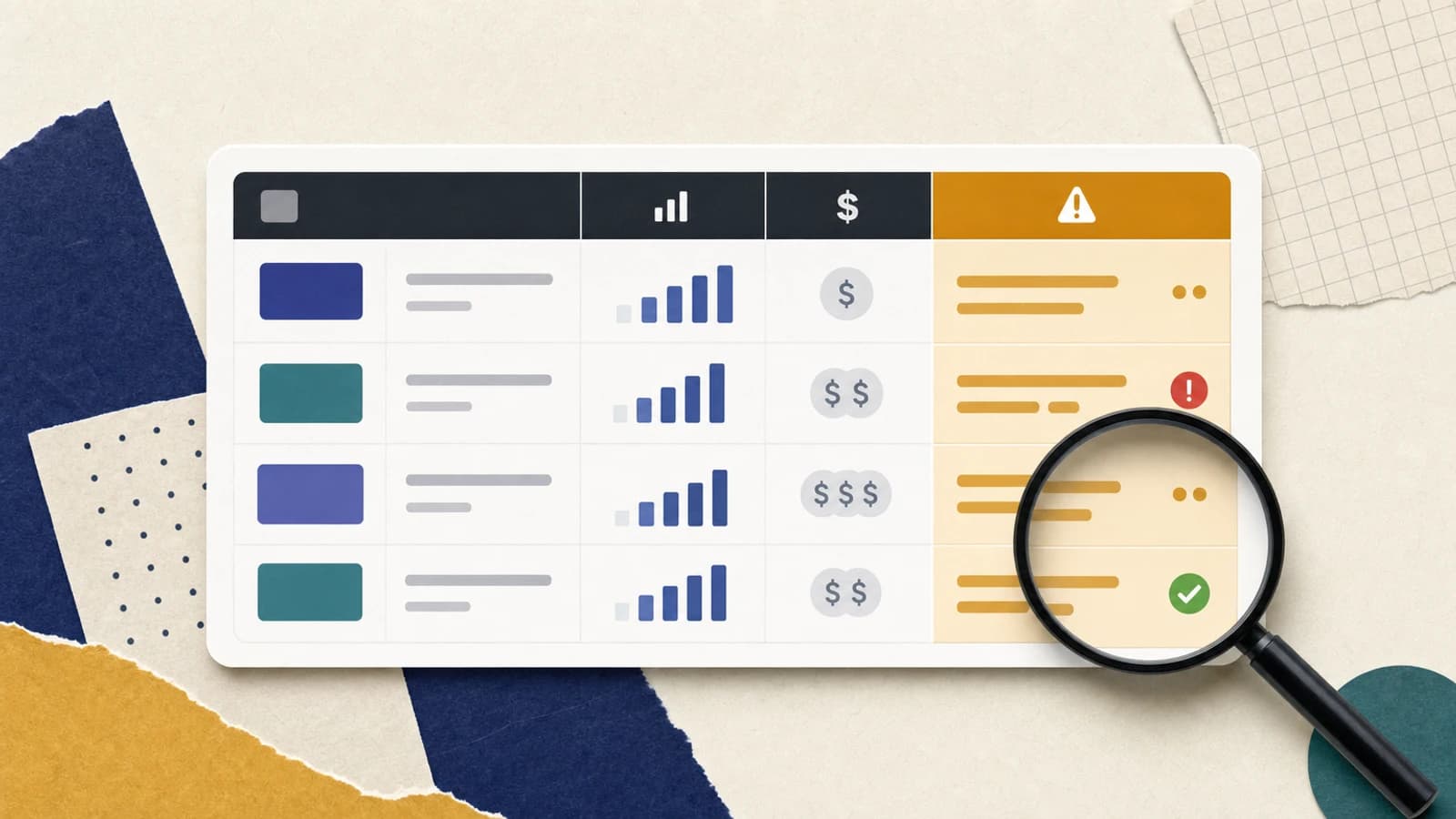
The "Biggest Weakness" column is where your opportunity lives. Read 2-star and 3-star reviews on G2, Capterra, and app stores. Those reviews come from people who tried the product, paid for it, and were disappointed enough to explain why. Their complaints are your product roadmap.
Step 3: Run the Decision Tree
This is the step every "how to check if your idea exists" article skips. You found competitors. Now what? Three scenarios:
The Decision Tree
- ✓Beatable: Competitors have weak reviews (under 4 stars), limited traction, or serve a broad audience poorly. High search demand confirms the market exists. This is a green light.
- ⚠Saturated: Multiple well-funded competitors with strong reviews, commodity pricing, and no clear underserved segment. You can still enter by niching down, but a head-on play will fail.
- ✗Empty (investigate): Zero competitors and zero search demand. This is a warning, not an opportunity. Validate that the problem exists before building.

I run this tree for every idea that comes through Preuve's scanner. The most common outcome is "beatable," which surprises founders who assumed "taken" meant "game over."
Is It Bad if Someone Already Has My Startup Idea?
No. It is almost always good news.
Google was not the first search engine, and Slack entered a team-chat market that HipChat and Campfire had been fighting over for years. Notion might be the more telling example, because there were already dozens of note-taking apps when it launched. Over 70% of public SaaS companies are new versions of older ideas (SaaStr, 2023). Competition is proof of demand - someone already convinced customers to pay for a solution to the problem you want to solve. That means the hardest part of market validation is already done.
What should worry you is the absence of competition. When I see an idea with zero competitors, my first question is not "is this genius?" It is "why did everyone else pass?"
Competitors with 3-star reviews are the best signal a founder can find. They proved people pay for the solution, and also that enough users are frustrated to write about it publicly. That frustrated user is the one you are building for.
What Should You Do When Competitors Already Exist?
Finding competitors is where most founders stop and panic. It should be where you start working. I use a competitor analysis framework that turns a list of rivals into a positioning strategy. Here is the condensed version.
Read their worst reviews. Go to G2, Capterra, or the App Store and filter for 2-star and 3-star reviews. These come from real users who paid for the product, gave it a real shot, and were disappointed enough to write about it. Common patterns in those reviews reveal exactly what to build differently.
Find the segment they ignore. Large competitors serve the broadest possible audience. That means they serve specific niches poorly. If you are building project management software and Asana is a competitor, you do not compete with Asana. You build the best PM tool for freelance designers, or construction teams, or nonprofit orgs. A niche is not a limitation. It is a wedge.
Complete this sentence: "[Your product] is for [specific user] who is frustrated with [specific competitor] because [specific pain point]. Unlike existing tools, we [specific differentiator]." If you cannot fill all four blanks with something specific and concrete, that is a research problem, not a writing problem - go talk to more potential users.
Skip weeks of manual research
Get complete market research, sourced proof, competitor map, and pricing data for your idea instantly.
What Does It Mean if No One Is Building My Idea?
It usually means one of four things, and in my experience three of those four are problems worth understanding before you build anything.
- 1.The market is too small. The problem affects too few people, or the willingness to pay is too low. This is the most common explanation.
- 2.Someone tried and failed. Search the Internet Archive, dead Product Hunt launches, and old Hacker News "Show HN" threads. The corpses of past attempts often reveal why the market rejected the idea.
- 3.You are searching the wrong keywords. Your industry uses different language than you do. Ask five potential users what they call the problem. Their words are the search terms that will surface the competitors you missed.
- 4.It is genuinely novel. Rare, but possible. If true, your next step is to validate the business idea before writing a single line of code. Novelty without demand is an academic exercise.
Before celebrating the empty landscape, rule out explanations 1 through 3. Talk to ten potential users. Ask what they currently do to solve the problem. If the answer is "nothing," ask why. The reason is usually more revealing than the idea itself.
How Do You Run a Competitor Scan in 30 Minutes?
The manual version takes about 30 minutes if you stay disciplined. Here is the sequence I use.
Minutes 1-5: Google the problem. Search "[problem] app," "[problem] tool," and "[problem] software." Note every product on page 1 and page 2. Check "People also ask" for related terms you had not considered.
Minutes 5-10: Search Product Hunt and G2. Product Hunt catches early launches Google has not indexed yet. G2 catches established tools with real user reviews. Sort PH by newest to spot what launched recently in your space.
Minutes 10-15: Check Crunchbase. Search your category. Filter by founding date and funding stage. A competitor that raised $10M last quarter is a different threat than one bootstrapped by a solo founder.
Minutes 15-25: Scan Reddit and Hacker News. Search site:reddit.com [your problem] on Google. Read the threads where people recommend or complain about existing tools. The tools people mention in those threads are effectively a competitor list, and the complaints map directly to what you should build differently.
Minutes 25-30: Fill the table. Put every competitor you found into the table format from Step 2. Name, traction signals, pricing, biggest weakness. This is the artifact you make decisions from, not a mental list.
Or skip the manual work. Preuve's idea validation tool runs this scan across 60+ sources in 60 seconds and returns a competitor landscape with names, pricing, funding, and the weaknesses that matter for positioning. I built it because I got tired of doing this manually for every idea that crossed my desk.
How Do I Know if a Market Is Too Saturated to Enter?
People fixate on the number of competitors when the real question is whether any gaps exist in how they serve customers.
Fifty competitors with consistently bad reviews is a more open market than three competitors sitting at 4.8-star ratings with aggressive pricing. The count tells you almost nothing without the review data.
Three signals together indicate saturation:
- Multiple well-funded competitors with strong retention and reviews above 4.5 stars.
- Commodity pricing - a race to the bottom where free tiers dominate and paid tiers struggle to convert.
- No identifiable underserved segment - every niche already has a tool built for it.
If all three are true, competing head-on will fail. You can still enter, but only by targeting a segment so narrow that no existing player bothers to serve it well. That distinction - between a broad assault and a focused wedge - is usually what separates the founders who burn runway from the ones who actually land customers.
FAQ
How do I quickly check if my startup idea already exists?
Run three searches: Google the problem (not your solution), search Product Hunt and G2 for your category, and check Crunchbase for funded competitors. If you find nothing in 30 minutes, either the market does not exist or you are searching the wrong terms. Preuve AI automates this across 60+ sources in 60 seconds.
Is it bad if someone already has my startup idea?
No. Competitors validate that the problem is real and people pay to solve it. Roughly 70% of public SaaS companies are new versions of older ideas (SaaStr). Having predecessors is the norm. What matters is whether those predecessors are beatable - weak reviews, missing features, or underserved segments are your opening.
What if I cannot find any competitors for my idea?
Zero competitors is a warning sign, not a victory. It usually means one of three things: the market is too small, the problem is not painful enough for people to pay, or you are searching the wrong keywords. Broaden your search to indirect competitors and manual workarounds before assuming novelty.
How do I know if a market is too saturated to enter?
A saturated market has three signals: multiple well-funded competitors with strong reviews, commodity pricing (race to the bottom), and no underserved customer segment you can identify. If all three are true, consider niching down or pivoting. If even one is false, there is an opening.
Should I abandon my idea if a big company is already doing it?
Not necessarily. Large competitors are slow, serve broad audiences, and ignore niches. If you can identify a specific customer segment they underserve and deliver a focused solution, size becomes their weakness. The question is not whether they exist but whether they serve your target user well.
Cite this page
Last updated June 11, 2026
Forat, V. (2026, June 11). How to Know if Your Startup Idea Already Exists. Preuve AI. https://preuve.ai/blog/how-to-know-if-your-startup-idea-already-exists
Forat, Vincent. “How to Know if Your Startup Idea Already Exists.” Preuve AI, 11 June 2026, preuve.ai/blog/how-to-know-if-your-startup-idea-already-exists.
Forat, Vincent. “How to Know if Your Startup Idea Already Exists.” Preuve AI. June 11, 2026. https://preuve.ai/blog/how-to-know-if-your-startup-idea-already-exists.
@misc{forat2026-how-to-know-if-your-startup-idea-already-exists,
  author = {Forat, Vincent},
  title = {{How to Know if Your Startup Idea Already Exists}},
  howpublished = {Preuve AI},
  year = {2026},
  month = jun,
  url = {https://preuve.ai/blog/how-to-know-if-your-startup-idea-already-exists},
  note = {Last updated June 11, 2026}
}
Vincent
5 years in B2B growth, building Preuve AI in public. 82% of ideas it scores aren't ready, the point is finding out in 10 minutes, not 3 months.
Follow on X →
Building is expensive. Validation is free.
Run your idea through 10 AI agents before you write a line of code. Every claim source-linked.