Key takeaways
- The AI market is saturated at the wrapper and horizontal layer, But wide open in vertical workflows, regulated industries, and back-office operations. 5,600+ AI startups have shut down since January 2025, almost all horizontal.
- Red oceans: AI writing assistants (1,213 startups, $7 median MRR), generic chatbots, meeting summarizers, SDR agents, and no-code agent builders are all oversaturated.
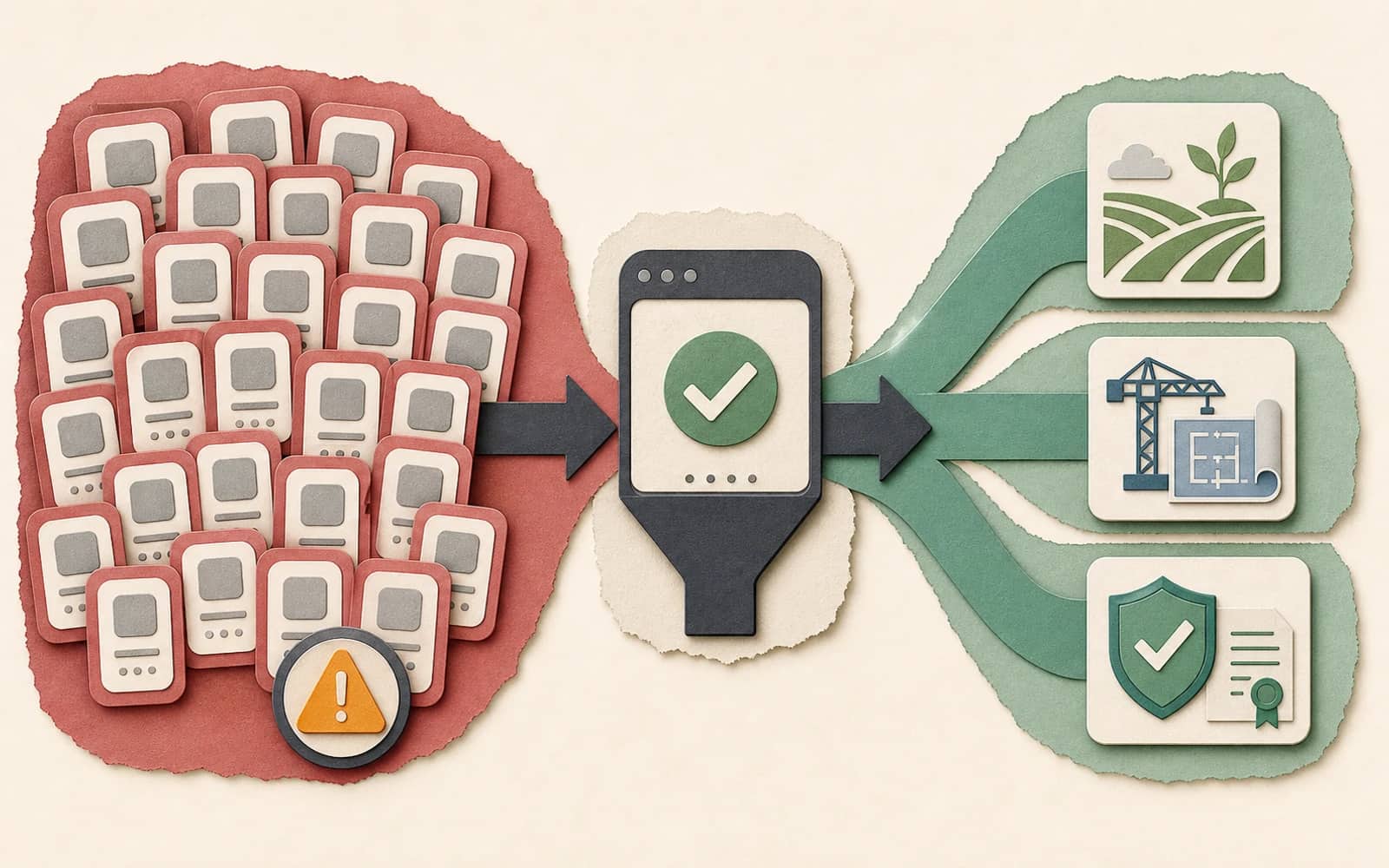
- Open lanes: Agriculture AI, skilled trades, construction, compliance tooling, and industrial-services workflows have fewer than 5 funded competitors per niche.
- The test: Count funded competitors in your exact buyer segment, confirm search demand for the problem, and check whether a foundation-model vendor could ship your product as a default feature.
5,600 AI startups shut down between January 2025 and March 2026. If you are weighing an AI startup idea right now, that number either scares you off or tells you nothing useful, depending on which layer of the AI market you plan to enter. The honest answer to whether the AI market is saturated in 2026: the top layer is a graveyard, the middle is brutal competition for scraps, and the bottom has barely been touched.
I run Preuve AI, a tool that scans startup ideas against 60+ live data sources. The pattern I keep seeing is blunt: roughly 70% of founders build in markets that already have 15+ funded competitors. The other 30% picked a vertical nobody else is serving. That second group converts, raises, and survives far more often. This post is the framework I use to tell the difference.

Will your idea survive the market?
Preuve AI runs 10 agents against live market data and links every claim to a source. Free analysis in 60 seconds.
Which AI markets are already too crowded to enter?
AI market saturation occurs when the number of funded startups in a category exceeds the number of viable market positions, compressing margins and raising customer-acquisition costs to unsustainable levels. The saturated categories in 2026 share one trait: the model providers ship the feature for free, or an incumbent platform bundles it. Once that happens, your standalone product competes against $0. Here is the current red-versus-green map, backed by Q1-Q2 2026 market data.
| Layer | Status | Examples | Key signal |
|---|---|---|---|
| Foundation models | Closed | OpenAI, Anthropic, Google, xAI | $188B to 4 companies in Q1 2026 |
| Horizontal wrappers | Oversaturated | AI writing, chatbots, meeting tools | 1,213 startups, $7 median MRR |
| Dev tools / infra | Heating up | Eval, observability, cost optimization | 1,500+ active investors, early consolidation |
| Vertical AI (boring industries) | Wide open | Agriculture, trades, construction | <5 funded competitors per niche |
| Compliance / regulatory AI | Wide open | EU AI Act, AML, medical coding | Regulation = forced demand + moat |
The numbers behind the red zone are brutal. BigIdeasDB tracked 1,213 AI tool startups, and the median one makes $7 per month. According to a 2025 CB Insights analysis, 78% of AI startups launched in 2024 are wrappers, thin interfaces on top of OpenAI or Anthropic APIs. SimpleClosure's 2026 shutdown report found that 60 to 70% of those wrappers generate zero revenue. If your AI idea has no moat beyond the model, you are startup number 1,214 in a category where half the field does not make rent.
The specific categories to avoid: AI writing assistants (Google Docs and Notion ship this natively), generic customer-support chatbots (Zendesk and Intercom embed AI), AI meeting summarizers (Zoom, Teams, and Google Meet all do it), horizontal SDR agents (over a dozen funded players chasing the same buyer), and no-code agent builders (OpenAI and Anthropic ship builders for free, and Builder.ai raised $445M on this thesis before going bankrupt). I wrote a full breakdown in my AI agent startup ideas post, where I rated 27 agent categories by saturation level.

Which AI niches are still wide open in 2026?
AgentMarketCap published a vertical AI saturation map in April 2026 that I keep coming back to. Their green-zone verticals, the ones with few or no funded players at scale, match what I see in scan data: agriculture, skilled trades, pre-construction, and industrial services. The vertical AI agent market was $5.1 billion in 2024 and is projected to reach $47.1 billion by 2030. The market size is real, but so far actual competition at scale has not shown up in most of those verticals.
Agriculture and AgTech AI
A $20B market with near-zero agent-native startups. Yield prediction, pest detection, and supply-chain optimization are the obvious targets, and equipment makers have started embedding AI into hardware, but autonomous agent-level workflows across the whole operation are still early.
Skilled trades and construction
Pre-construction is a dense information environment where LLMs provide the most lift. HVAC, plumbing, and electrical contractors still run on paper. Rebar ($14M Series A) builds for commercial trades, but the field is sparsely populated.
Compliance and regulatory AI
EU AI Act enforcement hit June 2026. AML investigation, medical coding, and audit-trail requirements create forced demand that model providers cannot serve horizontally. Regulation is a moat, not a cost.
Vertical healthcare (specialty workflows)
U.S. healthcare administrative burden is estimated near $250B a year. Clinical documentation for specialty medicine, insurance billing for mental-health providers, and revenue-cycle management for small practices are all underserved. Enterprise vendors sell upmarket and leave the solo operator open.
The pattern across every open lane is identical. I wrote about it in the AI SaaS startups piece: a high-volume, high-cognitive-load workflow inside an industry the foundation-model vendors cannot serve directly. The more boring the industry, the wider the lane. AgentMarketCap pegs the critical window for establishing a dominant vertical position at roughly 12 months, from mid-2026 to mid-2027. After that, the cloud-SaaS pattern kicks in and markets consolidate around two or three players.

Skip weeks of manual research
Get complete market research, sourced proof, competitor map, and pricing data for your idea instantly.
How do you check if your specific AI niche is saturated?
To check whether a specific AI niche is saturated, run three signals before writing a line of code: competitor density, demand proof, and model-provider risk. Most saturation articles skip this part entirely. They tell you the market is crowded, name the crowded categories, then stop as if knowing the category answers the question. That is not useful when your idea sits somewhere between obviously red and obviously green.
Competitor density in your exact buyer segment. Not the broad category. "AI for healthcare" has hundreds of players. "Insurance billing agent for solo mental-health practices" has fewer than 3. Count the funded competitors targeting your specific buyer on G2, Capterra, ProductHunt, and Crunchbase. Under 5 = open. 5 to 15 = heating up. Over 15 = red ocean.
Demand proof, not TAM claims. Confirmed search volume for the problem you solve. People complaining about it on Reddit, G2 reviews, or in support tickets. At least one incumbent charges money for a manual or legacy version of the workflow. If nobody pays for the outcome today, AI will not magically create the budget. A free viability scan can run the demand-signal check in about 60 seconds.
Model-provider risk. Could OpenAI, Anthropic, or Google ship your product as a default feature in their next release? If yes, you are building on rented land. The wrappers that died in 2025 all failed this test. Your idea needs to touch proprietary data, regulated processes, or integrated systems that a model vendor cannot serve horizontally.
If all three signals are green, the niche is worth entering. If even one comes back red, the positioning needs rethinking before you write a line of code. The Fluenta research team scored 89 AI startup ideas against live data feeds and found that only 35% remain defensible. The other 65% were either ghost markets (hype with no paying users) or red oceans (too many competitors for a new entrant to differentiate). This three-signal check is the fastest way I know to figure out which side your idea is on.
Can you still raise funding for an AI startup?
AI startup funding is still available in 2026, but the capital is concentrated and the bar has changed. Q1 2026 saw $242 billion in AI venture funding, the largest quarter ever recorded. Four companies, OpenAI, Anthropic, xAI, and Waymo, absorbed roughly $188 billion of it. The application layer, where you and I build, split the rest. That remainder is still a perfectly healthy venture market by historical standards. It is invisible next to the headline.
The practical shift for founders: investors now require revenue or contracted pilots on the first call. In 2023 you could show up with a deck and a demo and get a term sheet. Now you need proof someone will actually pay. Revenue multiples compressed to 15 to 20x ARR, down from the 30x+ insanity of 2023, and the "we will monetize later" pitch expired somewhere around Q3 2025. If your deck leads with "AI-powered" and describes a workflow tool, you are in the softer part of the market. Leading with the industry problem, where AI is the method, puts you in the stronger part.
Vertical SaaS with AI-native workflows is the quiet cash machine. Legal and procurement AI raised round after round in 2025 and 2026, and so did compliance and logistics, all with zero fanfare. I compared the best ways to validate before you raise in my startup validation tools guide.
What kills AI startups in saturated markets?
AI startups fail for predictable reasons. A dataset of 220 startup postmortems analyzed by Manthan Intelligence breaks it down. Competition killed roughly a third. The rest died of AI-specific problems: model commoditization (15%), the wrapper trap (12%), the demo-to-product gap (18%), single-agent failure modes (8%), and GPU cost spirals (12%). In almost every case the underlying technology worked fine. The business model around it did not survive contact with the market.
The wrapper trap is the most predictable killer. A founder finds a tedious workflow, wraps a model around it, ships a clean UI, grows to $5K MRR. Six months later the model provider ships the same workflow as a default and churn spikes to terminal. SimpleClosure data confirms 60 to 70% of wrappers generate zero revenue. The fix is the same every time: your product needs to touch live customer systems, proprietary data, or regulated processes that model vendors cannot ship horizontally.
Four defensible moats for AI startups still hold in 2026: proprietary data that improves with usage, embedded workflow integration that creates switching costs, regulatory complexity that slows competitors, and distribution lock-in through existing customer relationships. Your idea needs at least two. Run yours through Preuve's validation pipeline and the ones that survive past month 18 all have at least two of these four. The ones that die have none.

The AI market is not saturated across the board. Specific layers of it are, and those layers are brutal. The foundation-model layer is closed unless you have billions in compute. The horizontal-wrapper layer is a graveyard. But vertical AI for boring industries, compliance workflows, and back-office operations still running on paper? That market barely started, and right now you can still walk into most niches without bumping into a funded competitor. So the real question is whether your specific niche is open. Check it for free before you build.
FAQ
Is it too late to start an AI company in 2026?
No, but it depends on the layer. Horizontal AI tools like writing assistants, chatbots, and meeting summarizers are oversaturated, with 1,213 AI tool startups competing for a $7 median MRR. Vertical AI for specific industries, regulated workflows, and boring back-office tasks is still early. The vertical AI agent market is projected to grow from $5.1 billion in 2024 to $47.1 billion by 2030, and most niches still have fewer than 5 funded competitors.
What percentage of AI startups fail?
About 40% of AI startups launched in 2024 have already shut down: 3,800 in 2025 and another 1,800 in Q1 2026 alone. The 2023 cohort has a 92% failure rate. AI startups fail faster than traditional tech startups because lower barriers to entry, faster competitive responses from model providers, and wrapper-trap economics accelerate the cycle.
Which AI startup ideas are oversaturated in 2026?
The oversaturated categories are AI writing and content generation, generic customer-support chatbots, AI meeting summarizers, horizontal SDR agents, coding assistants at the generic level, no-code agent builders, AI logo generators, and AI resume builders. The pattern: if a platform like Google Docs, Zoom, or Notion has added the feature natively, the standalone market is collapsing.
How do I find an unsaturated AI niche?
Run three checks before building. First, count how many funded competitors target your exact buyer segment, not the broad category. Under 5 means open. Second, confirm that real people search for the problem you solve and at least one incumbent charges money for a manual version. Third, check whether OpenAI, Anthropic, or Google could ship your product as a free default. If all three signals are green, the niche is worth entering. A free viability scan can run the demand-signal check in about 60 seconds.
What makes an AI startup defensible in a saturated market?
Four moats still hold in 2026: proprietary data that improves with usage, embedded workflow integration that creates switching costs, regulatory complexity that slows competitors, and distribution lock-in through existing customer relationships. A defensible AI startup needs at least two of these four. Companies with only a model API and a UI have a 60 to 70 percent chance of generating zero revenue.

Vincent
5 years in B2B growth, building Preuve AI in public. 82% of ideas it scores aren't ready, the point is finding out in 10 minutes, not 3 months.
Follow on X →
Building is expensive. Validation is free.
Run your idea through 10 AI agents before you write a line of code. Every claim source-linked.