Key takeaways
- Ship or Die is a gamified founder community: Members ship a startup every 30 days or get publicly eliminated.
- As of July 2026, 291 founders have boarded. In the first 30 days, members shipped 155 startups, 57 of them made revenue, and 33 have since been marked overboard for missing a deadline.
- Price is $299, rising by tranche. The first batch was $199, the next tranche is $349. The game mechanics are genuinely clever.
- The gap: It assumes the idea being shipped is worth shipping.
- For a validated idea, board the ship. For an unvalidated one, a free scan takes under a minute first.
Ship or Die crossed 291 founders in under two months, and 33 of them have already been thrown overboard for missing a deadline. The pitch is brutal and simple: pay once, ship a startup every 30 days, or get publicly kicked out. The game mechanics are sharp and the accountability is real. But before you pay $299 to start a 30-day clock, there is one question the timer never asks: does the thing you are about to build have a market?

Will your idea survive the market?
Preuve AI runs 10 agents against live market data and links every claim to a source. Free analysis in 60 seconds.
What is Ship or Die?
Ship or Die is a gamified founder accountability community created by Marc Lou and Jack Friks in May 2026. Members pay a one-time fee (now $299), join a private Discord, and commit to shipping a live startup with a buy button every 30 days or get publicly eliminated. It is not a tool, not a course, not a boilerplate. It is social pressure and deadlines, packaged as a game.
Here is what you get for $299:
- A private Discord with daily check-ins, voice coworking channels, and peer feedback from other founders who are also on the clock.
- A 30-day recurring deadline. You pick an idea, start a "mission," and the timer begins. You ship something live with a buy button before it hits zero. One mission at a time. After shipping, you can start a new one or keep building what is working.
- A public profile that tracks every startup you shipped (or did not). Other members can see your record.
- MMO-style progression. You start as a Noob Pirate and level up by completing quests like buying your first domain, getting 1,000 visitors, landing your first paying customer. There is a leaderboard.
- A public death if you fail. Miss the deadline and you get "marked overboard," kicked from Discord. Your profile shows a "Churn" badge for everyone to see. No refund.
That is the whole product. No code templates, no AI tool, no curriculum. The real value is the deadline pressure, amplified by the fact that everyone in the community can watch you fail publicly. Marc ships about one startup per month and has done it since 2022 with 30+ launches. The man is his own proof of concept.
How does the pricing work?
Escalating tranches. The first batch sold at $199, then $249, then $269, all sold out. Current price is $299 with limited spots left. Next tranche: $349. One-time, lifetime, no refunds. The escalation is doing exactly what it is designed to do. Every hour you wait, the price goes up and someone else takes your spot.
The scarcity mechanic (limited spots per tranche) stacks with the price-only-goes-up loss aversion loop, and the no-refund policy makes sure you have skin in the game from minute one. The 291-pirate social proof figure is doing its own work on top of all that. Marc knows his behavioral psychology.
Ship or Die by the numbers. In the first 30 days (by late June 2026), members shipped 155 startups, 57 of them made revenue, and Marc Lou tracked $33K+ in member revenue across the crew. As of July 2026, 291 founders are aboard and 33 have been marked overboard for missing a deadline. The pressure mechanic is not a gimmick, it is doing measurable work.
What does Marc Lou get right?
The finishing problem is real. Most indie hackers do not fail because they picked the wrong idea. They fail because they never shipped anything at all. They tweak, they redesign, they add one more feature. Six months later they have a half-built app and no users. Ship or Die attacks that pattern directly.
Getting kicked out with your name on a "walked the plank" list is a stronger motivator than any productivity app I have seen. The social contract is the product, and that is genuinely hard to replicate with a solo setup. On top of that, charging $299 with no refund preselects people who are actually serious. Free communities tend to drown in lurkers, and I have seen it happen with every open Discord I have joined.


Skip weeks of manual research
Get complete market research, sourced proof, competitor map, and pricing data for your idea instantly.
Does Ship or Die help you pick the right idea?
No. Ship or Die is built around getting founders past the finish line, and it is genuinely good at that. But picking the right direction in the first place is a completely separate problem, and that is where most founders actually lose their money.
Shipping faster does not fix building the wrong thing. It just gets you to the dead end sooner.
In a 2026 survey of 500 founders, 67% said they validated before building, but only 23% used structured research with their actual target market. The rest just asked people they knew. The average post-launch rework cost from those unvalidated assumptions was $4,200, plus 3.2 months of delay.
Ship or Die puts a 30-day clock on that pattern. The clock does not care whether your idea has buyers. You will ship faster, that part works. But shipping a product nobody wants in 30 days instead of 6 months just means you find out you wasted your time sooner. I wrote a separate piece on the fake door test if you want a quick way to stress-test demand before committing 30 days.
I built Preuve AI because I kept seeing the same loop: founder gets excited about an idea, spends two months building it, and then finds out at launch that nobody was actually waiting for it. A free viability scan takes under a minute and pulls from 60+ data sources: market size, competition density, demand signals. It does not replace Ship or Die. It tells you whether the thing you are about to ship for 30 days has a market waiting for it.
When should you join Ship or Die vs validate first?
Unlike Ship or Die, which costs $299 and gives you a 30-day execution deadline, a startup validation scan costs $0-$59 and takes under a minute. They solve different problems. Use this table to pick the right tool for your situation:
| Scenario | Best move |
|---|---|
| You have a validated idea with demand signals | Join Ship or Die. Accountability will get you across the finish line. |
| You have an idea but have not tested demand | Validate first. Run a free scan, then decide. |
| You have no idea yet, want to pick one fast | Validate 3-5 ideas first. Compare the market signal for each, pick the strongest opportunity, then ship it. |
| You keep building but never launching | Join Ship or Die. Your problem is finishing, not direction. The deadline will fix it. |
| You ship fast but keep building things nobody buys | Validate first. Speed is not your bottleneck. Market fit is. |
Should I validate before joining Ship or Die?
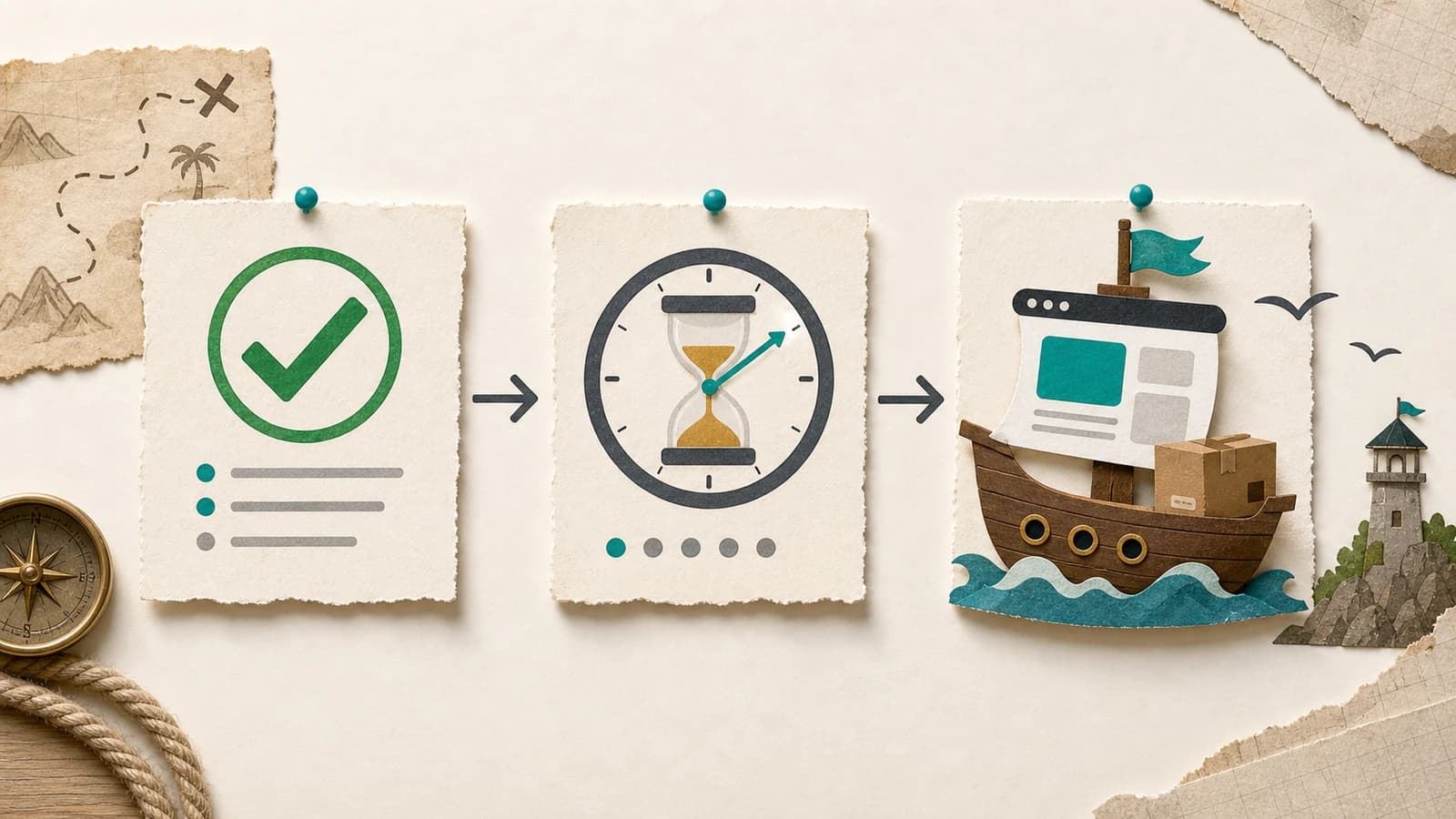
Ship or Die and validation are not competing strategies. They operate at different stages of the same problem. Validate your direction, then ship with a deadline. Validation takes under a minute; the 30-day clock only starts after. Doing them in the wrong order costs founders $4,200 in rework and 3 months of delay on average.
Preuve's published benchmark study, based on anonymized data from 6,000+ ideas, found that most do not pass. The patterns that kill ideas are not things you discover by building faster. They are things like a market that is already saturated, or a price point the target segment has never paid for anything adjacent. A 30-day deadline does not surface any of that, but data will.
Marc Lou built 30+ products since 2022. I would bet money he has developed an intuition for what markets want, which is its own form of validation. Most people joining Ship or Die do not have 30 launches worth of pattern recognition. For those founders, a data layer before the 30-day clock starts is the difference between shipping something people buy and shipping something people ignore.
I wrote a full breakdown of how to validate a startup idea if you want the full framework. Or just run a free scan and see what the data says about your idea before you set the 30-day timer.
FAQ
What is Ship or Die?
Ship or Die is a gamified founder community by Marc Lou and Jack Friks. You pay a one-time fee (now $299, rising by tranche), join a private Discord, and commit to shipping a startup every 30 days. Miss the deadline and you get "marked overboard," which means kicked from the community with your failure visible on a public profile. It uses MMO-style game mechanics: you start as a Noob Pirate and level up by completing quests like buying a domain or getting 1,000 visitors.
Is Ship or Die worth $299?
It depends on where you are in the founder journey. If you have already validated your idea and know there is demand, Ship or Die gives you a deadline, a community, and public accountability to actually finish and launch. If you have not validated yet, you are paying $299 to build something fast that might have no market. The 30-day clock does not care whether your idea has buyers.
What happens if you miss the Ship or Die deadline?
You get "marked overboard." That means you are kicked from the Discord community, you lose access, and your public profile shows a "Churn" status visible to all other members. There are no refunds. The public shame mechanic is the core accountability loop. As of July 2026, 33 founders have already gone overboard.
Should I validate my idea before joining Ship or Die?
Yes. Ship or Die solves a finishing problem, not a direction problem. If you spend 30 days shipping an idea nobody wants, the deadline worked exactly as designed, but you still wasted a month. Running a validation scan or a fake door test before you board takes a day and tells you whether the market exists.
What is a good alternative to Ship or Die for idea validation?
Ship or Die and idea validation tools solve different problems. Ship or Die gives you accountability to finish building. Preuve AI gives you evidence on whether to start building. The strongest move is validation first, then Ship or Die to execute. A free viability scan takes under a minute and covers market size, competition, and demand signals before you commit 30 days.
Is Ship or Die a scam?
No. Marc Lou is a well-known indie hacker with $94K+/month in public revenue across his product portfolio (including DataFast and TrustMRR). Jack Friks is a legit builder (Post Bridge at $35K MRR, Curiosity Quench). The product does what it says: deadline, community, public accountability. Whether it is worth $299 for you depends on whether your bottleneck is finishing or direction.
Can I get a refund from Ship or Die?
No. The no-refund policy is intentional, it is part of the accountability mechanic. If you could get your money back, the "skin in the game" disappears and the deadline loses its bite.
Do I need to be technical to join Ship or Die?
No. The FAQ says "vibe code it" is acceptable. You need to get something live with a link and a buy button. What they care about is that something is live with a payment link.
What is better: Ship or Die or validating my idea first?
They are not either/or. Validation tells you what to build. Ship or Die makes sure you finish building it. The best sequence is: validate your idea (free scan takes under a minute), pick the strongest opportunity, then join Ship or Die to execute with a deadline.
Cite this page
Last updated July 10, 2026
Forat, V. (2026, July 10). Ship or Die Review: Smart Bet or $299 Gamble? Preuve AI. https://preuve.ai/blog/ship-or-die-review
Forat, Vincent. “Ship or Die Review: Smart Bet or $299 Gamble?” Preuve AI, 10 July 2026, preuve.ai/blog/ship-or-die-review.
Forat, Vincent. “Ship or Die Review: Smart Bet or $299 Gamble?” Preuve AI. July 10, 2026. https://preuve.ai/blog/ship-or-die-review.
@misc{forat2026-ship-or-die-review,
  author = {Forat, Vincent},
  title = {{Ship or Die Review: Smart Bet or \$299 Gamble?}},
  howpublished = {Preuve AI},
  year = {2026},
  month = jul,
  url = {https://preuve.ai/blog/ship-or-die-review},
  note = {Last updated July 10, 2026}
}
Vincent
5 years in B2B growth, building Preuve AI in public. 82% of ideas it scores aren't ready, the point is finding out in 10 minutes, not 3 months.
Follow on X →
Building is expensive. Validation is free.
Run your idea through 10 AI agents before you write a line of code. Every claim source-linked.