Key takeaways
- A startup is ready for pre-seed when it can demonstrate five things investors evaluate: A validated problem, credible market sizing, a mapped competitive landscape, demand signals, and a go-to-market plan.
- Readiness bar: Data from 6,000+ startup scans shows the average viability score is 56.3/100, and only 17.5% score 70 or higher.
- Top fixable killer: Missing go-to-market plan (25.7% of ideas), followed by underestimating competition (11.5%).
- What investors expect: Not revenue. Sourced research, market sizing with citations, competitor analysis with named alternatives, and demand signals from real conversations.
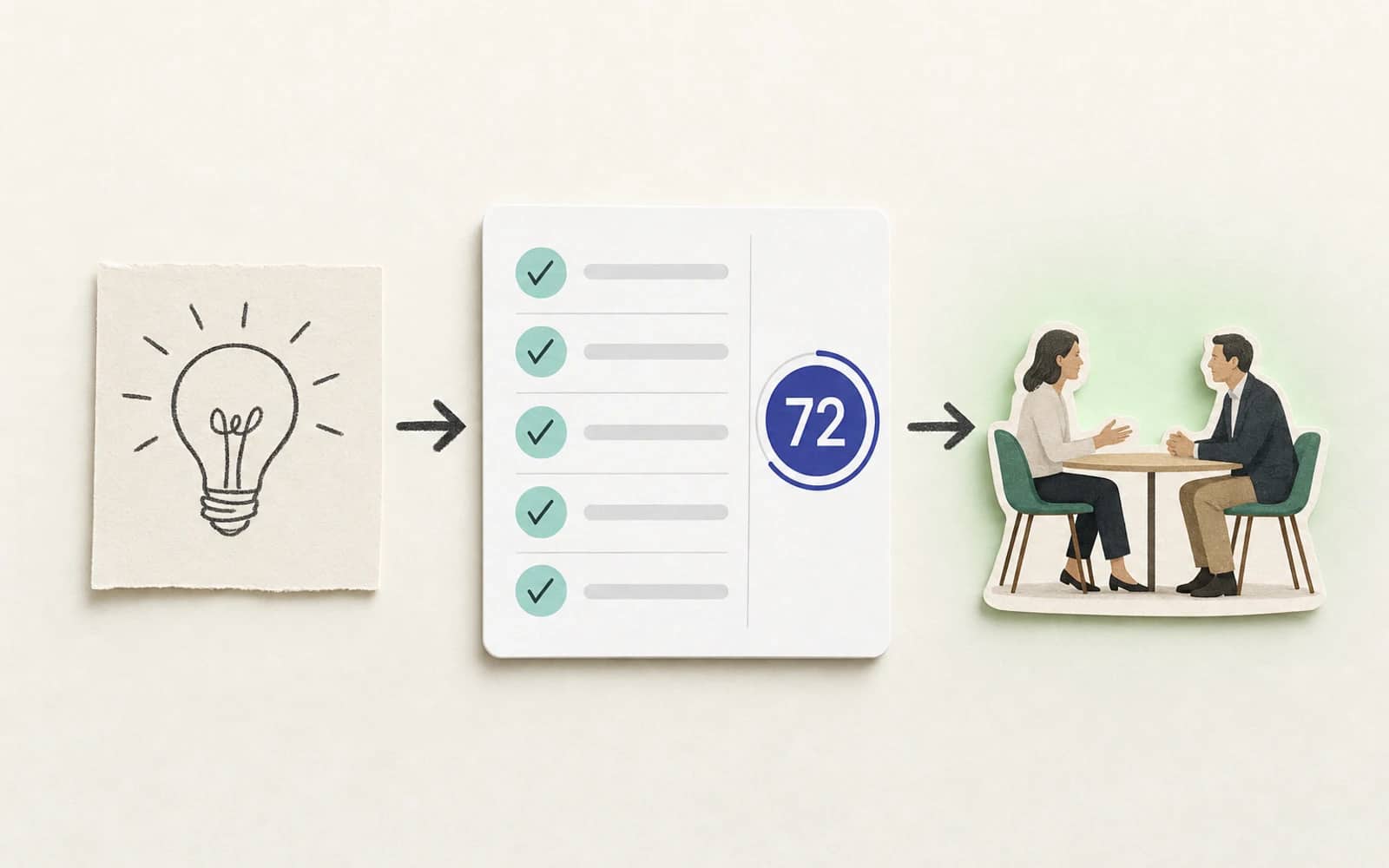
Is your startup ready for pre-seed? You are ready when you can answer the five questions every investor runs through: is the problem real, is the market big enough, who are the competitors, where is the demand evidence, and what is the go-to-market plan.
This post maps each pre-seed investor criterion to the validation evidence that answers it. Fill every row and you are ready. Find a gap and you know what to fix before your first pitch instead of in the meeting.

Will your idea survive the market?
Preuve AI runs 10 agents against live market data and links every claim to a source. Free analysis in 60 seconds.
What do pre-seed investors actually evaluate before writing a check?
Pre-seed investors skip the revenue conversation entirely at this stage. They are trying to figure out whether you actually understand the problem well enough that people would eventually pay to have it solved. That evaluation breaks down into five questions.
1. Is the problem real?
Investors want evidence that real people experience the pain you describe. The consensus across every pre-seed guide is 20+ customer discovery interviews, and not with friends. SeedForge and NUVC both set this as the floor. You need specific quotes about the pain point, not survey checkboxes.
If you have not done the interviews, stop thinking about fundraising and go do them. No tool replaces that step. But a structured validation process helps you walk into those conversations with sharper questions.
2. Is the market big enough?
Investors reject top-down market sizing ("the global SaaS market is $300B") because it tells them nothing about your actual opportunity. They want bottom-up TAM/SAM/SOM: how many potential customers exist, what you can charge them, and what a realistic capture rate looks like.
I wrote about this in detail because it is one of the most common gaps I see. Founders either skip market sizing entirely or cite a top-down number from a report they did not read. Neither survives an investor conversation.
3. Who are the competitors?
"We have no competitors" is the fastest way to lose credibility in a pre-seed meeting. Every problem has existing solutions, even if those solutions are spreadsheets and manual processes. Investors want to see that you have mapped the landscape and can articulate why your approach is different.
Across our benchmark data, 11.5% of scanned ideas underestimate or ignore competition entirely. That is the second most common validation gap we see, and it is the easiest to fix with 30 minutes of research.
4. Is there demand evidence?
You do not need revenue. You need proof that someone besides you wants this to exist. NUVC frames the bar well: 40+ customer interviews with insight themes, 200+ waitlist signups, 3 signed LOIs, or a working prototype with 50+ beta testers. Any of those counts.
The key is specificity. "People said they would use it" is the sentence investors hear from every founder who has not shipped yet. The version that actually moves a conversation forward sounds more like: 12 out of 15 pilot companies converted to paid at $800/month. That gap in specificity is usually the gap between a second meeting and a polite rejection.
5. Do you have a go-to-market plan?
This is where most founders fail. Across 6,000+ ideas scanned through Preuve AI, 25.7% have no go-to-market plan at all. Not a weak plan. None. That makes it the number one concrete validation gap, ahead of competition (11.5%) and every other category we track except ideas still too vague to score (36.9%). I published the full breakdown in our 2026 benchmark report.
An investor does not expect a polished marketing strategy. They expect you to name your first acquisition channel, describe how you will reach your first 100 customers, and explain why that channel fits your ICP. If you cannot answer those three questions, you are not ready to raise.

How much validation do you need before raising pre-seed?
Founders usually worry about the wrong bar. Investors care less about metrics at this stage than most people expect, but they are stricter about evidence quality than the pitch deck templates suggest. Here is the practical threshold, synthesized from what the best pre-seed guides agree on and what I have seen work:
Pre-seed readiness checklist
- Problem validation: 20+ customer discovery interviews with documented pain points in the customer's own words
- Market sizing: Bottom-up TAM/SAM/SOM with named customer segments, not a top-down industry report number
- Competitive landscape: Named alternatives with clear positioning gaps you can exploit
- Demand signal: At least one of: waitlist signups, LOIs, pilot commitments, beta users, or pre-orders
- Go-to-market plan: Your first acquisition channel, your path to 100 customers, and why that channel fits your buyer
- Prototype or MVP: Something tangible that proves you can build, even if rough
- Founder-market fit: A clear two-sentence explanation of why you are the right person for this problem
You do not need all seven at full strength. But if you are missing more than two, most pre-seed investors will ask you to come back later. The founders who close in 60 to 90 days have at least five of these locked before their first outreach.

Skip weeks of manual research
Get complete market research, sourced proof, competitor map, and pricing data for your idea instantly.
What kills most startups before they can raise?
Preuve AI sits on a dataset most founders never see: the results from 6,000+ anonymized idea validation scans run by founders on the platform, each scored across market size, competition, demand, and go-to-market readiness. The patterns are consistent enough to publish benchmarks.
The average viability score across all scanned ideas is 56.3 out of 100, and only 17.5% clear the 70 mark. That threshold is roughly where the evidence package becomes defensible enough that investor conversations do not collapse at the first follow-up question.
The top two killers:
- No go-to-market plan (25.7%) - almost a third of founders have no clear path to their first customers. Investors notice immediately because GTM is the question that separates "interesting idea" from "fundable business."
- Underestimating competition (11.5%) - founders either claim no competitors exist or list only the biggest names and miss the direct alternatives that investors will find in two minutes of Googling.
Both of these gaps are fixable before you pitch. A structured market research process covers the competitive landscape. A 30-minute exercise naming your first channel and first 100 customers covers GTM. Most founders spend time on the wrong thing, pulling together a polished deck before they have sourced any of the underlying research. These five investor criteria at least tell you where to aim first.

How do you build an investor-ready validation package?
Start with the five criteria above and work through them in order. The problem and demand criteria have to come from actual conversations, and no tool shortcuts that. Market sizing, competition, and GTM you can mostly build through structured research, which is where most founders lose days pulling data from scratch.
I built Preuve AI to compress that research step. The free scan takes your idea description, runs it against 60+ data sources, and returns a scored report covering market size, competitive landscape, demand signals, and go-to-market readiness. The output is the same evidence package an investor evaluates, formatted as a report you can attach to your deck or bring to a meeting.
Here is how I would sequence the full validation package if you are three to four weeks out from your first investor meeting:
- Week 1: Run a free scan to get your baseline viability score, market sizing, and competitive map. Identify the gaps.
- Week 2: Start 20+ customer discovery interviews. Use the scan's competitor list to ask better questions about current workarounds.
- Week 3: Build or polish your prototype. Document your demand signals (waitlist numbers, interview quotes, LOIs).
- Week 4: Write your GTM plan. Build your pitch deck using the sourced data from your scan and interviews as the backbone of your market and traction slides.
The scan is not a substitute for conversations, prototype work, or thinking through GTM. What it does compress is the manual research phase, which founders either skip entirely and get exposed in the meeting, or spend three weeks on and push their timeline back.
Get the report investors want to see
Free scan. Sourced market sizing, competitor map, and a viability score in under two minutes.
Scan My Idea Free →FAQ
How do I know if my startup is ready for pre-seed funding?
Your startup is ready for pre-seed when you can answer five questions investors ask: Is the problem real (customer evidence)? Is the market big enough (bottom-up TAM/SAM/SOM)? Who are the competitors? Is there demand evidence? Do you have a go-to-market plan? Data from 6,000+ startup scans shows only 17.5% of ideas score above 70/100 on viability, the range where investor conversations gain traction.
Do I need revenue before raising pre-seed?
No. Pre-seed investors do not expect revenue. They expect evidence of a real problem, a credible market, and demand signals. That evidence can come from customer interviews, waitlist signups, letters of intent, or a sourced validation report with market sizing and competitor analysis.
What is the biggest reason startups fail to raise pre-seed?
Across 6,000+ startup scans, the most common concrete gap is a missing go-to-market plan, appearing in 25.7% of scanned ideas. Underestimating or ignoring competition follows at 11.5%. Both are questions investors ask in the first meeting.
How long does it take to raise a pre-seed round?
Well-prepared founders typically close pre-seed in 60 to 90 days from first outreach. Founders who pitch before validating their thesis often see the process stretch to six months or longer.
What should I validate before raising pre-seed?
Validate the problem (20+ customer interviews), the market (bottom-up TAM/SAM/SOM with sources), the competition (named alternatives with positioning gaps), demand (waitlist, LOIs, or pilot interest), and your go-to-market plan (first channel, first 100 customers). A free validation scan can generate the market and competitive evidence in under two minutes.
Cite this page
Last updated July 30, 2026
Forat, V. (2026, July 30). Is Your Startup Ready for Pre-Seed Funding? Preuve AI. https://preuve.ai/blog/is-your-startup-ready-for-pre-seed
Forat, Vincent. “Is Your Startup Ready for Pre-Seed Funding?” Preuve AI, 30 July 2026, preuve.ai/blog/is-your-startup-ready-for-pre-seed.
Forat, Vincent. “Is Your Startup Ready for Pre-Seed Funding?” Preuve AI. July 30, 2026. https://preuve.ai/blog/is-your-startup-ready-for-pre-seed.
@misc{forat2026-is-your-startup-ready-for-pre-seed,
  author = {Forat, Vincent},
  title = {{Is Your Startup Ready for Pre-Seed Funding?}},
  howpublished = {Preuve AI},
  year = {2026},
  month = jul,
  url = {https://preuve.ai/blog/is-your-startup-ready-for-pre-seed},
  note = {Last updated July 30, 2026}
}
Vincent
5 years in B2B growth, building Preuve AI in public. 82% of ideas it scores aren't ready, the point is finding out in 10 minutes, not 3 months.
Follow on X →
Building is expensive. Validation is free.
Run your idea through 10 AI agents before you write a line of code. Every claim source-linked.