Key takeaways
- A business model canvas maps 9 blocks: Customer Segments, Value Propositions, Channels, Customer Relationships, Revenue Streams, Key Resources, Key Activities, Key Partnerships, and Cost Structure. Developed by Osterwalder and Pigneur in 2010, the framework has been downloaded over 5 million times.
- Most free generators hand you empty boxes: Canvanizer, Miro, and Canva offer blank templates. Preuve AI's free BMC generator fills all 9 blocks from a one-sentence idea in roughly 10 seconds, with a direct path to verify the finished canvas against 60+ live data sources.
- A canvas without evidence is a guess: The three mistakes that kill a canvas are writing aspirational fiction, copying competitor language, and never revisiting it. Treat each block as a hypothesis you need to test.
- Lean Canvas replaces 4 blocks with startup-specific ones: Problem, Solution, Key Metrics, and Unfair Advantage. Use Lean Canvas pre-product-market fit. Switch to BMC when you need to communicate the full operational model to investors or partners.
The business model canvas has been downloaded over 5 million times since Alexander Osterwalder and Yves Pigneur published Business Model Generation in 2010, according to a PR Newswire report. Stanford, Harvard, and IESE all teach it. Yet every time I watch a founder open a free business model canvas generator, they stare at nine empty boxes and type wishful thinking into each one. If your "Customer Segments" block says "everyone" and your "Revenue Streams" block says "subscriptions," that is a horoscope, not a business model.
This guide walks through what actually belongs in each of the 9 blocks, with filled examples for three real business types: a residential cleaning company, a DTC skincare brand, and a B2B SaaS tool. Then I compare the free generators that exist today, including the one I built at Preuve AI, which fills all 9 blocks from a single sentence and connects the finished canvas to a real validation scan for the blocks where you are guessing instead of proving.

Will your idea survive the market?
Preuve AI runs 10 agents against live market data and links every claim to a source. Free analysis in 60 seconds.
What is the Business Model Canvas and why does it still matter?
The Business Model Canvas is a one-page strategic management template that maps how a business creates, delivers, and captures value across 9 building blocks: Customer Segments, Value Propositions, Channels, Customer Relationships, Revenue Streams, Key Resources, Key Activities, Key Partnerships, and Cost Structure. Osterwalder and Pigneur designed it as a shared language for business models, a replacement for the 40-page plans that nobody reads past page three.
It stuck. A Strategyzer research report surveyed over 1,300 canvas users and interviewed 35 Fortune 500 and FT Global 500 companies about adoption. Most top MBA programs include it in their curriculum, and many accelerators ask applicants for a one-page model of exactly this shape before an interview.
It survives because nine blocks on one page force you to confront gaps that a paragraph of hand-waving hides. When a founder shows me their canvas, I can spot in seconds whether they have thought about how they reach customers (Channels) or just assumed "build it and they will come." A business plan buries that gap somewhere around page 17, but a canvas hangs it on the wall where you cannot ignore it.
What goes in each of the 9 blocks?
This is where most guides stop at definitions, which is not helpful when you are staring at an empty box. Below, I walk through each block with what it means and then show exactly what three different businesses would write.
Customer Segments
The distinct groups of people or organizations you serve. Name them by who pays, not who benefits. If your product helps employees but the CTO signs the check, the CTO's department is your segment.
Cleaning company
Dual-income homeowners in suburban neighborhoods (3+ bedrooms, both adults working full-time, household income above $120k). Secondary segment: property management firms with 10-50 rental units.
DTC skincare brand
Women aged 28-42 with sensitive skin who have tried 3+ brands and switched away from each due to irritation. They read ingredient lists, spend $40-80/month on skincare, and buy online.
B2B SaaS (project management tool)
Engineering managers at companies with 20-200 employees running agile sprints across 2-5 teams. They are frustrated with Jira complexity but need more structure than Notion or a spreadsheet.
Value Propositions
The bundle of products and services that creates value for each segment. The test: can you finish the sentence "People switch to us because..." with something specific? If your answer is "because we are better," you have not found the proposition yet.
Cleaning company
Same two-person team every visit (no stranger lottery), flexible rescheduling via text, and a satisfaction photo sent after every cleaning so you see the result before you get home.
DTC skincare brand
Every product has 7 or fewer ingredients, all published with sourcing origin. A 60-day "skin diary" program tracks irritation triggers. Free returns within 30 days, no questions.
B2B SaaS (project management)
Agile boards that a non-engineer can set up in under 10 minutes, with cross-team dependency tracking that Jira buries under three layers of configuration. One-click sprint reports in PDF for the Monday stand-up.

Channels
How you reach each segment to deliver the value proposition. Channels cover the full cycle: awareness, evaluation, purchase, delivery, and after-sales. Most first-time founders fill this block with "social media" and call it done. Name the specific platform, tactic, and cost.
Cleaning company
Awareness: Google Business Profile + Nextdoor neighborhood posts. Evaluation: before/after photo gallery on website. Purchase: online booking with Stripe. Delivery: in-home service. After-sales: SMS follow-up with rebooking link.
DTC skincare brand
Awareness: Instagram Reels + dermatologist micro-influencers (1k-10k followers). Evaluation: free sample kit ($5 shipping). Purchase: Shopify storefront. Delivery: subscription box, auto-ships every 8 weeks. After-sales: skin diary check-in emails.
B2B SaaS (project management)
Awareness: SEO targeting "Jira alternative for small teams" + comparison blog posts. Evaluation: 14-day free trial, no credit card. Purchase: self-serve checkout. Delivery: browser app + Slack integration. After-sales: in-app onboarding + monthly usage review email.
Customer Relationships
The type of relationship each segment expects. This block answers: once someone buys, how do you keep them? Options range from self-service to dedicated personal assistance to automated retention sequences. Match the relationship to the margin. High-touch support on a $9/month product is a fast path to bankruptcy.
Cleaning company
Dedicated: same cleaning team assigned. Semi-automated: post-cleaning satisfaction photo + rebooking reminder via SMS. Community: referral discount ($25 off for both).
DTC skincare brand
Automated: subscription auto-renewal. Self-service: online ingredient transparency database. Personal: email skincare advisor for subscribers spending $60+/month.
B2B SaaS (project management)
Self-service: in-app help center + community forum. Automated: onboarding drip emails. Dedicated (enterprise only): named CSM above $500/month plan.
Revenue Streams
The cash each segment generates and the pricing mechanism behind it. "We will charge a subscription" is not a revenue stream. A revenue stream is the price, the billing frequency, and why a buyer agrees to that number.
Cleaning company
$150/visit for a 3-bedroom home, billed per visit or via a monthly retainer ($540/month for weekly service). Upsell: deep-clean add-on ($80) for move-in/move-out. Property managers pay $95/unit/clean on a volume contract.
DTC skincare brand
Subscription: $45/month for a 3-product routine, 8-week auto-ship. One-time purchase: $18-$35 per product. Sample kit: $5 (covers shipping, loss leader). Average order value target: $52.
B2B SaaS (project management)
Free tier: 1 team, 3 members. Pro: $12/user/month billed annually. Enterprise: custom pricing starting at $500/month, includes SSO + priority support. Expansion revenue via seat growth within existing accounts.
Key Resources
The assets required to make the model work. Four categories: physical, intellectual, human, and financial. List only what you cannot operate without. If removing the resource breaks the model, it belongs here. If it is nice to have, it does not.
Cleaning company
Human: trained cleaning teams (bonded, insured). Physical: cleaning supplies, vehicle fleet. Intellectual: booking/scheduling software. Financial: $15k working capital for payroll float.
DTC skincare brand
Intellectual: proprietary formulations + ingredient sourcing relationships. Physical: contract manufacturing capacity. Human: formulation chemist (part-time). Financial: $50k inventory float for minimum order quantities.
B2B SaaS (project management)
Intellectual: codebase + data architecture. Human: 3-person engineering team + 1 designer. Physical: cloud infrastructure (AWS). Financial: 12-month runway to reach break-even.
Key Activities
The operations the business must execute well. This is not your to-do list. It is the short list of things that, if you stopped doing them, the business model stops working.
Cleaning company
Recruiting and training cleaning staff. Quality control (post-clean photo + feedback loop). Scheduling optimization to minimize drive time between jobs.
DTC skincare brand
Product formulation and testing. Content marketing (ingredient education, skin diary program). Supply chain management for 8-week subscription cadence.
B2B SaaS (project management)
Product development (shipping features, fixing bugs). Customer onboarding (getting teams to first sprint in under 10 minutes). Content-driven acquisition (comparison pages, SEO).

Key Partnerships
The network of suppliers, alliances, and joint ventures that reduce risk or acquire resources you do not own. In the canvases founders have shown me, most list too many partners. List only partners where the deal changes your unit economics or unlocks a channel you cannot reach alone.
Cleaning company
Property management firms (volume contracts, steady demand). Eco-friendly supply distributors (bulk pricing on green products). Local real estate agents (move-in/move-out referrals).
DTC skincare brand
Contract manufacturer with clean-beauty certification. Dermatologist micro-influencers (product seeding, not paid sponsorship). Packaging supplier with sustainable materials at scale.
B2B SaaS (project management)
Integration partners: Slack, GitHub, Linear (users expect these connections). AWS/GCP (infrastructure credits for startups). Potential co-marketing with complementary tools (time-tracking, design).
Cost Structure
The major cost drivers. Split them into fixed costs (rent, salaries, insurance) and variable costs (materials per job, transaction fees per sale, cloud compute per user). The ratio between fixed and variable costs defines your scaling risk. High fixed costs mean you need volume to survive. High variable costs mean margins shrink under pressure.
Cleaning company
Fixed: insurance ($3k/year), vehicle leases ($800/month), scheduling software ($50/month). Variable: labor ($35-45/hour per cleaner), supplies ($8-12/job), fuel. Cost-driven model: margins depend on route density.
DTC skincare brand
Fixed: formulation chemist ($2k/month part-time), Shopify ($79/month), warehouse lease. Variable: COGS ($8-14/product), shipping ($4-7/order), payment processing (2.9% + $0.30). Minimum order quantities create inventory risk.
B2B SaaS (project management)
Fixed: engineering salaries (70% of burn), cloud infrastructure ($500-2k/month at early scale). Variable: payment processing (2.9%), customer support per ticket. Value-driven model: high gross margins (80%+) once past break-even.
What mistakes make a business model canvas useless?
Between public accelerator canvases, startup post-mortems, and the canvases founders have shown me while I built Preuve, the broken ones tend to share the same three patterns. The canvas itself works fine, it is how people fill it that causes the damage.
Aspirational fiction instead of testable claims. "Our customers are health-conscious millennials who value sustainability" sounds smart but tells you nothing. You cannot test it, disprove it, or act on it. Rewrite it as a falsifiable claim: "Women aged 28-35 who bought organic skincare on Amazon in the last 90 days and left a 3-star review mentioning irritation." Now you can find them.
Copying competitor language into the Value Propositions block. If your value proposition could be pasted onto three competitors' websites without anyone noticing, it is not a proposition. It is camouflage. The replacement test: read your VP block and ask "would a customer switch from the current solution to get this specific thing?" If the answer is "not really," rewrite until the switch reason is obvious.
Filling the canvas once and framing it. The canvas is a snapshot of your current assumptions. Assumptions change when you talk to buyers, run a pricing test, or discover that your Channels block ("Instagram ads") costs four times what you modeled. Ash Maurya, who created the Lean Canvas adaptation, puts it plainly: "Most startups fail, not because they fail to build what they set out to build, but because they waste time, money, and effort building the wrong product" (LeanStack). A canvas you never revisit is exactly that failure mode.
The fix is treating each block as a hypothesis, not a fact. Mark every entry with your confidence level. Green: you have evidence (a paying customer, a signed LOI, a real cost quote). Yellow: you have signals (survey data, competitive pricing, search volume). Red: you are guessing. A canvas full of red is fine, honestly, that is what early stage looks like. What kills companies is treating those red blocks as if they were green.

Skip weeks of manual research
Get complete market research, sourced proof, competitor map, and pricing data for your idea instantly.
How do free business model canvas generators compare?
I tested six free options so you do not have to rotate through signup pages yourself. Most hand you a blank template, a handful use AI to pre-fill the blocks, and only one of them gives you a next step for the parts of your canvas that are still a guess.
| Tool | Type | AI-fill? | Export | Validation path? |
|---|---|---|---|---|
| Canvanizer | Blank template + AI sidebar | Partial | PDF, PNG | No |
| Miro | Blank whiteboard template | No | PDF, image | No |
| Canva | Design template | No | PDF, PNG, PPT | No |
| Strategyzer | Official canvas (paid tool) | No | Web app | No |
| Creately | AI canvas generator | Yes (all 9) | PDF, PNG, SVG | No |
| Preuve AI | AI canvas generator | Yes (all 9) | Print-to-PDF | Yes ($59 source-linked scan) |
The blank-template tools (Miro, Canva, Strategyzer's downloadable PDF) are fine if you already know your model and just need a visual layout. They are the digital equivalent of sticky notes on a whiteboard, useful for layout, but they will not help you figure out what to write in the first place.
The AI-fill tools (Canvanizer's sidebar, Creately, Preuve AI) save the first-draft step. You describe your idea and the tool populates the blocks. The difference I care about is what happens after the fill. Creately fills the boxes and stops. I built Preuve's generator to also hand you a validation path for the parts of your canvas that are still a guess, because a confident wrong answer is worse than a visible gap. Preuve AI's free business model canvas generator works like this: you type a one-sentence idea, optionally pick an industry and stage, and get all 9 blocks filled in about 10 seconds. Three blocks (Customer Segments, Value Propositions, Revenue Streams) are visible immediately. Enter your email to unlock the remaining six. The output prints to PDF.
Honest limitation: the current version is read-only. You cannot edit the generated blocks inline yet. Generate, export, iterate in your tool of choice. If you want to pressure-test the strongest blocks against real market data, you can run a full validation scan that pulls from 60+ live data sources across 10 parallel AI agents, and takes about eight minutes for a paid report.
What is the difference between a Business Model Canvas and a Lean Canvas?
Both fit on one page and both force you to stop writing paragraphs and start making decisions, but they prioritize very different ones.
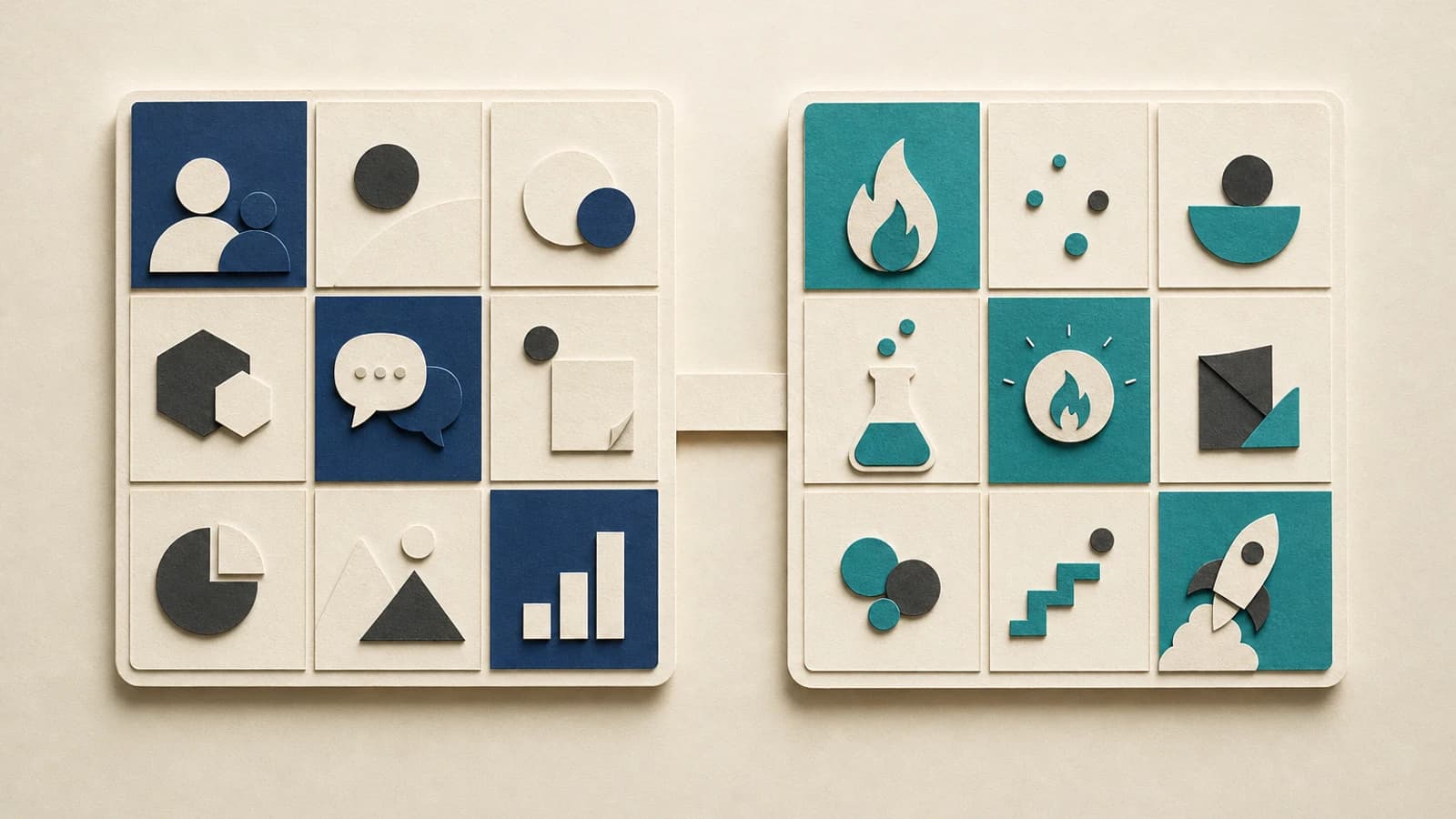
The Business Model Canvas (Osterwalder and Pigneur, 2010) maps the full operating model: who your partners are, what resources you need, how your channels work. It is designed for communicating a business model that already exists or one you have at least partially validated.
The Lean Canvas (Ash Maurya, 2010) replaces four of the BMC blocks with startup-specific ones: Problem, Solution, Key Metrics, and Unfair Advantage. It drops Key Partners, Key Resources, Key Activities, and Customer Relationships because, at the idea stage, those are premature details. The Lean Canvas asks: what is the problem, what is the riskiest assumption, and how will you know if you are wrong?
| Dimension | Business Model Canvas | Lean Canvas |
|---|---|---|
| Creator | Osterwalder & Pigneur (2010) | Ash Maurya (2010) |
| Best for | Validated model, investor communication, operations | Pre-PMF, assumption testing, rapid iteration |
| Unique blocks | Key Partners, Key Resources, Key Activities, Customer Relationships | Problem, Solution, Key Metrics, Unfair Advantage |
| Philosophy | Map the whole business holistically | Identify and test the riskiest assumptions first |
| Time to fill | About an hour by hand, in my experience | 20 minutes |
The practical path: start with a Lean Canvas while you are validating. Switch to the BMC once you know the model works and need to communicate operations, partnerships, and cost structure to investors, a board, or new hires, since the two are really sequential steps in the same process.
How do you validate what your canvas says?
A filled canvas is a set of hypotheses, not a strategy deck. Every block makes a claim about reality: these people exist, they have this problem, they will pay this much, I can reach them through this channel. The canvas becomes useful the moment you start crossing off the claims that turn out to be wrong.
Here is the sequence I use. Start with the blocks that carry the most risk: Customer Segments (do these people exist in meaningful numbers?), Value Propositions (do they care about this specific thing?), and Revenue Streams (will they pay this price?). Those three blocks tell you whether anyone will actually open their wallet. The operations side (Resources, Activities, Partnerships, Costs) matters too, but only after you confirm someone is willing to pay.
I wrote a full walkthrough of the evidence chain in my guide on how to validate a business idea. The short version: find sourced proof the pain exists, map the real alternatives and their pricing, talk to 10-15 buyers about money (not opinions), and collect one paid commitment before you build. If you want the research step compressed, Preuve's free BMC generator gives you the starting canvas, and the full validation scan pressure-tests each block against 60+ live data sources.
If you are coming from the business-plan side of things, I also cover the difference between a canvas and a full plan in my guide on how to start a business plan. A canvas takes me about an hour, a plan takes closer to a month, so filling the canvas and validating it first saves you from spending 30 days on a document nobody asked for.
FAQ
How do you fill in a Business Model Canvas?
Start with Customer Segments (who pays you), then Value Propositions (what problem you solve for them). Move to Channels (how you reach them), Customer Relationships (how you keep them), and Revenue Streams (how they pay). Then map Key Resources, Key Activities, Key Partnerships, and Cost Structure on the operations side. Use a free BMC generator like Preuve AI to pre-fill all 9 blocks from a one-sentence idea, then rewrite each block with real evidence from your market.
What is the difference between a Business Model Canvas and a Lean Canvas?
The Business Model Canvas (Osterwalder, 2010) maps the full business including Key Partners, Key Resources, Key Activities, and Customer Relationships. The Lean Canvas (Ash Maurya, 2010) replaces those four blocks with Problem, Solution, Key Metrics, and Unfair Advantage. Lean Canvas is designed for early-stage startups testing assumptions. BMC is better once you have a validated model and need to communicate operations to investors or partners.
Is there a free business model canvas generator with AI?
Yes. Preuve AI offers a free business model canvas generator that uses AI to fill all 9 blocks from a one-sentence idea description in about 10 seconds. Three blocks (Customer Segments, Value Propositions, Revenue Streams) are visible immediately. Enter your email to unlock the remaining six. The canvas prints to PDF.
What is the difference between a Business Model Canvas and a business plan?
A business plan is a detailed 20-40 page document covering strategy, financials, marketing, and operations. A Business Model Canvas is a single-page snapshot of how a business creates, delivers, and captures value across 9 building blocks. The canvas takes minutes to fill. A plan takes weeks. Most accelerators and startup programs now prefer the canvas for early-stage companies because it forces clarity without premature detail.
What mistakes make a Business Model Canvas useless?
Three common mistakes: writing aspirational fiction instead of testable claims (saying "everyone" instead of naming a specific segment), copying competitor language into your Value Propositions block without explaining how you differ, and filling it once and never updating it. A useful canvas treats each block as a hypothesis and marks which ones you have evidence for and which are still guesses.
Cite this page
Last updated July 19, 2026
Forat, V. (2026, July 19). Free Business Model Canvas Generator: Fill Each Block With Real Answers. Preuve AI. https://preuve.ai/blog/free-business-model-canvas-generator-guide
Forat, Vincent. “Free Business Model Canvas Generator: Fill Each Block With Real Answers.” Preuve AI, 19 July 2026, preuve.ai/blog/free-business-model-canvas-generator-guide.
Forat, Vincent. “Free Business Model Canvas Generator: Fill Each Block With Real Answers.” Preuve AI. July 19, 2026. https://preuve.ai/blog/free-business-model-canvas-generator-guide.
@misc{forat2026-free-business-model-canvas-generator-guide,
  author = {Forat, Vincent},
  title = {{Free Business Model Canvas Generator: Fill Each Block With Real Answers}},
  howpublished = {Preuve AI},
  year = {2026},
  month = jul,
  url = {https://preuve.ai/blog/free-business-model-canvas-generator-guide},
  note = {Last updated July 19, 2026}
}
Vincent
5 years in B2B growth, building Preuve AI in public. 82% of ideas it scores aren't ready, the point is finding out in 10 minutes, not 3 months.
Follow on X →
Building is expensive. Validation is free.
Run your idea through 10 AI agents before you write a line of code. Every claim source-linked.