Key takeaways
- Get one real buyer to commit money before you build, Not to praise it. Compliments are free; demand is what someone pays for.
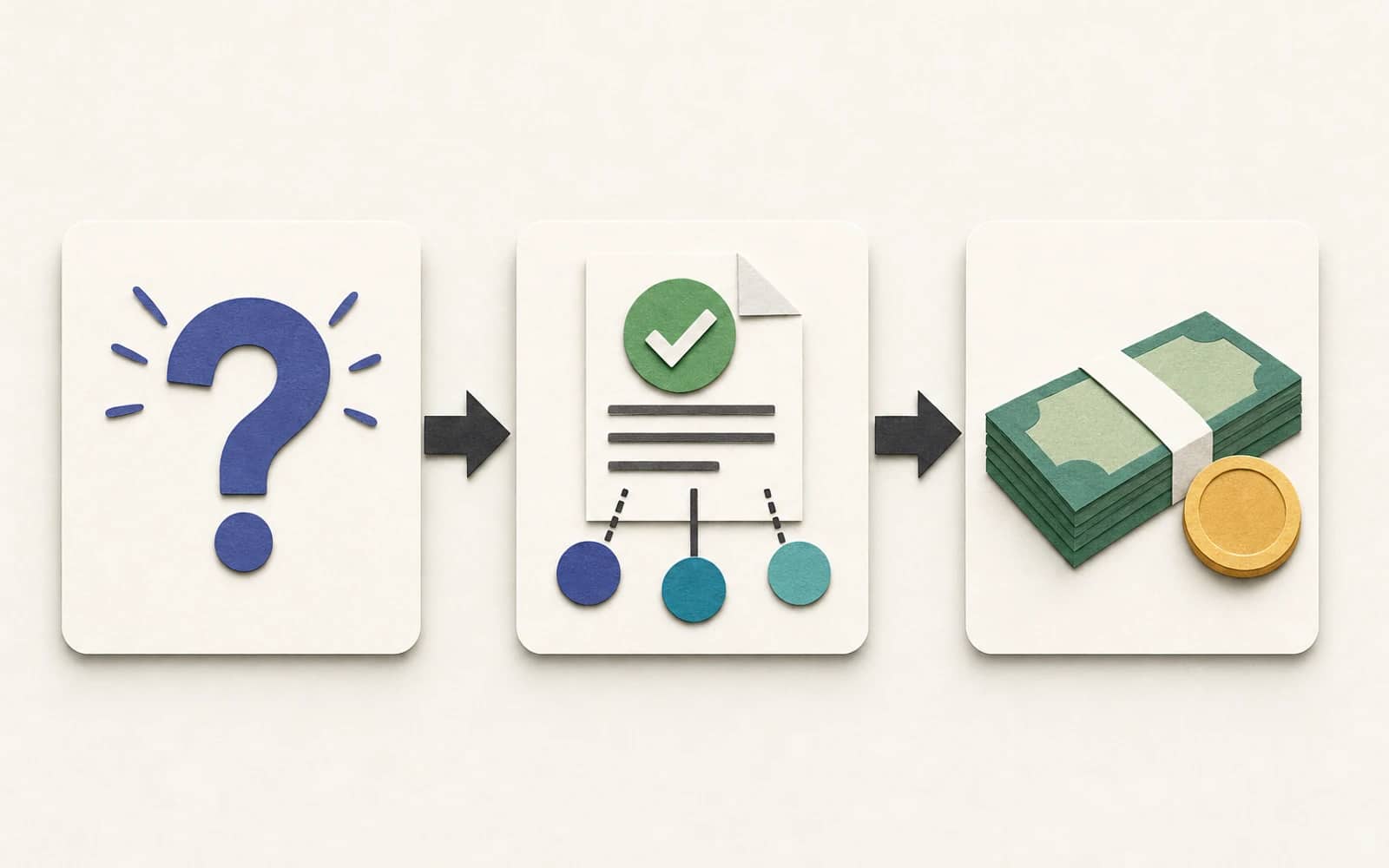
- The 5 steps: Write the problem as a claim you can prove false, find sourced proof the pain exists, map the real alternatives and their pricing, interview 10 to 15 buyers about money not opinions, then collect one paid commitment.
- Chase money, not compliments. A deposit or a signed pilot beats a hundred people who said they loved it.
- Set kill criteria before you start, And trust no number you cannot click through to a source.
To validate a business idea, you need evidence that real buyers will pay, not people telling you they like it. That is the fastest way to get lied to. I have scored thousands of ideas, and the ones that collapse rarely lose to a competitor. They lose because no one was ever going to pay. Here is the sequence I trust to tell a real business from a nice-sounding one before you spend a dollar building: five steps, the evidence that actually counts, and the moment to walk away.

Will your idea survive the market?
Preuve AI runs 10 agents against live market data and links every claim to a source. Free analysis in 60 seconds.
Why do most business ideas fail validation?
Because founders test whether people are nice, not whether a market exists. The data is blunt about it. CB Insights studied 431 venture-backed companies that shut down since 2023. Poor product-market fit drove 43% of the failures, bad timing 29%, and broken unit economics 19%. The headline cause, running out of money, showed up in 70% of cases, but that is where the story ends, not why it started. The median dead company had still raised $11M. Cash did not save them. A market that never widened killed them.
I see the same pattern from a different angle. In Preuve's 2026 benchmark of 6,000+ analyzed ideas, the median viability score is 54 out of 100, and only 17.5% earn a clear "go." The most common fatal risk is not a crowded market (11.5% of ideas). It is having no realistic way to reach buyers (25.7%), second only to ideas too vague to score at all (36.9%). I wrote up the full distribution in my 2026 validation benchmarks. The takeaway is the same in both datasets: ideas die from no reachable demand, not from rivals.
What does it actually mean to validate an idea?
Validation is the search for evidence that real buyers have the problem and will pay to fix it, gathered before you build. That last clause is the whole point. Anyone can find demand after sinking six months into a product. The skill is finding it, or failing to, while it is still cheap to change your mind.
Here is the line I hold every founder to: chase money, not compliments. A compliment is "that is a great idea." Validation is a deposit or a signed pilot, something that cost them to hand over. The difference is whether someone gave up something they value. Keep that test in your pocket for every step below.

Step 1: Write the problem as a claim you can prove false
Start with the problem, never the product. Write one sentence in the shape: "[A specific person] struggles with [a specific job] badly enough to pay for a better way." If you cannot name the person and the job without using the word "everyone," the idea is too vague to test.
The reason I force a falsifiable claim is that a fuzzy idea can never fail, so it can never pass either. "A budgeting app for people" survives any evidence. "Freelance designers earning over $80k waste a day a month chasing late invoices and would pay to automate it" can be proven wrong in a week, which is exactly why it is useful. Define the exact buyer first. Everything downstream tests that one sentence.
Step 2: Find sourced proof the pain already exists
Before you talk to anyone, go looking for evidence the problem is real and that people are already trying to solve it. Search volume for the problem (not your product name), Reddit and niche forum threads where people complain unprompted, existing tools with paying users, and review sites where buyers say what they hate about current options. People paying for a bad solution is one of the strongest signals you can find. It means the budget exists.
This is also where the sourced-evidence rule earns its keep. Every market-size number or pricing claim, and every competitor you list, should trace back to something you can click. If you cannot open the source, assume the number is wrong, because most confident market estimates are. I built my entire product around this rule, and it is the same discipline I'd apply by hand. I cover the manual version in my guide on market validation and the math of sizing demand in the TAM SAM SOM guide.
Skip weeks of manual research
Get complete market research, sourced proof, competitor map, and pricing data for your idea instantly.
Step 3: Map who already solves this, and what they charge
Founders fear competitors. I worry more about their absence. An empty market usually means no one has found a way to make money there, not that you discovered a secret. So list the real alternatives, including the ugly ones: spreadsheets, an agency, a manual workaround, or simply living with the problem. The honest competitor to most B2B ideas is "a virtual assistant and a Google Sheet."
For each alternative, write down what it costs, where its users complain loudest, and the one thing it refuses to do. That gap is your wedge. Pricing tells you whether a business is even possible: if the best anyone pays today is $9 a month and you need $200 a seat to survive, the unit economics are the problem, and no amount of validation fixes that.
Step 4: Talk to buyers, not friends
Now talk to 10 to 15 people who match your exact buyer from Step 1. Skip your own network and the polite encouragers in it, and go find the person who would actually write the check. The goal is not to pitch. It is to learn whether the pain is real and what they already do about it.
Ask about the past, not the future. "Walk me through the last time this cost you" beats "would you use a tool that...". The first gets you a real account of what happened. The second gets you whatever they think you want to hear. This is the core of Rob Fitzpatrick's Mom Test, and it is the single highest-leverage skill in validation. I keep a list of the exact prompts I use in my post on customer discovery questions. Listen for one thing above all: have they ever spent money or real effort trying to solve this already? If yes, you found a market. If they shrug, you found a hobby.

Step 5: Get one real commitment before you build
Interviews tell you the pain is real. Only a commitment tells you they will pay. So before you write a line of code or sign a lease, run a test that asks for something costly: a pre-order, a refundable deposit, a paid pilot, a signed letter of intent, or a paid waitlist with a real card on file. A landing page that collects free emails is a warm-up, not proof.
Not all evidence weighs the same. This is the ladder I rank signals by, weakest at the top:
| Signal | What it proves | Strength |
|---|---|---|
| "Great idea" from a friend | Politeness | Worthless |
| Survey says they'd buy | A guess about the future | Weak |
| Free email signup | Mild curiosity | Weak |
| A booked sales call | Time spent on the problem | Moderate |
| Refundable deposit or pre-order | Money on the line | Strong |
| A repeat purchase | Real, durable demand | Strongest |
Aim as high up the ladder as the stage allows. One stranger handing you a deposit outweighs a hundred people who said they loved it.
Set your kill criteria before you start
Decide what would make you walk away before you are emotionally invested, because afterward you will rationalize anything. Write it down: "If fewer than 3 of 15 buyers have already spent money on this, I stop. If no one converts on the pre-sell at the price I need, I stop." Kill criteria are the part founders skip, and skipping them is how a six-week test becomes a two-year sunk cost. Think of it as preserving your runway for the idea that actually has legs, not as giving up early.
Where AI helps, and where it lies to you
AI is genuinely good at the slow research work: pulling search trends, surfacing competitors, and scanning forums for complaints, the stuff that used to eat a full afternoon. But the same tools fall apart where it counts. Ask a general chatbot to size your market and it will hand you a confident number with no idea whether it is true, inventing competitor names and pricing along the way.
That gap is exactly why I built Preuve to score an idea against 60+ live data sources and link every claim back to where it came from. You should never trust a viability number you cannot audit, including mine. Use AI to shrink the research phase, but verify any number that would actually change your call, and do not skip the buyer conversations, because no tool replaces those. The machine finds the signal faster. Asking for the money is still on you. If you want a sourced starting point in about a minute, you can run your idea through a free scan and use the result as the research layer under the five steps above.
FAQ
How do you validate a business idea?
Write the problem as a falsifiable claim, find sourced proof the pain already exists, map who solves it today and what they charge, interview 10 to 15 real buyers about money rather than opinions, then get one concrete commitment (a pre-order, a deposit, a signed pilot) before you build anything.
What counts as real validation versus a compliment?
A compliment is someone saying your idea is great. Validation is someone giving up something they value: money, a deposit, a calendar slot, a signature, or a verified email tied to a paid waitlist. If no one will spend anything, you have interest, not demand.
How long does it take to validate a business idea?
Plan on one to two weeks of focused work: a day to define the claim and the exact buyer, a day of sourced market research, a few days of buyer interviews, and a short pre-sell test. The research day can shrink to about 60 seconds with a sourced tool, but the buyer conversations cannot be skipped.
Can you validate a business idea with AI?
Partly. AI compresses market research from days to seconds, but most tools invent competitor names, market sizes, and pricing and state them with full confidence. The rule I use: if you cannot click through to the source, treat the number as wrong. Use AI for speed, then verify every claim that would change your decision.
What is the number one reason business ideas fail?
Not competition. In Preuve's 2026 benchmark of 6,000+ analyzed ideas, the top risk on ideas complete enough to score is no realistic go-to-market plan (25.7% of ideas), well ahead of a crowded market (11.5%). Ahead of both sits early-stage risk at 36.9%, meaning the idea is still too vague to evaluate. CB Insights data agrees that no product-market fit (43% of failures) beats most other causes. Ideas die from no reachable demand, not from rivals.
Cite this page
Last updated July 30, 2026
Forat, V. (2026, July 30). How to Validate a Business Idea Before You Spend a Dollar. Preuve AI. https://preuve.ai/blog/how-to-validate-a-business-idea
Forat, Vincent. “How to Validate a Business Idea Before You Spend a Dollar.” Preuve AI, 30 July 2026, preuve.ai/blog/how-to-validate-a-business-idea.
Forat, Vincent. “How to Validate a Business Idea Before You Spend a Dollar.” Preuve AI. July 30, 2026. https://preuve.ai/blog/how-to-validate-a-business-idea.
@misc{forat2026-how-to-validate-a-business-idea,
  author = {Forat, Vincent},
  title = {{How to Validate a Business Idea Before You Spend a Dollar}},
  howpublished = {Preuve AI},
  year = {2026},
  month = jul,
  url = {https://preuve.ai/blog/how-to-validate-a-business-idea},
  note = {Last updated July 30, 2026}
}
Vincent
5 years in B2B growth, building Preuve AI in public. 82% of ideas it scores aren't ready, the point is finding out in 10 minutes, not 3 months.
Follow on X →
Building is expensive. Validation is free.
Run your idea through 10 AI agents before you write a line of code. Every claim source-linked.