
Key takeaways
- Answer four questions before writing code: Who is the buyer, is demand real, who already solves this, and what signal says go.
- The bar is high: In the 2026 benchmark of 6,000+ analyzed ideas, only 17.5% scored high enough for a "go" verdict.
- The top fixable killer is not competition (11.5%), It is having no go-to-market plan (25.7%).
- Define one buyer, then validate demand With evidence strangers cannot fake: search volume, competitor revenue, and community pain.
Market research for first-time founders is four questions you answer before you write a line of code, and it takes days, not months. Most build first and research later, and that sequence is backwards.
If you have not settled on an idea yet, start with an idea validation tool first, then come back here.

Will your idea survive the market?
Preuve AI runs 10 agents against live market data and links every claim to a source. Free analysis in 60 seconds.
Why do first-time founders skip market research?
Because the first time feels different. You have not shipped something that landed to zero signups, so failure is still a concept, not a memory.
The data says it should feel concrete. In Preuve's 2026 benchmark of 6,000+ startup ideas, the average viability score is 56.3 out of 100. That is a "caution" verdict, not a "go." And 76.0% of all ideas land in the 40-69 caution zone, meaning three out of four ideas need more work before they are ready to build.
The most common fatal signal is not what you would expect. Competition accounts for only 11.5% of flagged risks. The top fixable killer is no go-to-market plan, at 25.7%, second only to ideas still too vague to score (36.9%). First-time founders fixate on "is someone else doing this?" when the better question is "how will anyone find out I exist?"
Market research is how you answer that question before it costs you six months. Here is the method, in four steps.

How do you define your target buyer when you have never sold anything?
Start narrow. First-time founders almost always define their audience too broadly because it feels safer. "Small business owners" is not a buyer. "A solo plumber in Phoenix who pays $300/month for lead gen and hates the results" is a buyer. The more specific you get, the easier every step after this becomes.
I use three questions to force specificity:
- Who has the problem right now? Not theoretically. Today. Can you name five specific people or companies?
- What are they currently doing about it? If the answer is "nothing," the problem might not hurt enough to pay to fix.
- Where do they already spend money on this? Existing spending is the strongest signal. It means the budget line already exists.
If you cannot answer all three, you are working with an assumption, not a buyer. That is fine at this stage, but write it down explicitly and test it in the next steps. For a deeper framework on evidence standards, I wrote a guide on how to validate a business idea that covers kill criteria and what counts as proof.
How do you check if enough people want what you are building?
This is demand sizing, and it does not require a research firm. You need three types of evidence, all free:
Search signals. Check Google Trends for your problem keywords (not your product name). Rising interest over 12 months is a green light. Flat or declining is a warning. Then check search volume with a free tool like Ubersuggest or Google Keyword Planner. If nobody is searching for the problem, either it is not widespread enough or you are using the wrong words to describe it.
Community signals. Search Reddit, Indie Hackers, relevant Slack groups, and niche forums for people describing the pain. Look for posts that start with "how do you handle X?" or "is there a tool that does Y?" Those are unprompted demand signals, and they are more reliable than survey responses because nobody is performing for you.
Competitor revenue signals. If competitors exist and make money, that is evidence, not a threat. Check their pricing pages, their hiring pages (hiring means revenue), and review sites like G2 or Capterra. Imperfect competitors with paying customers is one of the strongest market signals you can find. I wrote a full method for this in my guide on how to find competitors for your startup.

Skip weeks of manual research
Get complete market research, sourced proof, competitor map, and pricing data for your idea instantly.
How do you find competitors when you think your idea is unique?
It probably is not, and that is good news. "No competitors" almost always means one of two things : you have not looked hard enough, or the market does not exist. Neither is what a first-time founder wants to hear, but both are cheaper to discover now than after six months of building.
Search for the problem, not your solution. If you are building a scheduling tool for veterinarians, do not search "vet scheduling software." Search "how do vets manage appointments," "veterinary practice management," and "vet clinic scheduling spreadsheet." The people using spreadsheets and manual workarounds are your real competition, and they reveal the exact pain your product needs to solve.
For each competitor, note what they charge, what users complain about in reviews, and how they actually get customers. That third one matters most for first-time founders because it directly addresses the #1 risk in the data: having no distribution plan.
For the full process, I covered competitive mapping in my deeper guide on market research for startups.
What signals tell you the market is real?
After the first three steps you have evidence scattered across tabs and notes. Here is what I look for to decide whether it adds up:
- People already pay for imperfect solutions. Competitors with revenue prove the budget exists. No competitors with revenue is a red flag, not a blue ocean.
- Strangers describe the pain without prompting. Community posts, support tickets, negative reviews. If you have to explain why the problem hurts, it might not hurt enough.
- You can name your first 10 customers. Not a segment. Actual names or companies you could email tomorrow. If you cannot, your buyer definition from step one is too broad.
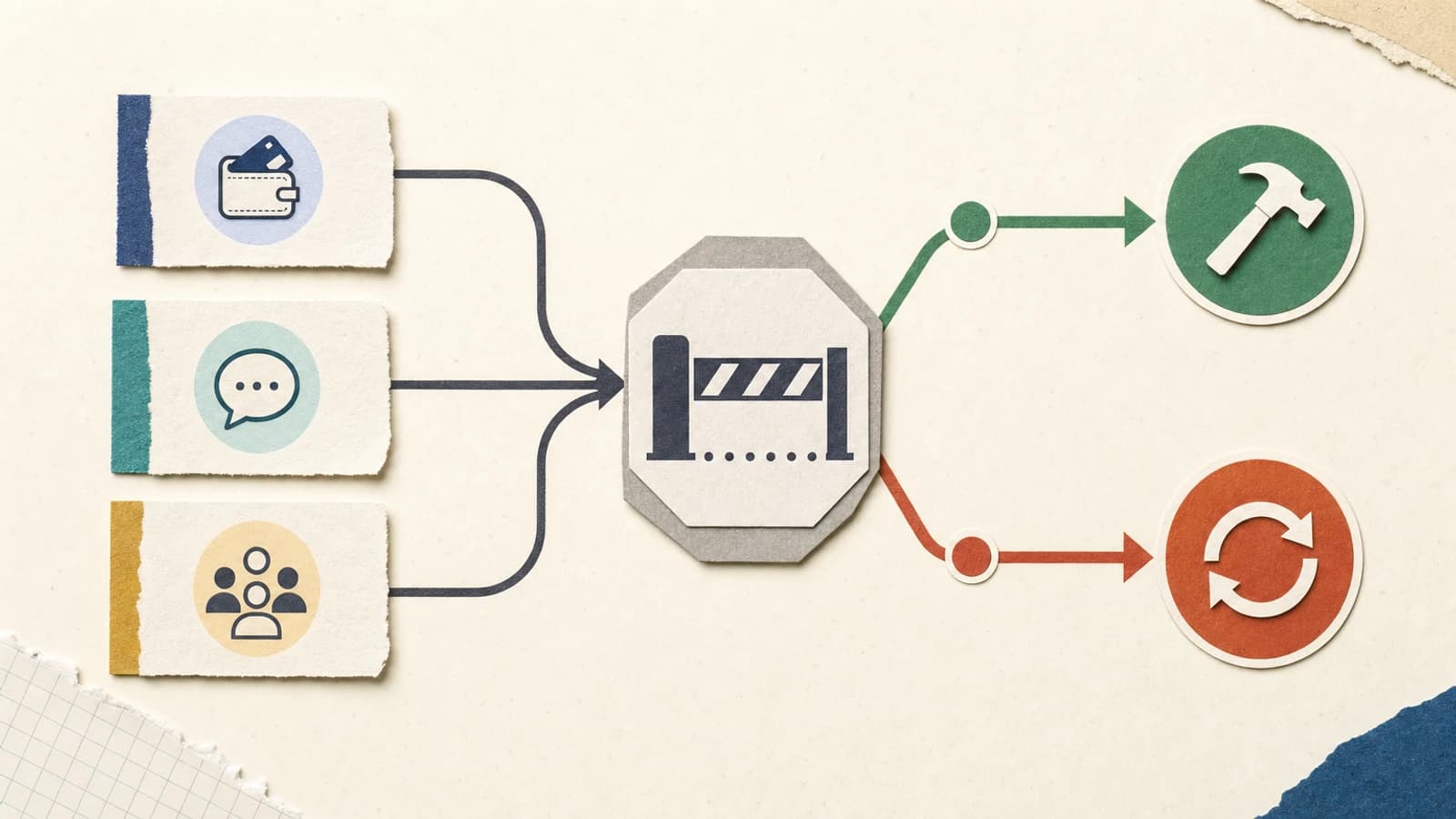
One signal alone is not enough. Search volume without anyone paying for solutions usually means the pain does not hurt badly enough. Competitors making money without complaint threads is rarer, and honestly fine if you can find the gap. The point is that these signals reinforce each other.
For a full validation framework that builds on these signals, see my guide on how to validate a startup idea.
How much market research is enough before you start building?
Every first-time founder asks this, usually because they want permission to stop researching and start building. Here is the honest answer: you have done enough when you can write down your buyer, their pain, and your first distribution channel in a sentence each, and show me the evidence for each one.
For most first-time founders, that takes one to two weeks of focused work. Not full-time. Maybe two hours a day. Days one and two: define the buyer and run desk research (competitors, demand signals, market size); an AI market research scan compresses those two days into about an hour. Days three through five: talk to five to ten potential buyers (not friends, not family). Days six and seven: decide. If the evidence is strong, build. If it is weak, refine the buyer or kill the idea.
What you should not do is research for three months. Three months of research without a decision is avoiding the build. The point is to gather enough evidence to make a build-or-kill decision. Uncertainty does not go away. The research is there to catch the obvious killers before you spend six months on them.
FAQ
How long does market research take for a first-time founder?
Plan for one to two weeks of focused work. Desk research (competitors, demand signals, market sizing) takes two to three days manually or under an hour with AI research tools. Customer conversations take another week because scheduling is the bottleneck, not the conversations themselves.
Can I do startup market research for free?
Yes. Google Trends, Reddit, Product Hunt, G2, Capterra, and Crunchbase free tier cover most desk research. Customer interviews cost nothing but time. The only step that benefits from a small budget is smoke testing with ads at $50 to $100. AI tools like Preuve AI offer a free scan that automates the desk research phase.
What is the biggest market research mistake first-time founders make?
Asking friends and family whether they like the idea. Opinions from people who care about your feelings are not market evidence. Real evidence comes from strangers: search volume, competitor revenue, community threads asking for solutions, and pre-orders from people who have no reason to be polite.
What is the difference between market research and idea validation?
Market research answers whether a market exists and how big it is. Idea validation answers whether your specific solution will win in that market with specific customers. Market research is one input to validation, not a substitute for it. A large market with no path to your first 100 customers is still unvalidated.
Cite this page
Last updated August 4, 2026
Forat, V. (2026, August 4). Market Research for First-Time Founders. Preuve AI. https://preuve.ai/blog/market-research-for-first-time-founders
Forat, Vincent. “Market Research for First-Time Founders.” Preuve AI, 4 Aug. 2026, preuve.ai/blog/market-research-for-first-time-founders.
Forat, Vincent. “Market Research for First-Time Founders.” Preuve AI. August 4, 2026. https://preuve.ai/blog/market-research-for-first-time-founders.
@misc{forat2026-market-research-for-first-time-founders,
  author = {Forat, Vincent},
  title = {{Market Research for First-Time Founders}},
  howpublished = {Preuve AI},
  year = {2026},
  month = aug,
  url = {https://preuve.ai/blog/market-research-for-first-time-founders},
  note = {Last updated August 4, 2026}
}
Vincent
5 years in B2B growth, building Preuve AI in public. 82% of ideas it scores aren't ready, the point is finding out in 10 minutes, not 3 months.
Follow on X →
Building is expensive. Validation is free.
Run your idea through 10 AI agents before you write a line of code. Every claim source-linked.