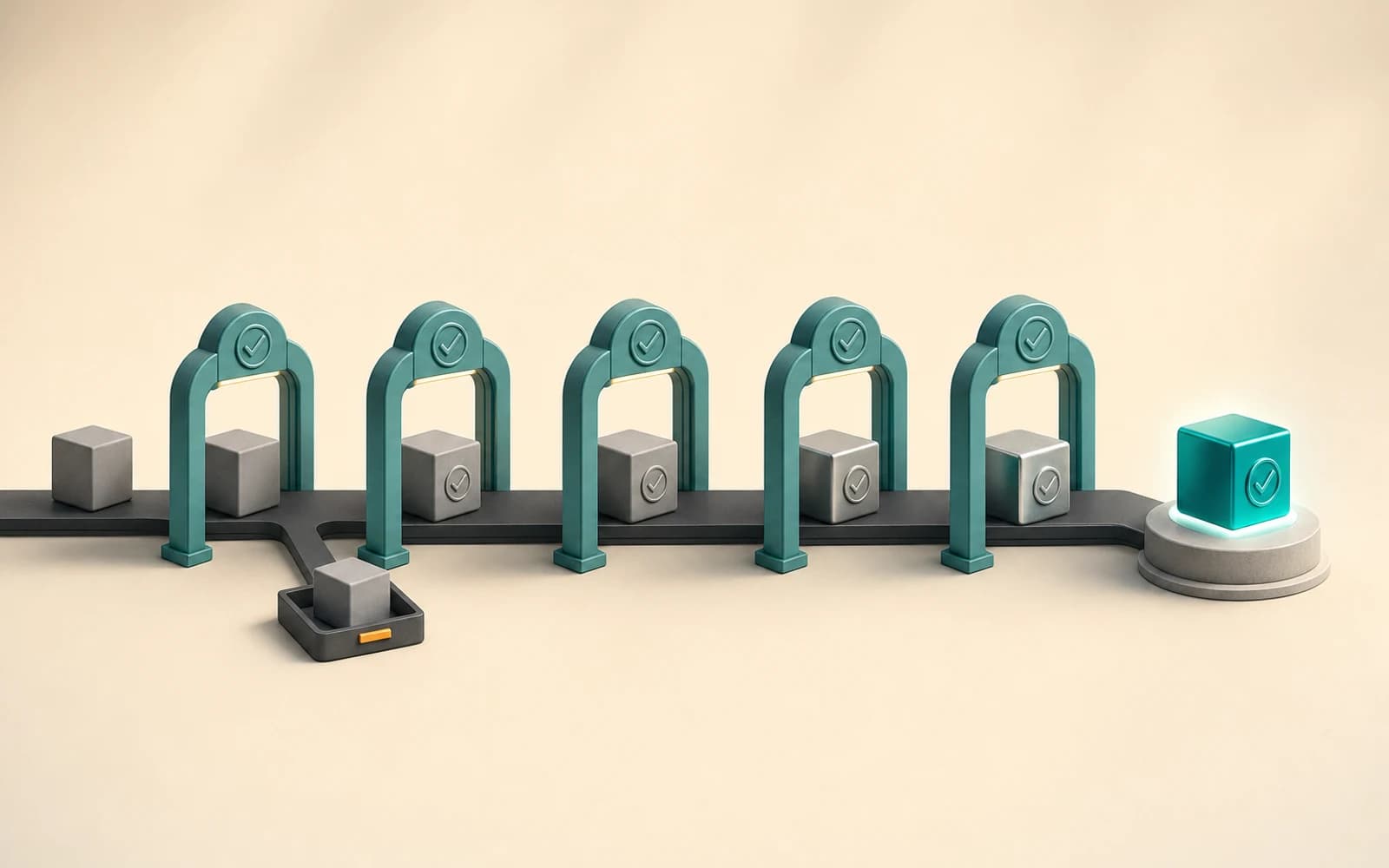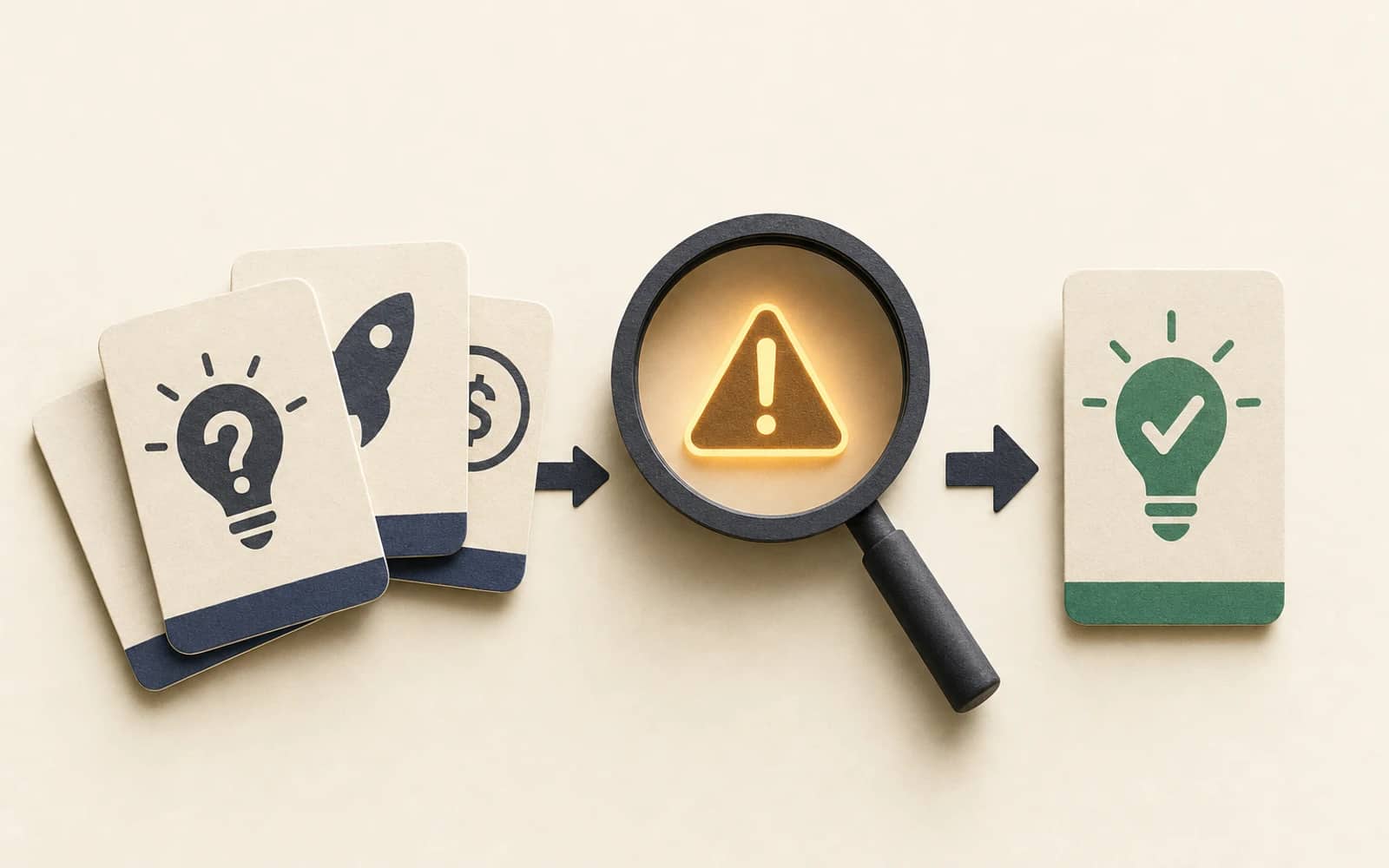
Key takeaways
- Most failed startup ideas had a detectable signal before launch: A cheaper substitute already on the shelf, unit economics that broke on the first sale, stated demand that vanished at the payment screen, or a problem the customer never actually had.
- The signal is rarely hidden: Juicero's $400 press competed with $8 store-bought juice. MoviePass charged $9.95/month when a single ticket cost about $9. Neeva asked users to pay for search when DuckDuckGo was free.
- Twelve failed ideas across $14B+ in burned capital share one pattern: Each founder treated an assumption as a fact and skipped the one check that would have flagged it.
- The check is available before you write code: A substitution test, a unit economics sanity check, or ten conversations with strangers who describe the problem without prompting.
Twelve startup ideas on this list burned through more than $14 billion combined, and every one of them ignored a validation signal that was available before launch. They had funding, teams, and pitch decks that made each idea look inevitable. Not one of them passed a validation check you can run in an afternoon.
A failed startup idea is a business concept that attracted founder commitment and often investor capital but shut down before reaching sustainable revenue, typically because one or more validation signals were ignored before launch. I built Preuve to catch exactly these patterns. Dig into the postmortems and the same signals keep surfacing in concepts that look brilliant on paper and collapse on contact with the market. I do not read these as stories about bad founders. Each one is a record of a specific check that got skipped, a check that was available before anyone wrote a line of code.
If you are sitting on an idea right now, your job is to figure out which of these failure signals applies to yours before you build.

Will your idea survive the market?
Preuve AI runs 10 agents against live market data and links every claim to a source. Free analysis in 60 seconds.
What signals do failed startup ideas have in common?
After reading hundreds of postmortems, I keep seeing the same five early signals. All of them were visible before launch, and not one was acted on.
The substitution gap.
A cheaper or free alternative already does the job. The founder assumes their version is different enough to justify switching. It almost never is.
The stated-vs-revealed preference trap.
Surveys say people want it. Payment screens say they do not. The gap between "I would use this" and "here is my credit card" is where most ideas die.
The unit economics impossibility.
The cost of serving one customer exceeds what they will pay, and adding more customers just means the loss compounds faster.
The phantom problem.
The founder built something technically impressive for a need the customer never actually felt.
The scope trap.
The idea tries to fix three hard problems simultaneously. Each one alone would be a full-time problem to solve. Running all three at once means none of them get enough attention.

Every idea below maps to one of these five. The history is not the point. If you recognize one of these signals in your own idea now, pivoting costs almost nothing.
Which startup ideas looked like they had demand but didn't?
These four ideas raised a combined $460 million on the strength of demand signals that turned out to be mirages. Each one confused a different kind of noise for real signal.
Juicero ($120M raised)
A WiFi-connected juice press that squeezed proprietary fruit packs. The device cost $400, later reduced to $200. The packs ran $5 to $8 each.
Signal missed: the substitution test. Cold-pressed juice was already $8 to $12 at any grocery store. When Bloomberg reporters tested the packs in 2017, they found you could squeeze them by hand, no machine needed. Juicero shut down in September 2017. The customer already had a cheaper and faster option that did not involve a $400 appliance on the counter.
Your check: What does your customer do today? If the answer is "something that works fine for less money," your idea has a Juicero problem.
Neeva ($80M raised)
An ad-free, privacy-first search engine founded by a former Google SVP of ads. Subscription price: $4.95 per month.
Signal missed: stated vs. revealed preference. Pew Research surveys showed 72% of internet users were concerned about online privacy. DuckDuckGo already offered free private search. When Neeva asked users to pay, conversion collapsed. People valued privacy in surveys, not at the payment screen. Neeva shut down in 2024 after burning through its capital with minimal paying subscribers.
Your check: Are potential customers actively trying to solve this problem already, or do they just agree it exists when you ask?
Humane AI Pin ($230M raised)
A screenless wearable AI device priced at $699 plus $24 per month, positioned as a smartphone replacement. Built by former Apple employees.
Signal missed: behavior change magnitude. Nobody was actively trying to replace their phone. The "screen fatigue" problem existed in op-eds, not in purchasing behavior. The AI Pin launched to reviews citing slow responses, overheating, and failure at basic tasks like calls and messages. Sales hit roughly 10% of targets. Humane sold its assets to HP for about $116 million, roughly half of what it raised.
Your check: Is anyone changing their behavior right now to solve this problem, or does the problem only exist in think pieces?
Clinkle ($30M raised, pre-product)
A mobile payments app that raised $30 million from investors including Peter Thiel and Richard Branson. Entirely on a demo. No shipped product. No users.
Signal missed: pre-launch demand signal. The raise was based on the founder's pitch and investor connections, not on evidence that anyone would switch payment apps. Venmo already existed. Apple Pay was coming. The product eventually launched to near-zero adoption and shut down in 2016 after years of internal turmoil.
Your check: Has a single stranger outside your network described this problem to you unprompted?
What startup ideas failed because the unit economics never worked?
These three ideas share a trait: the math was broken on the first transaction. Every new customer deepened the loss, and the faster they scaled, the faster they burned.
MoviePass
Unlimited movie tickets for $9.95 per month. The pitch fit on a napkin, but the math never survived a calculator.
Signal missed: unit economics sanity check. The average US movie ticket cost about $9 in 2017 when MoviePass dropped its price. A subscriber who saw two movies per month cost the company about $18 in ticket purchases against $9.95 in revenue. Every active user was a guaranteed loss. The math was public and well-known. Millions of users signed up anyway, and MoviePass burned through its capital until the parent company collapsed.
Your check: Write down what it costs you to deliver value to one customer, one time. If that number exceeds what they pay, scale will not save you.
WeWork ($12B+ raised, $47B peak valuation)
"Tech-enabled" co-working spaces. WeWork signed long-term leases at market rates and sold short-term desk access at rates that did not cover the lease cost.
Signal missed: margin structure from unit one. The gap was negative before a single tenant moved in. SoftBank's billions masked the structural deficit by funding growth that deepened the loss per desk. WeWork's S-1 filing revealed $1.6 billion in losses in 2018 alone. The company filed for bankruptcy in November 2023 with $19 billion in debt.
Your check: Does your first unit of business generate more revenue than it costs to serve? If not, what specifically changes that, and can you prove it with numbers?
Forward Health ($110M raised)
AI-powered health kiosks called CarePods, paired with a $99 per month subscription for preventative care and AI diagnostics.
Signal missed: usage frequency vs. subscription price. Members visited CarePods sporadically. Blood test volumes disappointed. Preventative care is inherently infrequent. The subscription needed regular engagement to justify $99 per month. Real estate and maintenance costs piled up alongside regulatory compliance, demanding scale that sporadic visits could never support. Forward shut down in 2025 after running out of cash.
Your check: How often will your customer actually use this? If usage is monthly or less, can a subscription price survive that frequency?

Skip weeks of manual research
Get complete market research, sourced proof, competitor map, and pricing data for your idea instantly.
What happens when a startup builds for a problem nobody has?
These four ideas solved real engineering challenges. Sometimes the customer never asked for the solution. In other cases the founder tried to solve too many problems at once, or the revenue propping up the model was always going to be temporary.
Zume Pizza ($446M raised)
Robot-made pizza, cooked in delivery trucks en route to customers. Backed by SoftBank.
Signal missed: customer problem test. Pizza delivery was already fast (30 minutes), cheap ($10 to $15), and widely available. Nobody was complaining that pizza needed to be made by robots. Zume solved a supply-side efficiency problem and marketed it as a consumer product. After pivoting twice, to sustainable packaging and then to food processing, the company shut down. CB Insights cited Zume as a startup that "pivoted from robot-made pizza to sustainable packaging and still failed to find a viable market."
Your check: Can you find ten people in your target market who describe this problem without you prompting them?
Builder.ai (valued at $1.2B, Microsoft-backed)
An AI platform that auto-built apps by assembling pre-made components, positioned as "ordering software like pizza."
Signal missed: commoditization risk. Builder.ai wrapped AI infrastructure that was improving and getting cheaper by the month. By late 2024, the quality floor of foundation models had risen to the point where the value of routing or wrapping them dropped near zero. Builder.ai declared bankruptcy in May 2025. The same structural failure hit every AI aggregator product in the 2024-2025 wave.
Your check: If the thing you wrap or aggregate gets 10x cheaper next year, does your product still have a reason to exist?
Ula ($141M raised, Sequoia-backed)
A B2B wholesale marketplace for Indonesian small retailers, handling sourcing, delivery, inventory, and credit simultaneously.
Signal missed: wedge focus. Ula tried to fix four hard problems at once. Logistics alone is a company. Lending alone is a company. Each wedge needed its own unit economics, and none had proven standalone viability. When funding dried up in 2022, the entire structure collapsed. Ula shut down with roughly $50 million still in the bank because the burn rate of running four businesses exceeded any path to profitability.
Your check: How many distinct hard problems does your idea solve? If the answer is more than one, pick the one with the clearest unit economics and prove it first.
Carbon Health ($600M+ raised, $3.3B peak valuation)
Tech-enabled primary care clinics built around a proprietary EHR, with an AI scribe for notes and AI diagnostics layered on top. The plan was 1,500 locations.
Signal missed: revenue source durability. Carbon Health's growth spike came from COVID testing, a temporary windfall. When testing volume dropped, core primary care clinics could not support the tech overhead on standard reimbursement rates. The company filed for Chapter 11 bankruptcy in February 2026 with over $100 million in debt and only 93 clinics remaining from a planned 1,500.
Your check: Is the revenue driving your growth a permanent behavior shift or a temporary spike? Remove the spike. Does the business still work?
How do you check for these signals before you build?
The founder of RecoverFlow wrote one of the most honest postmortems I have read. He built a Stripe failed-payment recovery tool for small SaaS companies, spent weeks writing a 50-page PRD and deploying a landing page, launched on Twitter, and got zero signups in five days.
"I convinced myself that deploying the landing page was validation. It is not. Validation is a person handing you money."
Not one customer conversation before launch day. What RecoverFlow compressed into a $0 postmortem, the other eleven companies on this list compressed into $14 billion.
The rule I apply to every idea I scan: if you cannot find ten strangers who describe the problem without prompting, you do not have demand. You have a hypothesis. I distill every failure above into five checks you can run before writing code. If you want a structured version, I wrote a full guide on how to validate a business idea and built a free idea validation framework around them.

Substitution test. What does the customer do today? If a cheaper, faster, or free alternative already solves the problem, your idea needs to be 10x better to justify switching. Not 2x.
Unit economics check. What does it cost to deliver value to one customer, one time? If that number exceeds what they pay, growth accelerates your losses.
Revealed preference test. Forget surveys. Find ten strangers who describe the problem without prompting, then ask for a concrete action: a waitlist signup, a deposit, a pre-order. Stated interest that evaporates at the payment screen killed Neeva and Humane.
Customer problem interview. Can you find ten people who describe the pain without being led? If you have to explain why the problem matters, you are solving a phantom problem. Zume and Builder.ai failed this check.
Single-wedge focus. How many hard problems does your idea solve? If more than one, pick the one with the clearest margin and prove it alone. Ula tried four and ran out of time on all of them.
I built a free scan that runs these checks against live market data. Run it on your idea before you repeat one of these twelve mistakes.
Can a failed startup idea work if someone tries again?
Some of the best startup ideas in 2026 are ideas that already failed once. Vine died in 2017. TikTok took the same short-form video format and handed it to a billion users. Online grocery wiped out Webvan in 2001, and two decades later Instacart went public on the same premise once smartphones and gig labor existed. EV battery swapping bankrupted Better Place in 2013, but NIO now runs more than 3,800 swap stations because battery costs dropped by over 90%.
The difference between a failed idea and an early idea is a dated catalyst: a cost curve that dropped, a regulation that shifted, or a behavior that went mainstream. I wrote a full breakdown of 15 dead startup ideas worth reviving in 2026, each with the specific shift that makes it viable now. If your idea looks like one of the failures on this page, check whether the catalyst has changed. If it has, the idea might deserve another look.
Every failed startup idea on this list and the signal it missed
| Idea | Raised | Signal missed | One check |
|---|---|---|---|
| Juicero | $120M | Cheaper substitute on the shelf | Substitution test |
| Neeva | $80M | Stated interest did not convert to payment | Revealed preference test |
| Humane AI Pin | $230M | No active behavior change to solve the problem | Behavior observation |
| Clinkle | $30M | Raised on demo, zero demand validation | Pre-launch demand test |
| MoviePass | ~$300M | Cost exceeded price from the first ticket | Unit economics check |
| WeWork | $12B+ | Negative margins on every lease from day one | First-unit margin test |
| Forward Health | $110M | Usage too infrequent for the subscription price | Frequency-price match |
| Zume Pizza | $446M | Solved a problem nobody had | Customer problem interview |
| Builder.ai | $1.2B val. | Wrapped a commoditizing layer | Commoditization risk test |
| Ula | $141M | Four hard problems at once, none proven | Single-wedge focus |
| Carbon Health | $600M+ | Temporary COVID revenue treated as permanent | Revenue durability check |
| RecoverFlow | $0 | Zero customer conversations before building | 10-stranger test |
Every signal on this list was available before anyone spent a dollar. The founders who would have caught them earliest were the ones willing to have ten conversations with strangers before writing a line of code. Run a free scan on your idea and find out which signals apply to yours.
FAQ
What is the most common reason startup ideas fail?
The most common reason is building something nobody will pay for. CB Insights' 2024 analysis of 431 VC-backed shutdowns found 43% cited poor product-market fit as a primary cause. The signal is usually available before launch: no strangers describing the problem unprompted, cheaper substitutes already serving the need, or stated interest that disappears at the payment screen.
How do you know if a startup idea will fail before building?
Check three things before writing code. First, the substitution test: what does your future customer do today, and is it painful enough to switch? Second, the unit economics check: does the cost of delivering value to one customer exceed what they will pay? Third, the demand signal: can you find ten strangers who describe the problem without prompting and will take a concrete action like a waitlist signup, a deposit, or a pre-order? If all three come back negative, the idea has the same profile as most failures on this list.
What famous startups failed despite raising millions?
WeWork raised over $12 billion and filed for bankruptcy with $19 billion in debt. Zume Pizza raised $446 million for robot-delivered pizza and pivoted twice before shutting down. Humane raised $230 million for an AI Pin that sold at roughly 10% of targets. Forward Health raised $110 million for AI health kiosks that members visited too rarely to justify the subscription. Funding validates investor enthusiasm, not customer demand.
Can a failed startup idea work if someone tries again?
Some ideas fail because of timing, not concept. Online grocery killed Webvan in 2001 and worked for Instacart after smartphones and gig labor existed. Short-form video shut down Vine and then built TikTok into a global platform. The test is whether a specific dependency, a cost curve, a regulation, or a behavior, changed between then and now. If nothing structural shifted, the idea is not early. It is bad.

Vincent
5 years in B2B growth, building Preuve AI in public. 82% of ideas it scores aren't ready, the point is finding out in 10 minutes, not 3 months.
Follow on X →
Building is expensive. Validation is free.
Run your idea through 10 AI agents before you write a line of code. Every claim source-linked.